Diving with Barracuda
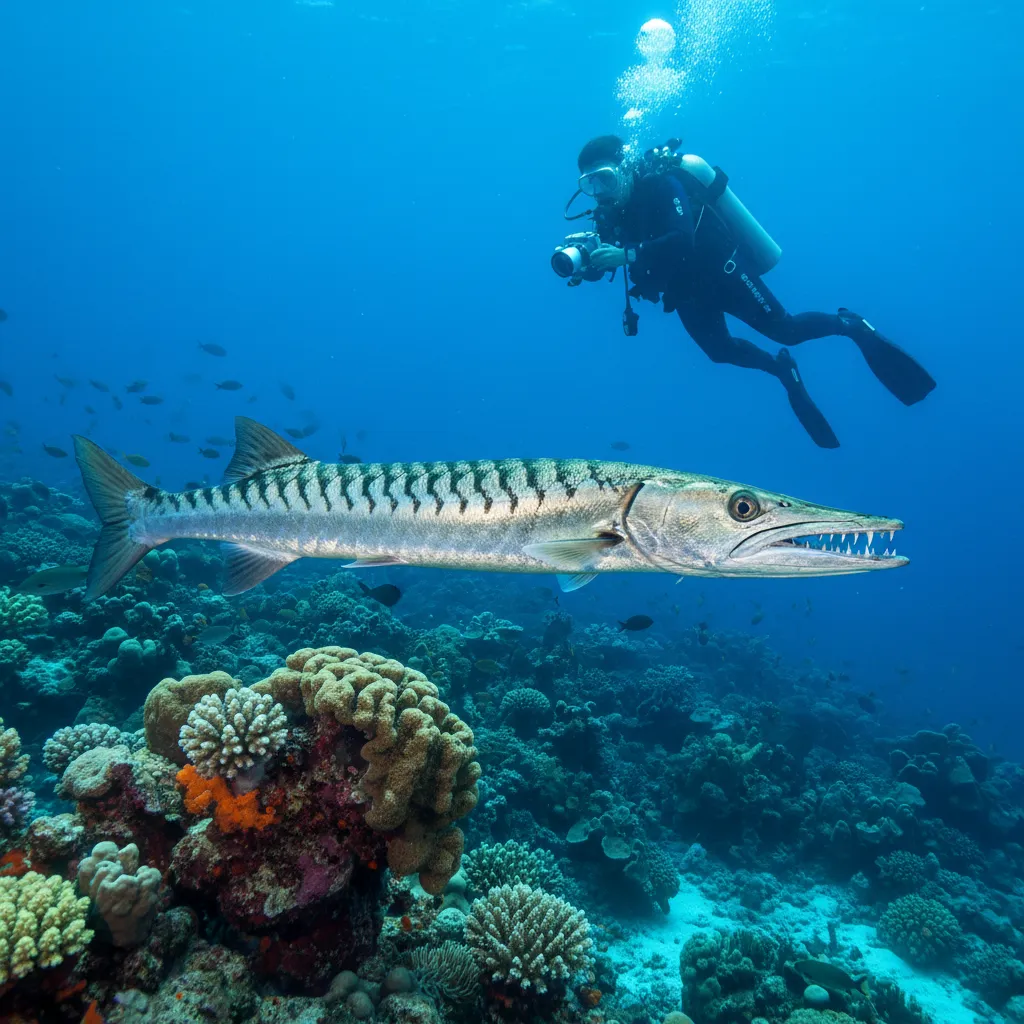
The great barracuda is one of the reef's most impressive predators - a silver torpedo with a mouth full of razor-sharp teeth and an unblinking stare that has earned it a fearsome reputation among swimmers and divers alike. Growing up to 1.8 metres long, solitary adults patrol reef edges and drop-offs with an air of supreme confidence. But the true spectacle comes from their schooling behaviour. At certain sites, hundreds or even thousands of chevron barracuda gather in massive swirling formations - the famous barracuda tornado of Sipadan being the gold standard. Hanging motionless at the centre of a vortex of thousands of silvery barracuda spiralling around you is one of those defining diving moments that stays with you forever. The play of light on their silvered flanks as they wheel and turn in perfect synchrony is mesmerising.
Where to Dive with Barracuda
Found across 61 countries, based on 5,299 verified observation records.

Bahamas
7 areas

Puerto Rico
3 areas

US Virgin Islands
2 areas

British Virgin Islands
2 areas

Belize
3 areas

Philippines
4 areas

Honduras
2 areas

Seychelles
2 areas
+ 53 more countries
Best Time to See Barracuda
Barracuda are non-migratory reef residents and can be encountered year-round. Sipadan's famous barracuda tornado is visible on most dives throughout the year, with visibility generally best from April to December. Red Sea barracuda schools are found year-round at sites like Ras Mohammed and the Brothers Islands. The Maldives offers barracuda encounters across all atolls year-round. Caribbean great barracuda are common on reefs in any season. Choose your destination based on overall dive conditions rather than barracuda-specific timing. Sipadan requires a permit (limited to 120 divers per day), so book well in advance regardless of season.
How to Dive with Barracuda
Barracuda encounters fall into two categories: solitary great barracuda, which are common on virtually every tropical reef, and large schools, which occur at specific sites. Solitary barracuda are often curious and will follow divers at a distance, sometimes hovering at the edge of visibility for an entire dive. For schooling barracuda, the key sites are Sipadan's Barracuda Point in Malaysia, where massive tornados of chevron barracuda are near-guaranteed, and similar aggregation sites in the Red Sea, Maldives, and Papua New Guinea. The technique for schooling barracuda is to approach slowly, find a comfortable depth at the edge of the formation, and let the school envelop you. Avoid making sudden movements or loud noises. Open Water certification is sufficient, though many of the best schooling sites involve currents that benefit from Advanced Open Water training.
Is it Safe to Swim with Barracuda?
Despite their fearsome appearance, barracuda attacks on divers are extremely rare and almost always the result of mistaken identity - barracuda may strike at shiny objects that resemble their prey. Avoid wearing reflective jewellery, watches with shiny bezels, or carrying bright metallic equipment when diving in barracuda territory. In murky water, barracuda may be more likely to investigate unfamiliar objects. Solitary barracuda that follow divers are simply curious and not threatening. Schools of barracuda are entirely harmless and will part around you if you swim into them. The main safety consideration at barracuda schooling sites like Sipadan is strong currents - carry a DSMB and stay close to your group.
Conservation Status
Great barracuda are not currently considered threatened globally, though localised overfishing has reduced populations in some areas. Barracuda are sometimes associated with ciguatera fish poisoning - a toxin that accumulates through the food chain in tropical reef fish - which has reduced fishing pressure in some regions. Their role as apex reef predators makes them important for maintaining healthy reef ecosystems. Large barracuda schools, like those at Sipadan, are significant dive tourism assets that generate far more economic value alive than as a fishing catch. Marine protected areas that safeguard these aggregation sites are essential for maintaining both the ecological and economic value of these spectacular formations.
Species Profile

Recommended Equipment
A wide-angle lens is essential for photographing barracuda schools - a fisheye or ultra-wide rectilinear lens (10-17mm on crop sensor) captures the full scale of a tornado formation. Natural light from below can produce stunning silhouette shots of barracuda against the surface. A strobe is useful for close-up portraits of solitary individuals, bringing out the metallic silver tones and the detail of their impressive teeth. For video, a wide-angle action camera (GoPro or similar) captures the immersive experience of being surrounded by a school. Standard tropical scuba gear is appropriate - 3mm wetsuit, BCD, and regulators. Carry a DSMB at current-prone sites.
Browse dive equipmentFrequently Asked Questions
Where can you see the barracuda tornado?
The most famous barracuda tornado is at Barracuda Point, Sipadan, Malaysia, where thousands of chevron barracuda form massive swirling formations on nearly every dive. Similar schools can be found at Ras Mohammed (Red Sea), Blue Corner (Palau), and various Maldives sites.
Are barracuda dangerous to divers?
Barracuda are not dangerous to divers. Attacks are extremely rare and almost always caused by the fish mistaking shiny jewellery or metallic objects for prey. Avoid wearing reflective items in murky water. Schools of barracuda are entirely harmless and will part around you.
Why do barracuda follow divers?
Solitary barracuda are naturally curious apex predators. They follow divers out of curiosity, not aggression. They may also use divers as cover to ambush smaller fish that are disturbed by the diver's movement along the reef. This behaviour is harmless and common.
Do you need advanced certification to dive with barracuda schools?
Open Water certification is technically sufficient, but the best barracuda schooling sites (Sipadan, Red Sea) often involve strong currents and deeper water. Advanced Open Water is recommended for comfort and safety at these sites.
How do you photograph barracuda schools?
Use a wide-angle or fisheye lens to capture the full scale of the formation. Shoot upward to silhouette the school against the surface for dramatic effect. Slow your approach and let the school envelop you. A strobe can freeze motion and add detail, but natural light silhouettes are often the most striking images.
More Encounter Guides
Ocean Sunfish (Mola Mola)
The ocean sunfish is one of the most surreal creatures a diver can encounter. Holding the record as ...
Clownfish
Few marine creatures have captured the public imagination quite like the clownfish. Made famous by F...
Napoleon Wrasse
The Napoleon wrasse - also known as the humphead wrasse or Maori wrasse - is one of the most charism...
Lionfish
Few fish command attention quite like the lionfish. With its dramatic array of elongated, venomous s...
Giant Moray Eels
The giant moray is the reef's most charismatic lurker. Reaching up to 3 metres in length and weighin...
Seahorses
Seahorses are among the ocean's most enchanting and improbable creatures. With their horse-shaped he...