Diving with Leafy & Weedy Sea Dragons
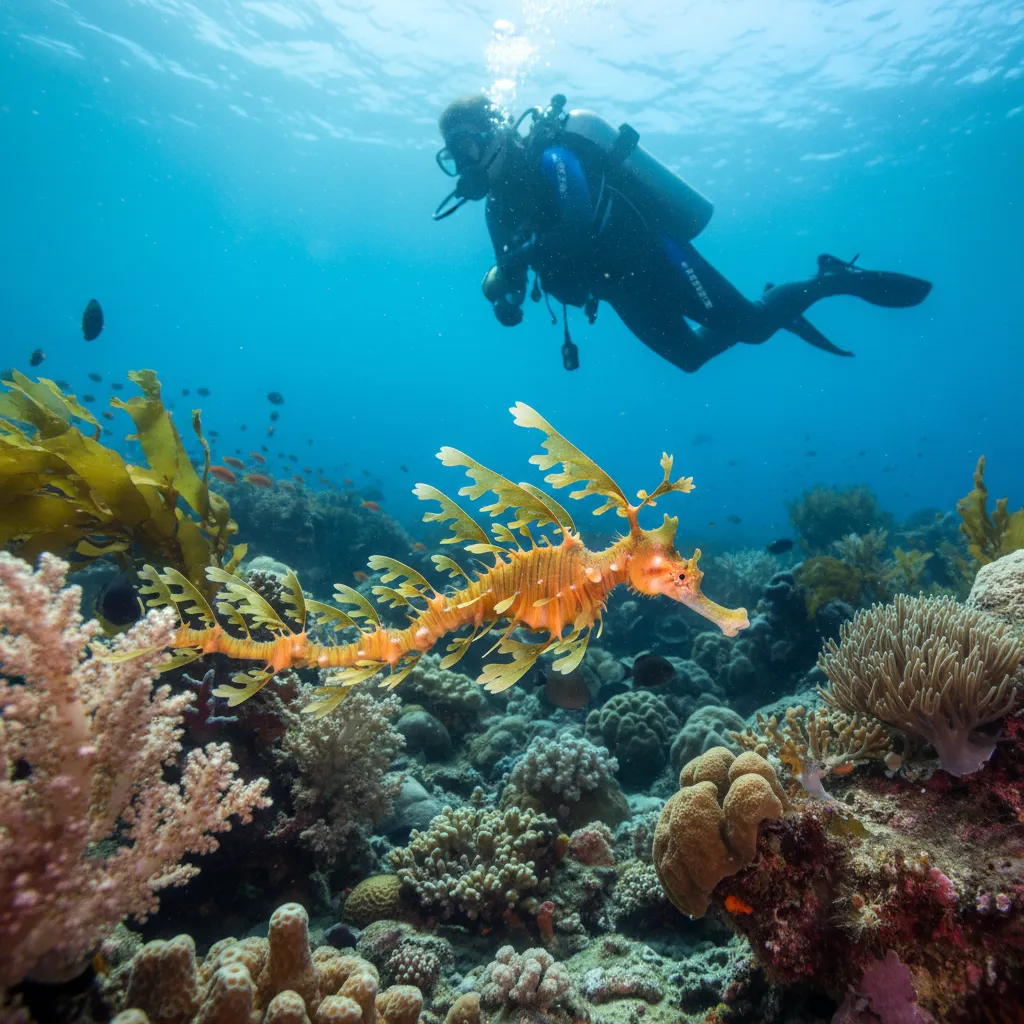
Sea dragons are the ocean's most ethereal fish - drifting through kelp forests and seagrass meadows like living works of art. Found exclusively in the temperate waters of southern and western Australia, these close relatives of seahorses and pipefish are divided into two spectacular species: the leafy sea dragon (Phycodurus eques), adorned with elaborate leaf-like appendages that provide perfect camouflage among kelp and seaweed, and the weedy sea dragon (Phyllopteryx taeniolatus), decorated with smaller, more delicate fronds and vivid purple, orange, and yellow colouring. A third species, the ruby sea dragon (Phyllopteryx dewysea), was discovered in 2015 from museum specimens and first filmed alive in 2016 - it lives in deeper waters and is rarely encountered by divers. Sea dragons grow up to 45 centimetres long, swim upright with tiny transparent fins that are nearly invisible, and appear to glide through the water like autumn leaves carried on a breeze. Like their seahorse cousins, male sea dragons carry the eggs - the female deposits up to 250 bright pink eggs onto a spongy brood patch on the underside of the male's tail, where he fertilises and carries them for approximately eight weeks until they hatch. Encountering a sea dragon in the wild is one of Australia's most iconic diving experiences and a genuine bucket-list moment for underwater photographers worldwide.
Best Time to See Sea Dragons
South Australia (Rapid Bay, Edithburgh): leafy sea dragons are present year-round, but the best conditions are from November to May when water temperatures reach 16-20°C and visibility improves. Male sea dragons carry eggs from approximately August to February, offering the chance to see a brooding male - one of the most special encounters in Australian diving. Sydney (Kurnell, Bare Island): weedy sea dragons year-round, with best visibility from March to June and September to November. Victoria (Mornington Peninsula, Portsea): weedy sea dragons year-round in kelp forests. Tasmania: weedy sea dragons in kelp forests, primarily from October to April when conditions allow comfortable diving. Winter diving (June-August) is possible everywhere but demands proper thermal protection and is less reliable for conditions.
How to Dive with Sea Dragons
Sea dragons are endemic to southern Australia, found nowhere else on Earth. The best diving for leafy sea dragons is along South Australia's coast - Rapid Bay Jetty, Edithburgh Jetty, Victor Harbor, and the Fleurieu Peninsula are the most reliable sites. Experienced local dive guides know individual animals and their territories, as sea dragons tend to stay in the same area for weeks or months. Weedy sea dragons have a slightly broader range, found from Sydney's eastern suburbs through Victoria, Tasmania, and across to Western Australia. In Sydney, Kurnell and Bare Island are excellent sites. Manly and Shelly Beach also produce regular sightings. Sea dragons are typically found between 3 and 25 metres depth in kelp forests, seagrass beds, and rocky reef covered in algae. They drift slowly through the vegetation, relying on their camouflage to avoid detection. Approach very slowly and avoid sudden movements - if a sea dragon feels threatened it will drift away into thicker vegetation where it becomes virtually invisible. Dive with a local operator who knows the current territories. Sea dragons are surprisingly well-camouflaged despite their spectacular appearance, and spotting your first one without a guide can take many dives.
Is it Safe to Swim with Sea Dragons?
Sea dragons are completely harmless to divers - they have no defensive mechanisms beyond camouflage and evasion. The safety considerations here are entirely about protecting the dragons. These are legally protected species in Australia, and it is illegal to collect, disturb, or harass them. Never touch a sea dragon or attempt to manipulate its position for photography. Do not chase sea dragons - if one begins to move away, let it go. Avoid using excessively bright continuous lights, which can disorient them. Flash photography is generally accepted but should be used sparingly - a few considered shots are better than hundreds of rapid-fire flashes. Never obstruct a sea dragon's path or corner it against rocks or kelp. Be mindful of your buoyancy control - the kelp and seagrass habitats where sea dragons live are fragile, and careless fin kicks can destroy the vegetation they depend on for shelter and hunting grounds.
Conservation Status
Sea dragons are listed as Near Threatened by the IUCN, and both species are fully protected under Australian law. They face several significant threats: habitat loss from coastal development, pollution, and storm damage to kelp forests; climate change driving warming waters that push their habitat range southward; and illegal collection for the aquarium trade (they rarely survive in captivity). Kelp forest decline along Australia's southern coast is particularly concerning - rising water temperatures and the range expansion of kelp-eating sea urchins have devastated kelp coverage in some areas. Sea dragons require healthy kelp and seagrass ecosystems for camouflage, feeding, and breeding. Citizen science programs like iNaturalist and Dragon Search encourage divers to report sightings, contributing valuable population data. Several marine parks along the South Australian and Victorian coasts provide protected habitat. The fact that sea dragons are found nowhere else on Earth makes Australia's stewardship of these species globally significant.
Recommended Equipment
A macro lens (100mm or 60mm) is the classic choice for sea dragon portraits, capturing the exquisite detail of their leaf-like appendages, tiny transparent fins, and jewel-like eyes. However, a mid-range zoom (24-70mm) or even a wide-angle with close-focus capability can produce stunning environmental shots showing the sea dragon in its kelp forest habitat. Strobes are essential - natural light at depth rarely does justice to the rich oranges, purples, and yellows of their colouring. Dual strobes positioned wide help avoid harsh shadows in the complex kelp environment. For video, a macro diopter on a wide-angle setup gives versatility. A wetsuit (5-7mm) or drysuit is essential - southern Australian waters range from 12-20°C depending on season and location. Hood and gloves are recommended year-round. Excellent buoyancy control is critical to avoid damaging the fragile kelp and seagrass habitat.
Browse dive equipmentFrequently Asked Questions
Where can I see leafy sea dragons?
Leafy sea dragons are found only in South Australia and parts of Western Australia. The most reliable dive sites are Rapid Bay Jetty and Edithburgh Jetty on the Fleurieu Peninsula south of Adelaide. Local dive guides know individual animals and their territories. Victor Harbor and Kangaroo Island also offer encounters.
What is the difference between leafy and weedy sea dragons?
Leafy sea dragons (Phycodurus eques) have large, elaborate leaf-shaped appendages covering their body for camouflage in kelp. Weedy sea dragons (Phyllopteryx taeniolatus) have smaller, more delicate fronds and are typically more colourful with vivid purples, oranges, and yellows. Weedy sea dragons have a broader range extending from Sydney to Western Australia, while leafy sea dragons are restricted to South Australia.
Are sea dragons related to seahorses?
Yes, sea dragons belong to the family Syngnathidae along with seahorses and pipefish. Like seahorses, male sea dragons carry the fertilised eggs - the female deposits eggs onto a spongy brood patch on the male's tail. Unlike seahorses, sea dragons cannot grip objects with their tails and instead drift freely through the water.
Can you keep sea dragons in an aquarium?
Sea dragons are fully protected under Australian law and it is illegal to collect them from the wild. A handful of public aquariums maintain captive breeding programs, but sea dragons are extremely difficult to keep - they require specific water temperatures, live food, and carefully maintained habitat. They should be appreciated exclusively in their natural environment.
When is the best time to see sea dragons in Australia?
Sea dragons are present year-round, but the best diving conditions in South Australia are from November to May. Males carry eggs from approximately August to February - seeing a brooding male with bright pink eggs on his tail is one of Australia's most special underwater encounters. Water temperatures range from 12-20°C, so a thick wetsuit or drysuit is essential.
More Encounter Guides
Ocean Sunfish (Mola Mola)
The ocean sunfish is one of the most surreal creatures a diver can encounter. Holding the record as ...
Clownfish
Few marine creatures have captured the public imagination quite like the clownfish. Made famous by F...
Napoleon Wrasse
The Napoleon wrasse - also known as the humphead wrasse or Maori wrasse - is one of the most charism...
Lionfish
Few fish command attention quite like the lionfish. With its dramatic array of elongated, venomous s...
Barracuda
The great barracuda is one of the reef's most impressive predators - a silver torpedo with a mouth f...
Giant Moray Eels
The giant moray is the reef's most charismatic lurker. Reaching up to 3 metres in length and weighin...