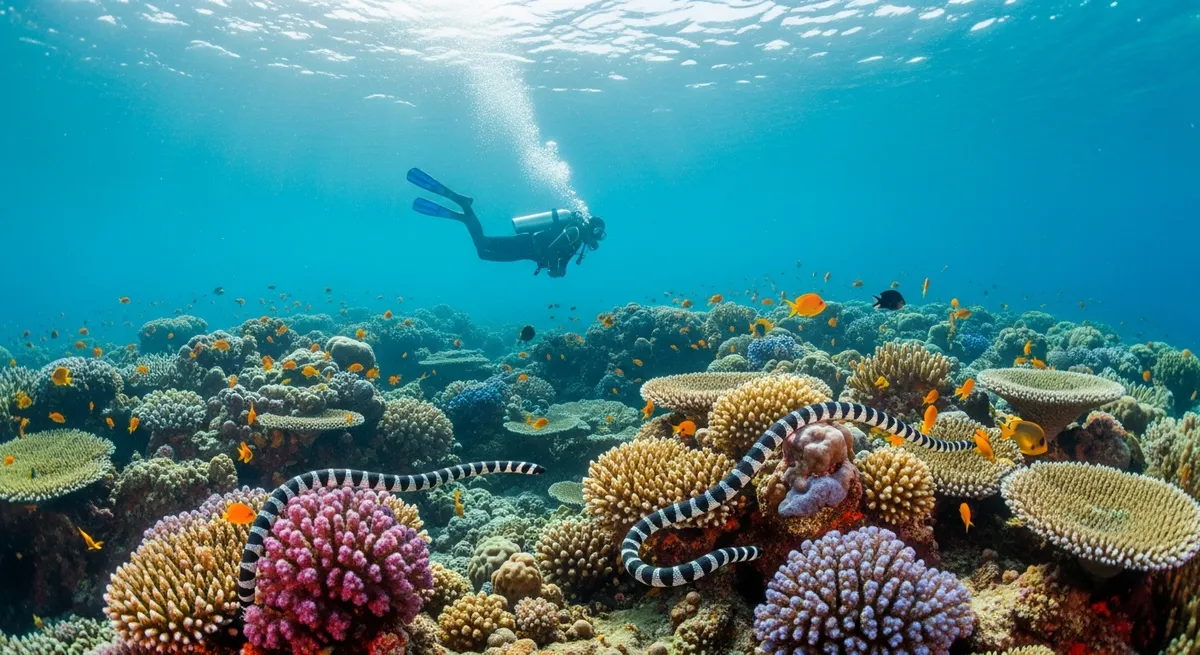
Diving in Loyalty Islands
Why dive here
Loyalty Islands offers some of New Caledonia's richest diving, with 116+ marine species recorded in the area - including dugongs, eagle rays, great white sharks, manta rays and mobula rays (devil rays). Water ranges 24-28°C, warmest January, February, March.
The Loyalty Islands are the real deal, a proper outer-island adventure for divers who appreciate genuine remoteness. We’ve always found the caves here particularly striking, with light shafts cutting through the gloom and revealing walls carpeted in sponges. It feels a bit like stepping into an underwater cathedral. Our pick, if you can swing it, is a liveaboard to explore the furthest reaches around Maré or Ouvéa. That’s where you’ll find the biggest schools of fusiliers, so thick they almost block out the sun, and the best chance of spotting tawny nurse sharks tucked under ledges. Seasonal highlights definitely include humpback whales, usually passing through from July to September. You might hear their songs rumbling through the water, even if you don't see them. Currents can be a factor, so we’d suggest going with a local guide who knows the tides. Visibility, though, is consistently excellent, often pushing past 30 metres. It lets you really appreciate the scale of those pinnacles and walls. Keep an eye out for the unique Yaté's Goby, a tiny flash of colour you won’t see just anywhere. This isn’t a place for casual resort diving; it’s for divers who want to explore.
Loyalty Islands Dive Site Map
Dive sites and dive centres in Loyalty Islands
Loyalty Islands Dive Sites
42 dive sites in Loyalty Islands
Aquarium
Aquarium, over in the Loyalty Islands, is one of those sites that just works, no matter your experience level. We love starting shallower, weaving through the coral bommies at about six metres, where the light really plays with the schools of Johnston Island Damsels. It feels like swimming through a living kaleidoscope. Deeper, around 15-19 metres, the reef really opens up, with overhangs and small caves that hide some proper macro life. Look for those tiny Orange-spotted Blennies peeking out, or if you're lucky, a Spitlure Frogfish camouflaged on the coral. This site is fantastic for photographers or anyone who just wants a relaxed, colourful dive. It’s pretty sheltered, so even if there’s a bit of chop elsewhere, Aquarium often stays calm. We’d always suggest doing it as your first dive of the day, when the fish are most active. You’ll typically spot a few resident Saddleback Butterflyfish flitting around the honeycomb corals, and the healthy anemones are usually busy with clownfish families. Keep an eye out into the blue, too; we’ve seen Bull Sharks cruise past, though they’re not an everyday occurrence.
Aquarium
Aquarium, over in the Loyalty Islands, is one of those sites that just works, no matter your experience level. We love starting shallower, weaving through the coral bommies at about six metres, where the light really plays with the schools of Johnston Island Damsels. It feels like swimming through a living kaleidoscope. Deeper, around 15-19 metres, the reef really opens up, with overhangs and small caves that hide some proper macro life. Look for those tiny Orange-spotted Blennies peeking out, or if you're lucky, a Spitlure Frogfish camouflaged on the coral. This site is fantastic for photographers or anyone who just wants a relaxed, colourful dive. It’s pretty sheltered, so even if there’s a bit of chop elsewhere, Aquarium often stays calm. We’d always suggest doing it as your first dive of the day, when the fish are most active. You’ll typically spot a few resident Saddleback Butterflyfish flitting around the honeycomb corals, and the healthy anemones are usually busy with clownfish families. Keep an eye out into the blue, too; we’ve seen Bull Sharks cruise past, though they’re not an everyday occurrence.
Arche aux gorgonnes
Arche aux Gorgonnes, off the Loyalty Islands, is a site we keep coming back to. The arch itself sits at 17 metres, a natural frame for the deeper drop-off, which tumbles past 60 metres. We love to drift along the wall, eyes peeled for grey reef sharks patrolling the blue. The name, ‘Arch of Gorgonians’, is no joke. These soft corals are everywhere, swaying gently in the current, creating a textured backdrop for the schooling fusiliers and triggerfish. Look closely, and you’ll spot parrotfish, particularly the vibrant Schlegel's and the chunky Humpnose unicornfish, munching on the reef. Our favourite moment here is always the swim-through the arch itself – it’s a tight squeeze in places, but worth it for the light play. Visibility here is usually excellent, around 30 metres, making it a dream for wide-angle photography. The site suits divers comfortable with wall dives and a bit of current, though it’s generally manageable. We suggest heading out in the morning; the light is best, and the chances of spotting an eagle ray or even a dugong grazing in the shallower sections feel a little higher.
Arche aux gorgonnes
Arche aux Gorgonnes, off the Loyalty Islands, is a site we keep coming back to. The arch itself sits at 17 metres, a natural frame for the deeper drop-off, which tumbles past 60 metres. We love to drift along the wall, eyes peeled for grey reef sharks patrolling the blue. The name, ‘Arch of Gorgonians’, is no joke. These soft corals are everywhere, swaying gently in the current, creating a textured backdrop for the schooling fusiliers and triggerfish. Look closely, and you’ll spot parrotfish, particularly the vibrant Schlegel's and the chunky Humpnose unicornfish, munching on the reef. Our favourite moment here is always the swim-through the arch itself – it’s a tight squeeze in places, but worth it for the light play. Visibility here is usually excellent, around 30 metres, making it a dream for wide-angle photography. The site suits divers comfortable with wall dives and a bit of current, though it’s generally manageable. We suggest heading out in the morning; the light is best, and the chances of spotting an eagle ray or even a dugong grazing in the shallower sections feel a little higher.
bargibenti
Bargibenti. Just saying the name brings back the particular chill of dropping into the Grande Passe de Poindimié. This isn't a site for lingering on the surface. We're talking two big pinnacles, right there at the mouth, acting like magnets for whatever the current decides to push in. Our pick here? Definitely a slow drift down, scanning the blue. We’ve had some cracking encounters with grey sharks here, and you’ll often spot blacktips cruising by. But the real magic, the thing we love, is when you get in tight on the reef. Those pinnacles are covered, and if you have the patience, the hunt for a Bargibenti pygmy seahorse is a true test. They’re tiny, maybe a fingernail, tucked right into gorgonian fans, blending perfectly. You’ll also find garden eels swaying in the sand patches, and we’ve seen eagle rays glide past with that slow, powerful wingbeat. Max depth here is around 26 metres, so it's a comfortable dive for anyone who’s happy in a bit of current. It's a fantastic spot for photographers who appreciate both the wide angle and the macro hunt, giving you a chance to spot the small and the large.
Carouso Mio
Carouso Mio sits out on the edge of the reef, a solid thirty minutes by boat, but absolutely worth the ride. We love the feeling of dropping into that deep blue. It’s a pinnacle, dropping to a manageable 25 metres, and the main event here is a massive arch. It’s completely draped in gorgonians, so many that they almost glow with colour in your torch beam. We’ve often found grey reef sharks cruising by, sometimes a barracuda or two, and once a small school of dorado zipped past, reflecting the light like polished chrome. The corals on the pinnacle itself are vibrant, lots of brain coral and honeycomb coral, and if you look closely you’ll spot an Electric Flame Scallop tucked into a crevice, its mantle flashing. For macro fans, there are plenty of cowries – the lined-lip and Carnelian are common – and keep an eye out for the patterned cones moving along the sandy patches. This site is fantastic for photographers, especially wide-angle shots of the arch. It’s also a solid pick for divers who appreciate a healthy, exposed reef with a good chance of pelagic encounters, without any wild currents to contend with.
Centre de plongée de Babou
Babou. Just saying the name brings back the smell of salt and sun. We’ve logged a few dives here over the years, and it always delivers a proper punch of Pacific action. It's not about big swim-throughs or dramatic walls; Babou is all about the little things, the stuff you’d miss if you weren’t really looking. We’ve spent entire dives just mesmerised by the sheer volume of molluscs – the Variable Stromb crawling along, Dwarf Planaxis clinging to rocks, and you’ll spot Coral Cerith everywhere. Keep your eyes peeled for the unusual – we once saw a pigmy sperm whale here, a fleeting glimpse that still gives us chills. Manta rays cruise through, too, though they’re not an everyday sight. What we really love about Babou is that feeling of discovery. It’s a site that rewards patience, perfect for macro enthusiasts and anyone who enjoys slowing down. Dive it in the morning, before the sun gets too high, for the best light on the corals.
Chemin des écoliers
Chemin des écoliers, or "Schoolchildren's Path," feels like a secret handshake with the ocean. We love this site for its geology, a real maze of pinnacles, tunnels, and caverns that you just don't get everywhere. It’s not about grand pelagics, though we have seen barracuda schools shimmering in the distance on a good current. No, the real magic here is in the quiet exploration, gliding through the shadowed swim-throughs, the light playing tricks on the brain coral formations. Keep an eye out for the Electric Flame Scallops tucked into crevices; their pulsing red lips are always a treat to find. This site is a fantastic pick for divers who appreciate intricate reef structures and a slower pace, giving you time to poke around. Maximum depth is a comfortable 19m, so it’s accessible without needing deep certs. We always try to dive it when the current is gentle, which makes navigating the network much more enjoyable. It's a place where you can spend an entire dive just exploring the nooks and crannies.
Dahab de Nous
Dahab de Nous isn't your typical flat reef dive. We love this site for its topography alone, a real maze of five distinct pinnacles just off the main reef. The dive becomes an adventure, navigating through a series of narrow canyons and faults that connect each one. You’ll spend a lot of time feeling the cool, shadowed rock walls as you squeeze between formations. Our favourite part is the long tunnel leading to the final pinnacle. It’s pierced by shafts of light, creating an almost theatrical effect as you swim through – watch for the flashes of silvery fusiliers darting in and out of the brightness. Keep an eye out for the big, colourful gorgonians that are just everywhere here; they’re truly magnificent and offer great shelter for smaller critters. While the max depth is 21m, which makes it pretty accessible, there's always a chance of jacks or tuna cruising past in the blue, especially if the current is picking up. We’d suggest this one for divers who enjoy exploration and a bit of a scenic swim-through challenge.
Eagle Paradise
Forget the 'ladies' pool' vibe from the site description, Eagle Paradise is much more than a training ground. We love it for its unexpected encounters, especially the cowries. Seriously, we’ve found Prickly Spotted Drupes and Snakehead Cowries here, tucked into crevices you might otherwise swim right past. The site maxes out at 23 metres, but the best stuff, particularly for macro enthusiasts, sits around the 10-15 metre mark. The reef here isn’t a grand wall, it’s more a collection of scattered blocks and bommies, which makes for some excellent hide-and-seek. Visibility averages 14 metres, which is decent enough for spotting the Blackspot Surgeonfish darting through the water. Our favourite time to dive it is mid-morning, just after the sun gets high enough to really illuminate the smaller cracks where those Leopard Cones often lurk. There's a gentle slope, perfect for just drifting along and scanning the sandy patches for Humpbacked Conchs. It’s a comfortable dive, not challenging, and suits anyone who enjoys taking their time to search for the small, interesting things. Keep an eye out for the Peacock-tail Anemone Shrimp – they’re surprisingly common here if you know where to look.
Faille de Poe
Faille de Poe is one of those sites we still talk about over beers, long after the trip. It’s an old riverbed slicing through the Poe Lagoon, and that unique geology really sets it apart. Forget your typical reef dive; this is about the big boys. From the moment you drop, you’re in the thick of it, often with a decent current pushing you along, which we love for the drift. Visibility can be a bit variable, maybe 12 meters on an average day, but honestly, you won't even notice once the schools start coming into view. We’ve seen barracudas so dense they’re a shimmering wall, jacks circling in the blue, and blacktip reef sharks gliding past with lazy confidence. Our favourite encounters here are definitely the guitarfish, an absolute treat to spot. The Black Angelfish and Two-tone wrasse add splashes of colour too, but it's the sheer biomass that truly impresses. This place is a proper festival of big fish, raw and powerful. We'd suggest this site for experienced divers, you need a minimum of 20 dives to even get in the water here, and that current means you need to be comfortable. It’s not about intricate macro life; it’s about that primal thrill of being surrounded by serious marine activity. Come prepared for an exhilarating drift and a guaranteed adrenaline rush.
FRANCE II
Forget what you think you know about wreck diving. The *France II*, off Lifou in the Loyalty Islands, isn’t some deep, dark behemoth. In fact, most of it isn't even underwater. This colossal sailing ship, once the largest in the world, ran aground in 1922 and broke up on the reef. What you dive here are the scattered remains, mostly engine blocks, winches, and massive iron ribs, now completely colonised by the reef. We love this site for its unique blend of history and biology. You’re weaving through metal skeletons draped in soft corals, anemones, and a vibrant cast of reef fish. Look for schools of snapper darting between the girders and inquisitive lionfish tucked into crevices. Our favourite part is navigating the shallower sections at high tide, where the light plays off the rust-red metal and the water is warm. It’s an accessible dive, perfect for those who enjoy pottering around a site, taking their time to really appreciate the details. Don't expect dramatic swim-throughs, but prepare for a fascinating exploration of how nature reclaims even the most imposing man-made structures.
Show all 42 dive sites in Loyalty Islands
- Grand coude de Kele
- grande passe
- Green Turtle
- Grottes aux Chats
- jardin d'alcyon
- Just for Nous
- Labyrinthe 1
- la caverne d'Albi baba
- la faille de baye
- l’arche
- Les Pléiades du Sud
- Les tunnels d’Actinéria
- Magic drift
- Manta point
- Mirlo
- Natacha
- Pascaline
- Phuket
- Pinacle d’Actineria
- Pinacle du 19 Novembre
- Récif de Cook
- Sarconphitum
- spaghetti
- Tignes
- tombant 60
- tubs ans co
- Val d’Isère
- Vertigo
- Waneck
- Zorglub
Loyalty Islands Dive Centres
3 dive shops and operators in Loyalty Islands
Ocean Wildlife in Loyalty Islands
116 species recorded in Loyalty Islands
Loyalty Islands Daylight & Sunrise/Sunset
Sunrise and sunset times for Loyalty Islands, calculated from coordinates
Today - Sunday 11 October
Sunrise
05:32
Sunset
18:00
Daylight
12h 28m
Golden Hour
17:31
First light (dawn) at 05:10 · Last light (dusk) at 18:23
Monthly Averages
| Month | Sunrise | Sunset | Daylight |
|---|---|---|---|
| Jan | 05:30 | 18:46 | 13h 16m |
| Feb | 05:50 | 18:37 | 12h 48m |
| Mar | 06:01 | 18:16 | 12h 14m |
| Apr | 06:10 | 17:48 | 11h 38m |
| May | 06:22 | 17:30 | 11h 8m |
| JunShortest | 06:34 | 17:26 | 10h 52m |
| Jul | 06:36 | 17:34 | 10h 58m |
| Aug | 06:23 | 17:45 | 11h 23m |
| Sep | 05:56 | 17:53 | 11h 57m |
| OctNow | 05:29 | 18:01 | 12h 33m |
| Nov | 05:11 | 18:17 | 13h 6m |
| DecLongest | 05:12 | 18:36 | 13h 24m |
Times are approximate local times based on longitude. Actual times may vary slightly depending on the exact timezone observed in Loyalty Islands.
Where to Stay near Loyalty Islands
Prices from Booking.com. We may earn a commission at no extra cost to you.
Marine Protected Areas near Loyalty Islands
36 protected areas near Loyalty Islands - please respect local regulations when diving
Lagons de Nouvelle-Calédonie : diversité récifale et écosystèmes associés
Nekoro
Atoll d'Ouvéa et Beautemps-Beaupré
Parc de la Zone Côtière Ouest
Parc de la Côte Oubliée
L’île de Bailly
L’îlot Ténia
Grand récif Aboré et de la passe de Boulari
Casy Islet
Parc du lagon de Bourail: Roche Percee and Baie des tortues
Ouano
Poé
Showing 12 largest of 36
Getting to Loyalty Islands
Touho
Nouméa (La Tontouta)
Port Vila
Plan & book
Ways to dive Loyalty Islands, from day trips to liveaboards.
Day trips & courses
via GetYourGuideGuided dives, courses and snorkel trips with instant booking.
Find dive trips in Loyalty IslandsPlaces to stay
via Booking.comHotels and dive resorts near Loyalty Islands.
Search stays in Loyalty IslandsDive insurance
Most travel insurance excludes or limits scuba. Check what you need before you go.
Dive insurance explainedPartner links: we may earn a commission if you book, at no extra cost to you. How we make money