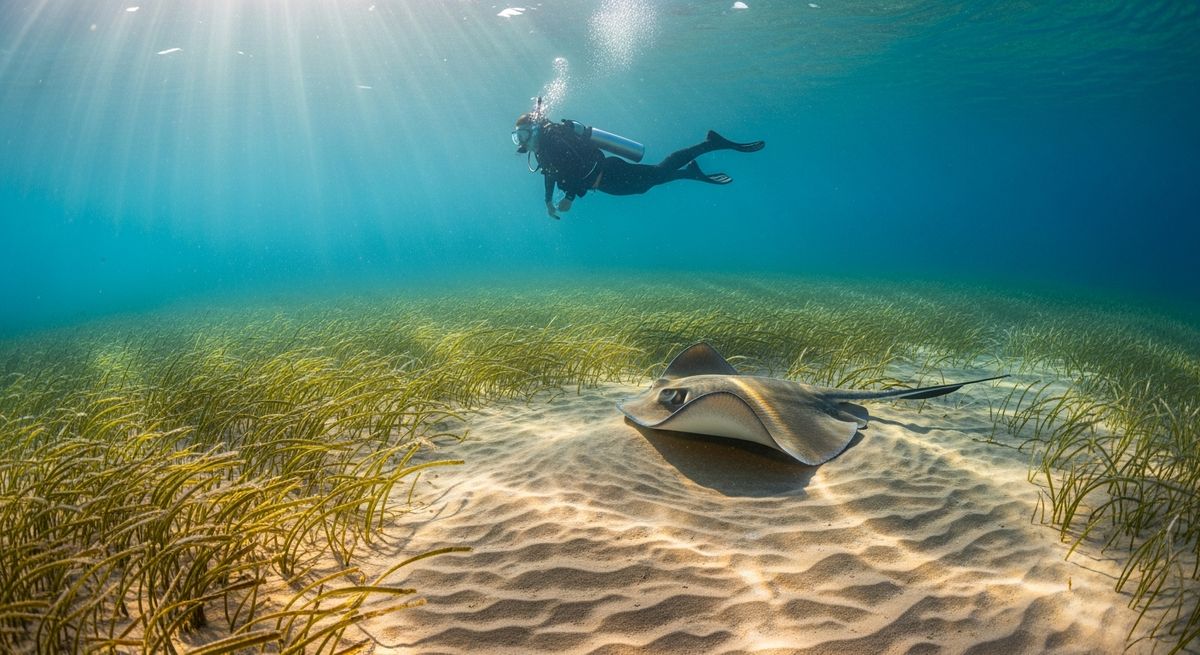
Cape Eleuthera - Eleuthera & Harbour Island

Cape Eleuthera offers a good taste of the wall diving this part of the Bahamas is known for. We're talking deep drifts here, with the reef dropping off to a serious 600 meters, so you'll want to be comfortable with exposure. Cave Rock, our pick in the area, has some accessible caves around 15 meters. You can swim right in; we've seen them packed with silversides, which usually brings in the jacks for a feed. It’s a solid dive for those who enjoy a bit of current and dramatic topography.

Location
Eleuthera & Harbour Island, Bahamas, Caribbean
Coordinates
24.800000, -76.200000

Best Time to Dive in Eleuthera & Harbour Island

The warmest water temperatures in Eleuthera & Harbour Island occur in January, averaging 26.0°C. The coolest conditions are in December at 26.0°C.

Monthly Water Temperatures

  • January: 26.0°C (air: 23.6°C)
  • February: 26.0°C (air: 23.6°C)
  • March: 26.0°C (air: 23.9°C)
  • April: 26.0°C (air: 24.5°C)
  • May: 26.0°C (air: 25.7°C)
  • June: 26.0°C (air: 27.2°C)
  • July: 26.0°C (air: 28.5°C)
  • August: 26.0°C (air: 28.8°C)
  • September: 26.0°C (air: 28.6°C)
  • October: 26.0°C (air: 27.6°C)
  • November: 26.0°C (air: 26.1°C)
  • December: 26.0°C (air: 24.4°C)

Nearby Dive Sites in Eleuthera & Harbour Island

Marine Life in Eleuthera & Harbour Island

Home to 275 recorded species including 239 reef fish, 10 whales & dolphins, 6 sharks & rays, 6 sea snails & nudibranchs, 4 other, 3 seagrass & algae.

Notable Species

Recommended Packing List for Cape Eleuthera

Based on average water temperature of 26.0°C.

  • Shorty or Rashguard - warm 26°C water needs minimal exposure protection
  • Mask - essential for every dive
  • Fins
  • BCD - buoyancy compensator
  • Regulator - your most safety-critical piece of gear
  • Dive Computer - tracks depth, time, and NDL
  • Surface Marker Buoy (SMB) - essential for boat pickups
  • Dive Torch - useful for crevices and colour at depth
  • Underwater Camera - capture your diving memories

Frequently Asked Questions

What are the typical dive depths at Cape Eleuthera dive sites?
The dive sites around Cape Eleuthera offer a range of depths, with over 20 different sites available. Typical profiles involve deep drift dives along the reef wall, which dramatically drops off to 2000 ft/600m. For instance, Cave Rock features accessible caves at 50 ft/15m, providing diverse depth experiences.
What kind of marine life and underwater features can divers expect to see when diving in Cape Eleuthera?
Divers at Cape Eleuthera can expect to explore colorful reef walls and impressive underwater features. Notable sites include Cave Rock, which boasts several large caves at 50 ft/15m, and a main rock forming a large swim-through. This swim-through is often teeming with silversides and hunting black jacks, offering exciting marine encounters. For more information on marine life, visit our wildlife database.
How challenging is the diving at Cape Eleuthera, and are there sites suitable for beginners?
Diving at Cape Eleuthera is generally rated as intermediate in difficulty. This is primarily due to the typical deep drift dives along the extensive reef wall. While specific beginner sites aren't detailed, the intermediate rating suggests that some experience is beneficial for most dives here.
What is the best time of year to go diving in Cape Eleuthera for optimal conditions and marine encounters?
Information regarding the best time of year for optimal diving conditions or specific marine encounters at Cape Eleuthera is not available in the provided data. We recommend checking our general when to dive guide for broader seasonal advice.
What scuba diving certifications are recommended or required for diving in Cape Eleuthera?
Given the intermediate difficulty and typical deep drift dives at Cape Eleuthera, certifications beyond Open Water are likely recommended. An Advanced Open Water certification, or specialties like Deep Diver and Drift Diver, would be highly beneficial for safely enjoying these exhilarating dives. Specific requirements may vary by dive operator.
What are the typical currents and visibility conditions like at Cape Eleuthera dive sites?
The dive sites at Cape Eleuthera are characterized by typical deep drift dives along the reef wall, indicating the presence of currents. This creates exhilarating drift experiences for divers. Information regarding specific visibility conditions, however, is not provided in the available data.