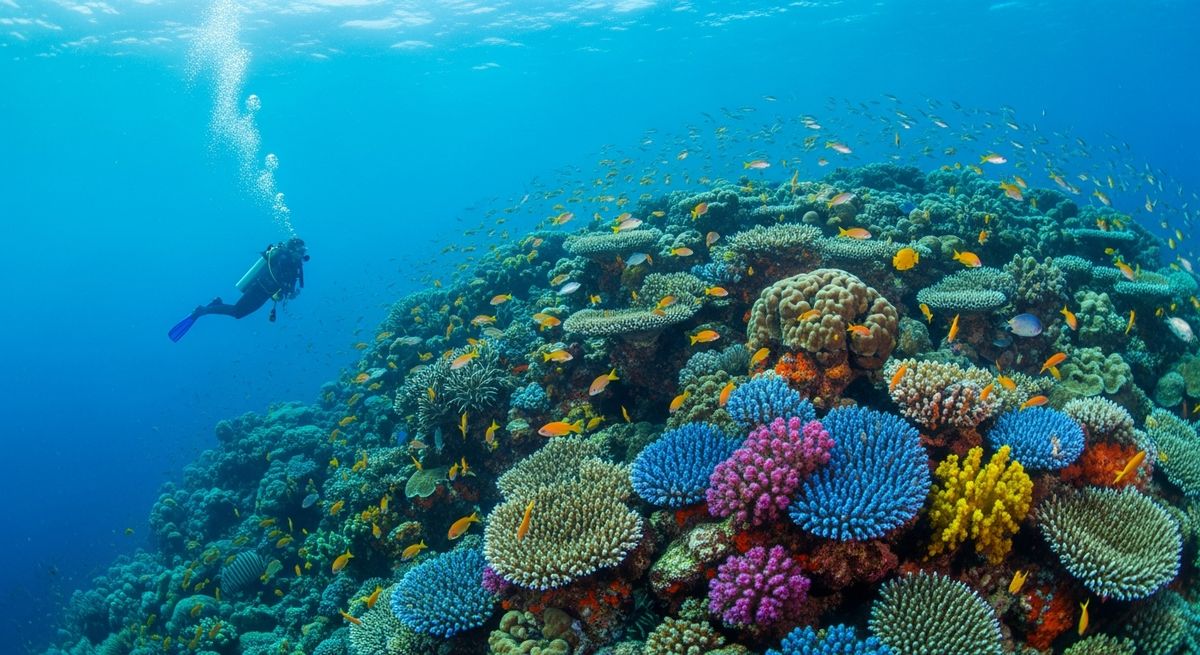
Sylvia’s Reef - Cayman Brac

Vista Blue, over on Klein, feels like one of those easygoing sites we always gravitate towards. You get in, fin out over a sandy slope dotted with turtlegrass and shoalgrass, and then the reef just drops. It's a proper wall dive, starting around nine metres and heading down to a comfortable 22m max. We love how the reef structure here creates little ledges and overhangs, perfect for spotting some of the smaller, more elusive stuff – think Puffcheek Blennies peeking from coral crevices or a flash of a Banded Basslet. Keep an eye out for larger visitors too, though. We’ve seen loggerheads cruising by, and if you’re lucky, an eagle ray might glide past in the deeper blue. The visibility is usually excellent, around 22m, which really shows off the range of corals, including some impressive fire coral formations. Just a heads-up, the entry here can get choppy if there are big waves, so check conditions before you jump in. It’s a great dive for anyone who appreciates a relaxed drift along a healthy wall.

Location
Cayman Brac, Cayman Islands, Caribbean
Coordinates
19.748900, -79.766500
Type
reef

Marine Protected Area: Spott Bay (Cayman Brac)

Best Time to Dive in Cayman Brac

The warmest water temperatures in Cayman Brac occur in September, averaging 30.5°C. The coolest conditions are in February at 27.1°C.

Monthly Water Temperatures

  • January: 27.4°C
  • February: 27.1°C
  • March: 27.2°C
  • April: 27.9°C
  • May: 28.8°C
  • June: 29.3°C
  • July: 30.0°C
  • August: 30.4°C
  • September: 30.5°C
  • October: 30.1°C
  • November: 29.0°C
  • December: 28.0°C

Nearby Dive Sites in Cayman Brac

Nearest Dive Centres to Sylvia’s Reef

Marine Life in Cayman Brac

Home to 141 recorded species including 111 reef fish, 23 hard corals, 2 whales & dolphins, 2 other, 1 sea snails & nudibranchs, 1 seagrass & algae.

Notable Species

Recommended Packing List for Sylvia’s Reef

Based on average water temperature of 28.8°C, currents 6 cm/s.

  • Shorty or Rashguard - warm 29°C water needs minimal exposure protection
  • Mask - essential for every dive
  • Fins
  • BCD - buoyancy compensator
  • Regulator - your most safety-critical piece of gear
  • Dive Computer - tracks depth, time, and NDL
  • Surface Marker Buoy (SMB) - essential for boat pickups
  • Dive Torch - useful for crevices and colour at depth
  • Underwater Camera - capture your diving memories

Frequently Asked Questions

What is the typical depth range for scuba diving at Sylvia's Reef in Cayman Brac?
Scuba diving at Sylvia's Reef offers a maximum depth of 17 meters (56 feet). This depth range makes it accessible for many divers to explore the vibrant reef. The average visibility at the site is an impressive 20 meters (65 feet), ensuring clear views of the underwater environment.
What kind of marine life and underwater features can divers expect to see at Sylvia's Reef?
Divers at Sylvia's Reef can expect to encounter a variety of marine life, including beautiful Queen Angel Fish, French Angel Fish, and even sharks. The underwater landscape is characterized by big coral heads, along with hidden ledges or caves that are perfect for exploration. For more information on marine species, visit our wildlife database.
How difficult is the dive at Sylvia's Reef, and is it suitable for beginner divers?
The dive at Sylvia's Reef is rated as intermediate difficulty. While not explicitly for beginners, divers with some experience will find it rewarding and manageable. It is generally recommended for those who are comfortable with basic diving skills and have completed an Open Water Diver certification.
What is the best time of year or day to dive Sylvia's Reef for optimal conditions and marine life viewing?
The provided data does not specify the best time of year or day to dive Sylvia's Reef for optimal conditions or marine life viewing. For general guidance on diving in the Caribbean, you might consult our When to Dive section. Always check with local dive operators for current conditions.
Are there any specific diving certifications required to dive at Sylvia's Reef?
The provided information does not specify any particular diving certifications required for Sylvia's Reef. However, given its intermediate difficulty rating, an Open Water Diver certification is typically the minimum for such sites. Advanced training could further enhance your experience and comfort exploring the hidden ledges and caves.
What are the typical current and water conditions like at Sylvia's Reef, especially for shore entry?
The provided data does not detail the typical current or water conditions at Sylvia's Reef. For shore entry, divers should look for the end of the white cement wall on the north side road, where a small turn leads to a dirt path and a cut for parking. It is always advisable to check local conditions with a dive center before planning your dive.