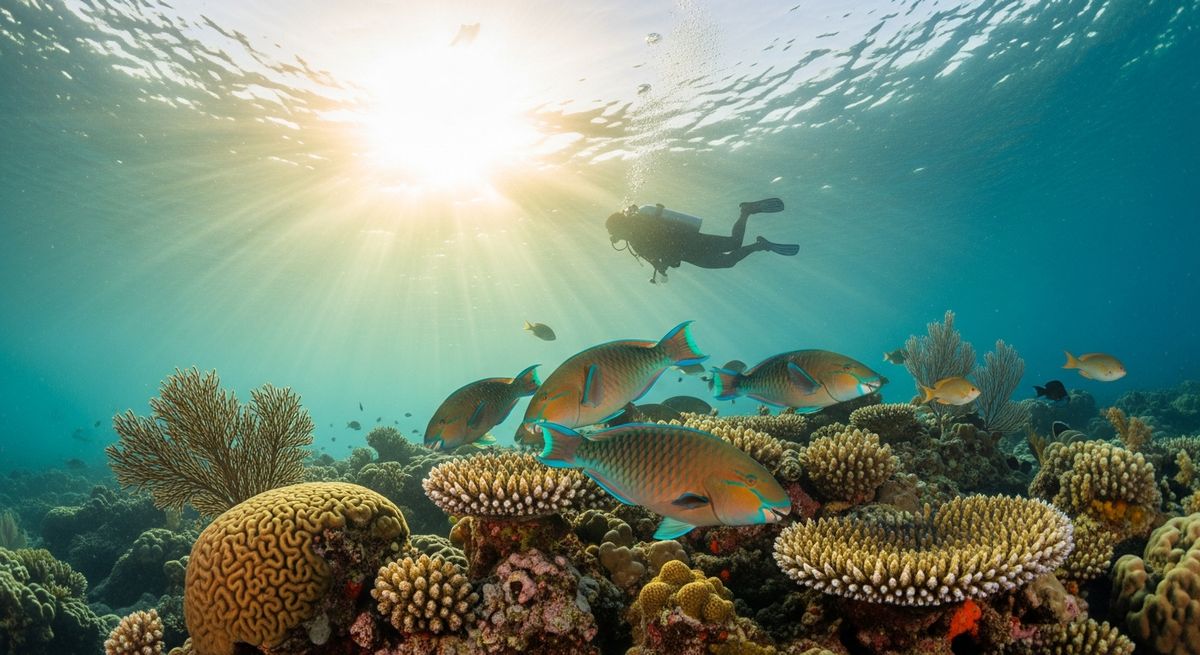
Lost Horizon - Soufriere-Scotts Head Marine Reserve

Palancar Bricks, tucked away at the southern end of the broader Palancar system, is one of those Cozumel sites we keep coming back to. It’s not just the sheer number of swim-throughs, though they are plentiful and at varying depths – a real playground. We love drifting through the deeper cuts, watching schools of painted wrasse and blue doctors flicker in the dappled light filtering from above. Visibility here is often ridiculously good, around 27 meters on most days, which really lets you appreciate the scale of the coral structures. You'll often spot rose coral blooming in massive formations and the impressive, branching elkhorn reaching towards the surface. Keep an eye out for the spotted trunkfish poking around the crevices, and we’ve had some cracking encounters with splendid toadfish tucked under ledges. While turtles are a year-round fixture, those winter months bring in the eagle rays and the occasional reef shark, adding another layer of excitement. It’s an easy drift, suitable for most divers looking for that classic Cozumel experience, offering plenty of macro opportunities without sacrificing the bigger picture.

Location
Soufriere-Scotts Head Marine Reserve, Dominica, Caribbean
Coordinates
15.208000, -61.359600
Type
reef

Marine Protected Area: Soufriere/Scott's Head

Best Time to Dive in Soufriere-Scotts Head Marine Reserve

The warmest water temperatures in Soufriere-Scotts Head Marine Reserve occur in January, averaging 27.2°C. The coolest conditions are in December at 27.2°C.

Monthly Water Temperatures

  • January: 27.2°C (air: 24.7°C)
  • February: 27.2°C (air: 24.5°C)
  • March: 27.2°C (air: 24.7°C)
  • April: 27.2°C (air: 25.5°C)
  • May: 27.2°C (air: 26.6°C)
  • June: 27.2°C (air: 26.8°C)
  • July: 27.2°C (air: 26.6°C)
  • August: 27.2°C (air: 26.9°C)
  • September: 27.2°C (air: 27.3°C)
  • October: 27.2°C (air: 27.0°C)
  • November: 27.2°C (air: 26.1°C)
  • December: 27.2°C (air: 25.2°C)

Nearby Dive Sites in Soufriere-Scotts Head Marine Reserve

Nearest Dive Centres to Lost Horizon

Marine Life in Soufriere-Scotts Head Marine Reserve

Home to 271 recorded species including 215 reef fish, 24 hard corals, 14 whales & dolphins, 3 other, 3 sea urchins, 3 sharks & rays.

Notable Species

Recommended Packing List for Lost Horizon

Based on average water temperature of 27.2°C.

  • Shorty or Rashguard - warm 27°C water needs minimal exposure protection
  • Mask - essential for every dive
  • Fins
  • BCD - buoyancy compensator
  • Regulator - your most safety-critical piece of gear
  • Dive Computer - tracks depth, time, and NDL
  • Surface Marker Buoy (SMB) - essential for boat pickups
  • Dive Torch - useful for crevices and colour at depth
  • Underwater Camera - capture your diving memories

Frequently Asked Questions

What are the typical dive depths at the dive sites accessible from Lost Horizon Beach Dive Resort?
The dive site Lost Horizon offers a maximum depth of 24 meters, making it suitable for a range of recreational divers. While the general depth is listed as unknown, the specific maximum depth provides a clear guideline for planning your dive. This depth allows for exploration of its diverse reef and spectacular canyon entry.
What kind of marine life and underwater features can divers expect to see when diving around Lost Horizon Beach Dive Resort?
Divers at the Lost Horizon dive site can expect a spectacular canyon entryway and a diverse mix of fish and corals on its reef. You'll encounter huge schools of fish, including creole wrasse, black durgeons, horse eye jacks, and bar jacks. Near the Suburbs mooring, black margates and schoolmasters are also common sights, offering a vibrant underwater experience.
How challenging are the dive sites near Lost Horizon Beach Dive Resort, and are they suitable for beginner or advanced divers?
The Lost Horizon dive site is classified as intermediate difficulty. Due to the missing mooring, divers are dropped off and need to swim towards the Suburbs mooring, which requires some comfort with drift or surface swimming. This makes it more suitable for divers with some experience rather than absolute beginners, but it's well within the capabilities of most certified recreational divers.
What is the best time of year to dive at Lost Horizon Beach Dive Resort for optimal conditions and marine life sightings?
The provided data for the Lost Horizon dive site does not specify the best time of year for optimal conditions or marine life sightings. For general information on diving seasons in the Dominica Island region, please consult our When to Dive guide.
What scuba diving certifications are typically required to participate in dives offered by Lost Horizon Beach Dive Resort?
Given the Lost Horizon dive site's intermediate difficulty and maximum depth of 24 meters, an Open Water Diver certification is generally sufficient. However, an Advanced Open Water certification or equivalent would enhance your experience, especially considering the need to swim to the site due to the missing mooring. Always check with your dive operator for specific certification requirements.
What are the usual water conditions and currents like at the dive sites around Lost Horizon Beach Dive Resort?
At the Lost Horizon dive site, divers can expect an average visibility of 8 meters. While specific current information is not detailed, the practice of being dropped off and swimming towards the Suburbs mooring suggests that divers should be prepared for potential mild currents or surface swims. Always consult with local dive guides for real-time conditions.