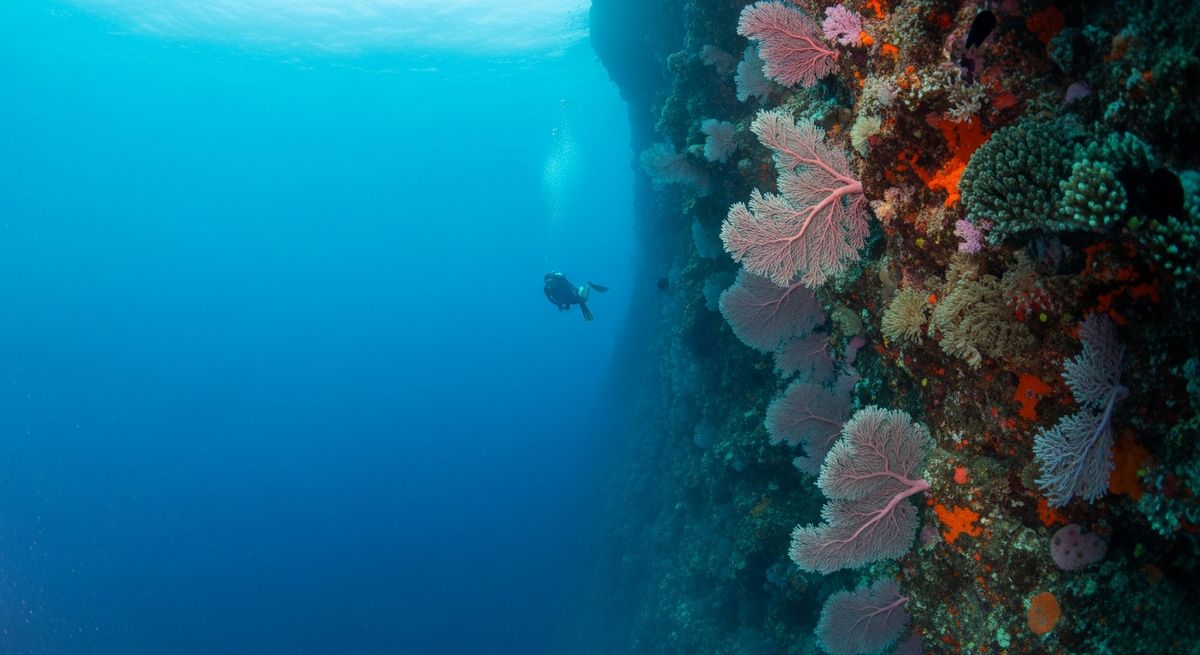
Mountain Top - Soufriere-Scotts Head Marine Reserve

We’ll be honest, when someone says "sand patch," our ears don't always perk up for a truly memorable dive. Pubudus Playground, though, is one of those places that teaches you to look closer. It starts with that big sandy area at 10 meters, and sure, it’s good for navigation practice, but we really love it for the macro stuff. Get your face right down there, and you’ll spot Eyed Flounder perfectly camouflaged, or maybe a tiny Rusty Goby darting between shell fragments. What makes it standout, for us, is the way the sand gives way to these fantastic canyon formations. It’s a real transition point, from flat, open sand to these dramatic cuts in the reef. They lead you straight to the main wall, where the topography shifts entirely. Suddenly you're among some truly impressive barrel sponges, the kind that dwarf a person, and tubular sponges reaching out like alien fingers. Visibility averages a comfortable 21 meters, giving you plenty of light to appreciate the scale. We think Pubudus Playground is fantastic for divers who appreciate the subtle beauty of a reef, those who love to slow down and really look. It’s not about big pelagics here, but about discovery, from tiny basslets in the sand to the grand architecture of the deeper wall. We'd suggest going in the late morning, when the sun hits the canyons just right, creating some lovely light play as you approach the drop-off.

Location
Soufriere-Scotts Head Marine Reserve, Dominica, Caribbean
Coordinates
15.206500, -61.381700
Type
wall
Maximum Depth
15-40m

Marine Protected Area: Soufriere/Scott's Head

Best Time to Dive in Soufriere-Scotts Head Marine Reserve

The warmest water temperatures in Soufriere-Scotts Head Marine Reserve occur in January, averaging 27.2°C. The coolest conditions are in December at 27.2°C.

Monthly Water Temperatures

  • January: 27.2°C (air: 24.7°C)
  • February: 27.2°C (air: 24.5°C)
  • March: 27.2°C (air: 24.7°C)
  • April: 27.2°C (air: 25.5°C)
  • May: 27.2°C (air: 26.6°C)
  • June: 27.2°C (air: 26.8°C)
  • July: 27.2°C (air: 26.6°C)
  • August: 27.2°C (air: 26.9°C)
  • September: 27.2°C (air: 27.3°C)
  • October: 27.2°C (air: 27.0°C)
  • November: 27.2°C (air: 26.1°C)
  • December: 27.2°C (air: 25.2°C)

Nearby Dive Sites in Soufriere-Scotts Head Marine Reserve

Nearest Dive Centres to Mountain Top

Marine Life in Soufriere-Scotts Head Marine Reserve

Home to 271 recorded species including 215 reef fish, 24 hard corals, 14 whales & dolphins, 3 other, 3 sea urchins, 3 sharks & rays.

Notable Species

Recommended Packing List for Mountain Top

Based on average water temperature of 27.2°C.

  • Shorty or Rashguard - warm 27°C water needs minimal exposure protection
  • Mask - essential for every dive
  • Fins
  • BCD - buoyancy compensator
  • Regulator - your most safety-critical piece of gear
  • Dive Computer - tracks depth, time, and NDL
  • Surface Marker Buoy (SMB) - essential for boat pickups
  • Dive Torch - useful for crevices and colour at depth
  • Underwater Camera - capture your diving memories

Frequently Asked Questions

What is the typical depth range for diving at the Mountain Top dive site in Dominica?
The Mountain Top dive site in Dominica offers diving from its top at 17 meters down to a maximum depth of 26 meters. This range allows divers to experience the vibrant marine life and unique topography of this stunning location.
What marine life and underwater topography can divers expect to encounter at Mountain Top in Dominica?
At Mountain Top, divers will encounter a stunning wall topography. The site is renowned for its abundant marine life, including huge schools of fish, massive horse eye jacks, rainbow runners, barracudas, and creole wrasse. With a little current, the horse eye jacks are known to approach divers closely.
How difficult is the Mountain Top dive site in Dominica, and is it suitable for beginner divers?
The Mountain Top dive site is classified as intermediate difficulty. Given its high susceptibility to wind, waves, and current, it is not recommended for beginner divers. Experienced divers will best appreciate this stunning location when conditions are calm.
What are the best times or conditions to dive the Mountain Top pinnacle in Dominica?
The optimal conditions for diving Mountain Top are when there is absolutely no wind, waves, or current, as the site is highly susceptible to these factors. Calm conditions are essential for a safe and simply stunning dive experience. For more general information on dive conditions, visit When to Dive.
What scuba diving certifications are recommended or required for diving Mountain Top in Dominica?
Given the Mountain Top dive site's intermediate difficulty and maximum depth of 26 meters, an Advanced Open Water certification or equivalent is highly recommended. This ensures divers have the necessary skills and experience to safely navigate the site and its potential conditions.
What are the usual current and surge conditions at the Mountain Top dive site in Dominica?
The Mountain Top dive site is highly susceptible to current, wind, and waves, making calm conditions crucial for a good dive. While strong currents are generally to be avoided, a little current can be beneficial, as it encourages the massive horse eye jacks to come right up to divers.