Diving in Cocos Island
Why dive here
Cocos Island offers some of Costa Rica's richest diving, with 288+ marine species recorded in the area - including blacktip reef sharks, blue sharks, dolphins, eagle rays and giant moray eels.
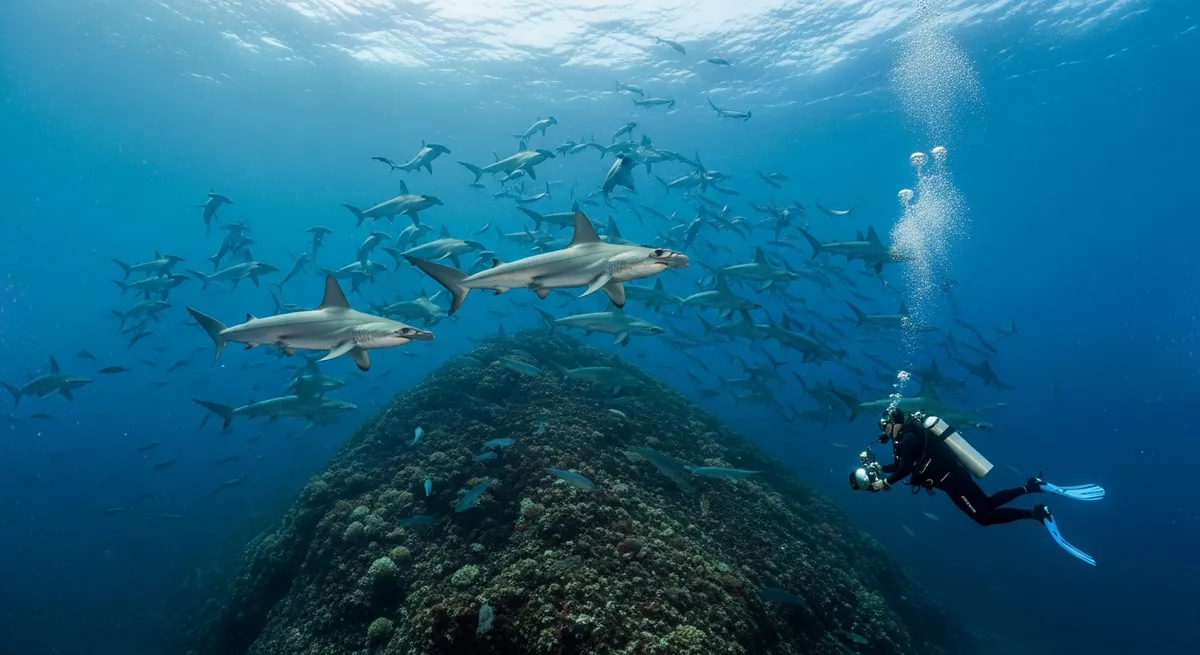
Cocos Island, that speck 500km off Costa Rica, isn't a casual drop-in. This is serious blue water stuff, strictly for advanced divers who relish big pelagics and aren’t fazed by being truly isolated. We love Cocos for its sheer unapologetic wildness. Forget shore dives; it’s liveaboard territory, and worth every day of the journey. Dive in, and you’re instantly plunged into a frantic, chaotic ballet of marine life. Huge schools of hammerheads, sometimes hundreds strong, glide past, often trailed by a squadron of oceanic mantas. We’ve seen whale sharks cruise by at cleaning stations, seemingly unfazed by our presence. It’s an almost primal experience, feeling the surge of the open ocean against the pinnacles and seeing creatures that truly belong to the deep. Our favourite moments here always involve just hanging motionless, letting the current carry us, and watching the oceanic theatre unfold. Expect some serious drift dives, so good buoyancy and current awareness are non-negotiable. This place really demands your full attention, but it pays off with encounters you’ll recount for years.
Cocos Island Dive Site Map
Dive sites and dive centres in Cocos Island
Cocos Island Dive Sites
20 dive sites in Cocos Island
Alcyone
Alcyone. Just the name brings back that metallic taste of salt and adrenaline. This seamount is what everyone pictures when they think of Cocos, and frankly, it delivers. We’re talking about getting dropped onto the crown of a submerged peak, then sinking down into hundreds, sometimes thousands, of hammerheads. They swirl around you, a silent, grey storm of muscle and fin. Seriously, the sheer number of sharks here can be dizzying. Our favourite approach is to drop in, tuck ourselves behind some rocks around 20-25m, and just wait. The surge is often present, a gentle push and pull against your body, but it’s worth it. You’ll see whitetips blanketing the bottom, and if you’re lucky, a marble ray or eagle ray will glide past the main event. Keep an eye on the blue for a passing whale shark, though the hammerheads are the main show. This dive is for experienced divers comfortable with current and deep water, who are ready for an unparalleled shark encounter.
Bait Balls
Bait Balls on Cocos Island delivers exactly what the name implies: massive schools of fish, often drawing in larger predators. We’ve seen tuna, jacks, and sometimes even a few hammerheads circling the frantic action. It’s an exciting, high-energy dive that really showcases the food chain in action. Expect strong currents and an open-water feel; this site is best for experienced divers comfortable with drift dives.
Bajo Alcyone
Bajo Alcyone is a submerged pinnacle at Cocos Island, one of our favorite spots to see big pelagics. We usually drop onto the top of the pinnacle, often at around 25 meters, then find a sheltered spot to watch the show. Hammerhead sharks are the main draw here, cruising in large schools, but you'll also likely spot Galapagos sharks and plenty of tuna. It’s a site best suited for experienced divers comfortable with deeper dives and potentially strong currents.
Bajo Dos Amigos
Bajo Dos Amigos is one of Cocos’ more dramatic sites. We've dropped into the blue here and quickly found ourselves surrounded by schooling hammerheads, often hundreds of them gliding by. It’s a site for experienced divers comfortable with deeper profiles and strong currents, as the action happens in the open water around a seamount. Keep an eye out for marble rays too; they often cruise past.
Dirty Rock
Dirty Rock, it’s not the prettiest name, but trust us, this pinnacle is one of our absolute favourites at Cocos. You drop in, often into a decent current, and immediately feel that surge of anticipation. The rock itself is a magnet for big stuff. We’ve had dives here where the schools of hammerheads are so thick, they literally blot out the sun for a few seconds. It’s like a living curtain. Below, the volcanic rock drops down to about 40 metres, and that’s where you position yourself, hooking in if the current is properly ripping. This is where the show really happens. We’re talking Galapagos sharks cruising by with that slow, deliberate power. Marble rays, some easily over two metres across, glide past almost without effort. Look closely into the nooks and crannies too; the moray eels, especially the speckled ones, are always curious. The visibility can be anything from 10 to 30 metres, depending on the currents and plankton, but it’s rarely a problem when you’ve got so much action right in front of you. This isn’t a leisurely drift; it’s an adrenaline shot, best suited for experienced divers comfortable in strong currents. Come here for the sheer volume of pelagics; it rarely disappoints.
Dirty Rock
Dirty Rock is a prime spot on Cocos, basically a meeting point for pelagics. We’ve seen huge schools of hammerheads here, often circling overhead or cruising past in the blue. Keep an eye out for marble rays, Galapagos sharks, and even the occasional whale shark making an appearance. It’s a drift dive, so comfortable with currents is a must.
Dos Amigos - Big
Dos Amigos - Big, off Cocos Island, is primarily a hammerhead shark dive. We’ve often found large schools patrolling the deeper sections here, particularly around the cleaning stations. The currents can be strong, so it’s best for divers comfortable with drift diving and managing their buoyancy in moving water. Visibility is generally good, allowing for wide views of the open ocean action.
Dos Amigos Grande
Dos Amigos Grande offers a classic Cocos experience, dominated by its namesake arch. Dropping to around 25 metres, you’ll find the arch itself rising majestically, big enough that our whole group swam through it with room to spare. This is where the action often unfolds. We've seen schools of hammerheads cruise right through the archway, often joined by whitetip reef sharks. Keep an eye out for eagle rays gliding past and the usual suspects like snappers and jacks hanging around. It’s a comfortable dive for those happy with moderate depths, and a solid bet for encountering some of Cocos' bigger residents.
Dos Amigos Pequeño
Dos Amigos Pequeño is one of those spots that just sticks with you. It’s got these two rocky islets, sure, but what really grabs you are the arches and tunnels beneath the surface. We always drop in expecting big things, and Dos Amigos Pequeño rarely disappoints. We’ve drifted past schools of hammerheads here, sometimes hundreds strong, like a shimmering wall moving through the blue. What we particularly love, though, are the whitetip reef sharks. Find a good cave or overhang, settle in, and watch them pile up, dozens of them just stacked on top of each other, resting out of the current. It’s not uncommon to see a whale shark cruise by in the distance, a gentle giant adding to the already dramatic scene. You’ll definitely want to keep an eye out for the smaller stuff too, like the iridescent rainbow basslets flitting about or the quirky rounded batfish. It’s a site that rewards patience and a keen eye, perfect for divers who appreciate both the pelagic show and the intricate details of a vibrant reef.
Dos Amigos - Small
Dos Amigos Small offers a deep wall dive, often with strong currents that make it better suited for experienced divers. We’ve seen schooling hammerheads pass through the blue here, along with marbled rays cruising the sandy bottom. Keep an eye out for white-tip reef sharks resting in the crevices. It’s a good spot to check if the current isn’t too much.
Isla Cascara
Isla Cascara is one of those Cocos Island sites where you just drop in and see what shows up. We’ve had good luck here with hammerheads cruising by, usually in small groups rather than the big schools you sometimes see elsewhere. Keep an eye out for marble rays on the sandy bottom too. It’s a pretty straightforward drift, good for any diver comfortable with current.
Isla Manuelita
Isla Manuelita is one of Cocos Island's more sheltered spots, often a good option if the currents are kicking up elsewhere. You'll usually find white-tip reef sharks sleeping in crevices and sometimes even a few hammerheads cruising the deeper edge of the reef. We'd suggest this site for divers who enjoy spotting smaller creatures as much as the big pelagics.
Show all 20 dive sites in Cocos Island
Cocos Island Dive Centres
1 dive shop and operator in Cocos Island
Ocean Wildlife in Cocos Island
288 species recorded in Cocos Island
Cocos Island Daylight & Sunrise/Sunset
Sunrise and sunset times for Cocos Island, calculated from coordinates
Today - Sunday 11 October
Sunrise
05:35
Sunset
17:37
Daylight
12h 2m
Golden Hour
17:09
First light (dawn) at 05:14 · Last light (dusk) at 17:58
Monthly Averages
| Month | Sunrise | Sunset | Daylight |
|---|---|---|---|
| Jan | 06:03 | 17:53 | 11h 50m |
| Feb | 06:05 | 18:02 | 11h 57m |
| Mar | 05:56 | 18:01 | 12h 5m |
| Apr | 05:42 | 17:56 | 12h 14m |
| May | 05:34 | 17:56 | 12h 22m |
| JunLongest | 05:36 | 18:03 | 12h 26m |
| Jul | 05:42 | 18:07 | 12h 25m |
| Aug | 05:45 | 18:03 | 12h 18m |
| Sep | 05:40 | 17:49 | 12h 9m |
| OctNow | 05:35 | 17:35 | 12h 0m |
| Nov | 05:37 | 17:30 | 11h 52m |
| DecShortest | 05:50 | 17:38 | 11h 48m |
Times are approximate local times based on longitude. Actual times may vary slightly depending on the exact timezone observed in Cocos Island.
Where to Stay near Cocos Island
Prices from Booking.com. We may earn a commission at no extra cost to you.
Marine Protected Areas near Cocos Island
3 protected areas near Cocos Island - please respect local regulations when diving
Isla del Coco
Isla del Coco
Parc national de l'île Cocos
Plan & book
Ways to dive Cocos Island, from day trips to liveaboards.
Day trips & courses
via GetYourGuideGuided dives, courses and snorkel trips with instant booking.
Find dive trips in Cocos IslandPlaces to stay
via Booking.comHotels and dive resorts near Cocos Island.
Search stays in Cocos IslandDive insurance
Most travel insurance excludes or limits scuba. Check what you need before you go.
Dive insurance explainedPartner links: we may earn a commission if you book, at no extra cost to you. How we make money