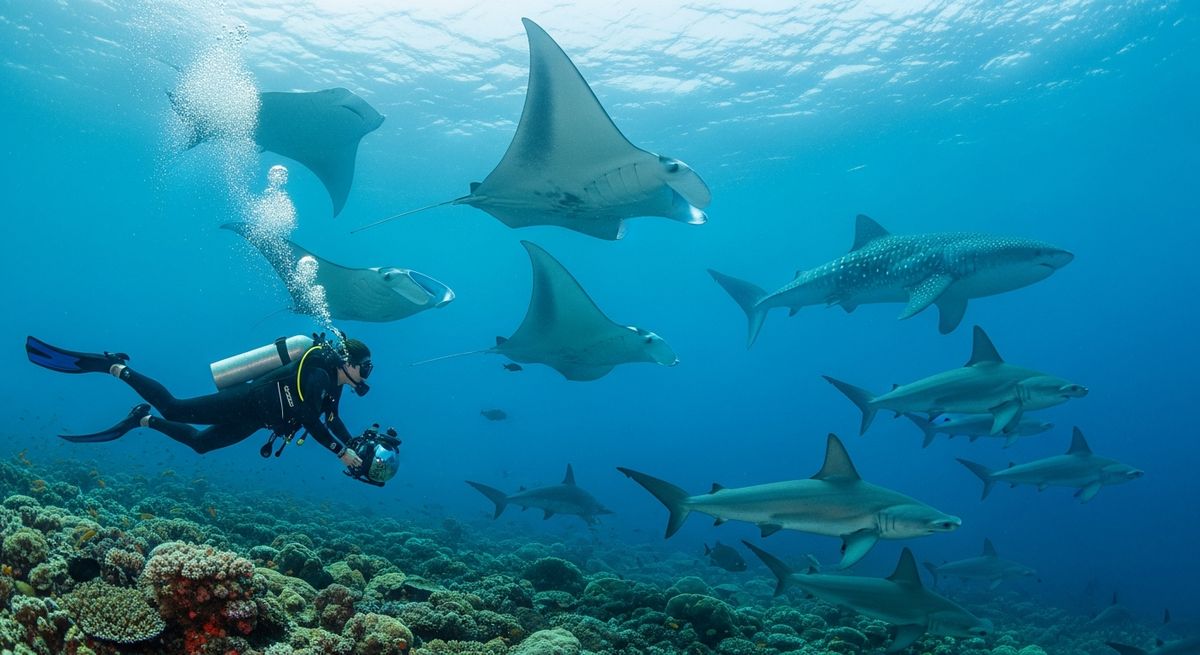
Vitawatawa Channel - Kadavu & Great Astrolabe Reef

The Vitawatawa Channel offers a good drift dive along Kadavu's southern coast. We usually drop in where the lagoon meets the open ocean, letting the current carry us past ledges of pore corals. Keep an eye out for lionfish, they're often tucked under rocky overhangs or even strutting along the wall, fins flared. It’s a pretty straightforward drift, good for a relaxed dive, especially if you enjoy watching the reef go by.

Location
Kadavu & Great Astrolabe Reef, Fiji, Central & South Pacific
Coordinates
-18.200000, 177.900000
Type
drift

Marine Protected Area: Vanua Serua

Nearby Dive Sites in Kadavu & Great Astrolabe Reef

Nearest Dive Centres to Vitawatawa Channel

Marine Life in Kadavu & Great Astrolabe Reef

Home to 385 recorded species including 289 reef fish, 66 hard corals, 12 sea snails & nudibranchs, 3 clams & mussels, 3 sharks & rays, 2 other.

Notable Species

Frequently Asked Questions

What is the typical depth range for diving in Vitawatawa Channel, and what kind of underwater topography can be expected?
The typical depth range for diving in Vitawatawa Channel is currently unknown. However, divers can expect a fascinating underwater topography characterized by a wall that forms the outside edge of the lagoon to the open ocean. This wall features ledges of pore corals and various rock protusions, providing interesting areas to explore.
What specific marine life, such as sharks, rays, or schooling fish, are commonly sighted when diving Vitawatawa Channel?
When diving in Vitawatawa Channel, divers commonly encounter the striking common lionfish, often seen displaying its spectacular, barbed pectoral fins along the wall or hidden under rock protusions. You can also expect to see blue goldbelly damsels, adding to the vibrant marine life of this site. For more information on marine species, visit our wildlife database.
How challenging are the currents and overall conditions at Vitawatawa Channel, making it suitable for which level of diver?
The Vitawatawa Channel is classified as a drift dive, indicating the presence of currents that make it an intermediate-level dive. Divers should be comfortable with drift diving techniques and have a good understanding of current management. This site is best suited for divers with some experience beyond entry-level certifications.
What is considered the best time of year or day to dive Vitawatawa Channel to experience optimal conditions and marine encounters?
The provided data does not specify the best time of year or day to dive Vitawatawa Channel for optimal conditions or marine encounters. For general information on diving seasons in Fiji, you may consult our When to Dive section.
Are there any specific diving certifications or experience levels recommended or required to safely dive Vitawatawa Channel, especially given potential strong currents?
Given that Vitawatawa Channel is an intermediate-level drift dive, it is recommended that divers have experience with currents and drift diving techniques. While no specific certification is explicitly required beyond standard open water, advanced certifications or specialized drift diving experience would be beneficial for safely navigating the conditions. Always dive within your comfort and experience level.
What are the typical current strengths and visibility levels encountered in Vitawatawa Channel, and how do they impact the dive experience?
While Vitawatawa Channel is identified as a drift dive, specific details regarding typical current strengths or visibility levels are not provided in the available data. As with any drift dive, currents will be a defining factor of the experience, influencing navigation and marine life encounters. Divers should be prepared for varying conditions inherent to drift diving.