KANAZONO MARU - Chuuk (Truk) Lagoon

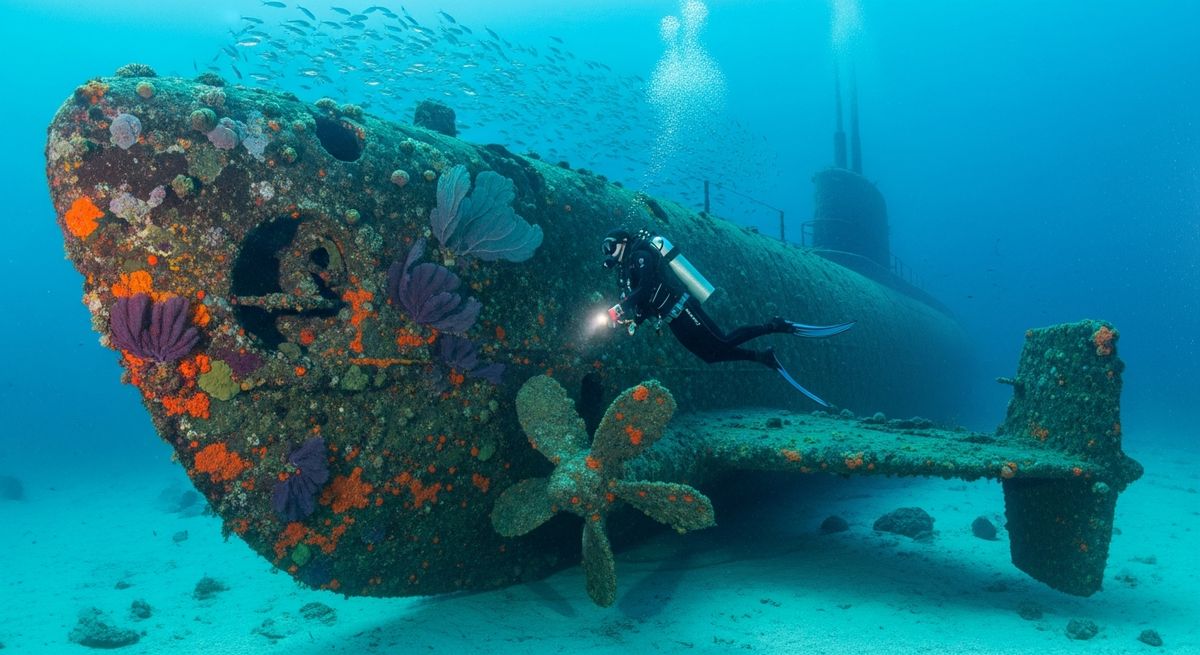
Okay, the *Kanazono Maru*. Let's be straight, this isn't a WWII wreck. She ran aground in '68, a much newer vessel, which means she’s not encrusted in the same way the Operation Hailstone wrecks are. Still, we love her for a different reason: the sheer scale of the break-up. She’s completely dismembered across the reef in fairly shallow water, offering a fantastic opportunity to really grasp the forces at play when a ship meets its end. The stern lies upright in the sand, while the bow is a crumpled mess, spilling cargo and twisted metal plates everywhere. You’ll find massive pieces of hull plating, the huge propeller shaft, and even sections of the engine room machinery scattered over a wide area. What’s really cool is how the hard corals have taken hold on the more stable sections. Look for large plate corals covering bulkheads, and schools of fusiliers darting between the mangled steel. It’s an easy, relaxed dive, perfect for photographers wanting to capture both marine life and the raw power of the ocean’s destructive force. We’d suggest going in the morning; the light penetration through the shallow water is beautiful.

Location
Chuuk (Truk) Lagoon, Micronesia, Central & South Pacific
Coordinates
8.587500, 151.359160
Type
wreck
Maximum Depth
0m

Best Time to Dive in Chuuk (Truk) Lagoon

The warmest water temperatures in Chuuk (Truk) Lagoon occur in January, averaging 28.9°C. The coolest conditions are in December at 28.9°C.

Monthly Water Temperatures

  • January: 28.9°C (air: 27.8°C)
  • February: 28.9°C (air: 27.7°C)
  • March: 28.9°C (air: 27.5°C)
  • April: 28.9°C (air: 27.5°C)
  • May: 28.9°C (air: 27.7°C)
  • June: 28.9°C (air: 27.5°C)
  • July: 28.9°C (air: 27.5°C)
  • August: 28.9°C (air: 27.7°C)
  • September: 28.9°C (air: 27.7°C)
  • October: 28.9°C (air: 27.9°C)
  • November: 28.9°C (air: 27.9°C)
  • December: 28.9°C (air: 27.9°C)

Nearby Dive Sites in Chuuk (Truk) Lagoon

Nearest Dive Centres to KANAZONO MARU

Marine Life in Chuuk (Truk) Lagoon

Home to 213 recorded species including 133 reef fish, 36 hard corals, 17 sea cucumbers, 12 sea snails & nudibranchs, 5 sharks & rays, 4 clams & mussels.

Notable Species

Recommended Packing List for KANAZONO MARU

Based on average water temperature of 28.9°C.

  • Shorty or Rashguard - warm 29°C water needs minimal exposure protection
  • Mask - essential for every dive
  • Fins
  • BCD - buoyancy compensator
  • Regulator - your most safety-critical piece of gear
  • Dive Computer - tracks depth, time, and NDL
  • Surface Marker Buoy (SMB) - essential for boat pickups
  • Dive Torch - useful for crevices and colour at depth
  • Underwater Camera - capture your diving memories

Frequently Asked Questions

What is the maximum depth of the KANAZONO MARU dive site?
The KANAZONO MARU dive site has a listed depth of 0m. This indicates that portions of this carrier vessel wreck are extremely shallow, possibly even breaking the surface. Divers can explore this fascinating wreck, which ran aground during bad weather, in very accessible conditions within Chuuk Lagoon.
What kind of marine life and artifacts can divers expect to see on the KANAZONO MARU wreck?
The KANAZONO MARU is a historic carrier vessel wreck, measuring 97.2m x 14.9m, offering a glimpse into its past as a transport ship. While specific details about marine life or artifacts are not provided in our current data, wrecks in Chuuk Lagoon are generally known for their historical significance and the marine ecosystems that develop around them. Divers can expect to explore the structure of this vessel, which was built in 1966 and sank in 1968.
How challenging is the KANAZONO MARU wreck dive, and is it suitable for intermediate divers?
The KANAZONO MARU wreck dive is classified as intermediate difficulty. This makes it a suitable and rewarding experience for divers who have some experience beyond entry-level certifications. Its accessible depth and classification as a wreck showing portions of its hull or superstructure offer an engaging exploration opportunity in Chuuk Lagoon.
What are the best months or seasons to dive the KANAZONO MARU for optimal conditions?
Our current data for the KANAZONO MARU dive site does not specify the best months or seasons for optimal diving conditions. For general information on when to dive in Chuuk Lagoon, we recommend checking our When to Dive section. This will help you plan your trip to Micronesia for the best possible experience.
What scuba diving certifications are recommended or required to dive the KANAZONO MARU?
Given the KANAZONO MARU is classified as an intermediate difficulty dive, it is recommended that divers possess certifications beyond entry-level, such as Advanced Open Water Diver or equivalent. While specific requirements can vary by dive operator, having experience with wreck diving or similar conditions would be beneficial. This ensures divers are well-prepared to explore this historic carrier vessel in Chuuk Lagoon.
What are the typical current conditions and visibility like at the KANAZONO MARU dive site?
Our available data for the KANAZONO MARU dive site does not include specific information on typical current conditions or visibility. However, Chuuk Lagoon is generally known for its calm waters and good visibility, especially around its famous wreck sites. Divers planning a trip should consult local dive operators for the most up-to-date conditions at this historic wreck.