EUGENIO TAVARES
Protected Area
RNI Ilhéus do Rombo
Why dive here
With 43+ marine species recorded in the area - including dolphins, humpback whales, orcas, sea turtles and sperm whales - EUGENIO TAVARES offers some of Santiago's richest wreck diving. Water ranges 24-29°C, warmest August, September, October.
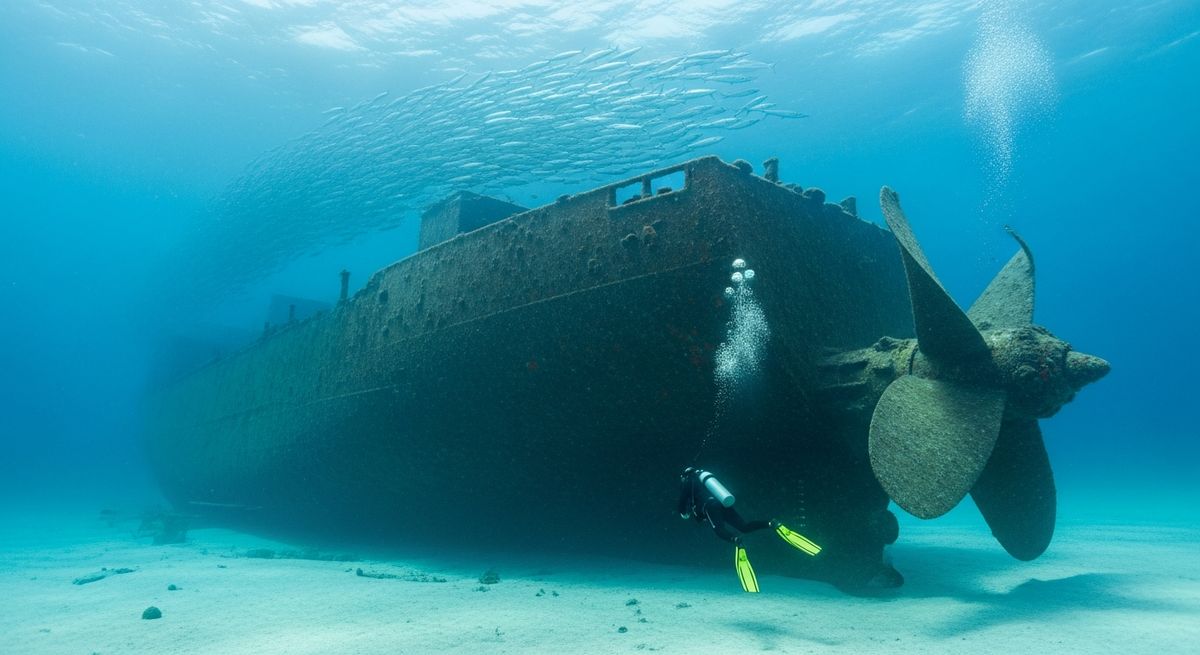
The Eugenio Tavares wreck isn't deep, topping out at 5m, but don’t let that fool you. This isn’t a quick swim-over. We love it for its story, a carrier vessel built in 1950, sunk in ’77 after a mishap while loading. She was eventually beached, leaving her bones splayed out in the shallows. What you get here is a proper shallow-water playground. Sunlight streaks through the hull sections, catching clouds of silversides that dart in and out of the rusted metal. We’ve spent whole dives just poking around the ribs and collapsed decks, noticing how the ocean has really taken over. Look closely and you’ll find moray eels tucked into crevices, their heads peeking out, and we often spot octopus camouflaged against the encrusted plating. It’s ideal for photographers who want to play with light and shadow, or divers who just enjoy a relaxed, exploratory dive without the pressure of depth. Our favourite time to visit is early morning, before any wind picks up, when the water is often glassy and the light is soft.
Typical EUGENIO TAVARES Dive Profile
Illustrative profile based on site depth and type. Actual dive profiles vary - always follow your dive computer and training.
Safety Notes
Wreck site - avoid penetration without wreck diving certification. Watch for sharp metal and entanglement hazards.
Reviews for EUGENIO TAVARES
Conditions
Ocean conditions, forecast and tides for EUGENIO TAVARES
EUGENIO TAVARES Ocean Conditions
Monthly averages for EUGENIO TAVARES, sourced from Open-Meteo marine data - nearest station: Open-Meteo marine grid (15.08, -23.79) (14km away)
October Averages
Sea Temperature
29°C
83°F · Range: 27.2–29.7°C
Air Temperature
27°C
80°F
Wind Speed
5.38 m/s
10.5 knots
Atmospheric Pressure
1013.6 hPa
Based on 4 years of monitoring data · Data sources: Open-Meteo marine data
Plan & book
Ways to dive Santiago, from day trips to liveaboards.
Day trips & courses
via GetYourGuideGuided dives, courses and snorkel trips with instant booking.
Find dive trips in SantiagoPlaces to stay
via Booking.comHotels and dive resorts near Santiago.
Search stays in SantiagoDive insurance
Most travel insurance excludes or limits scuba. Check what you need before you go.
Dive insurance explainedPartner links: we may earn a commission if you book, at no extra cost to you. How we make money
Where to Stay near EUGENIO TAVARES
Prices from Booking.com. We may earn a commission at no extra cost to you.