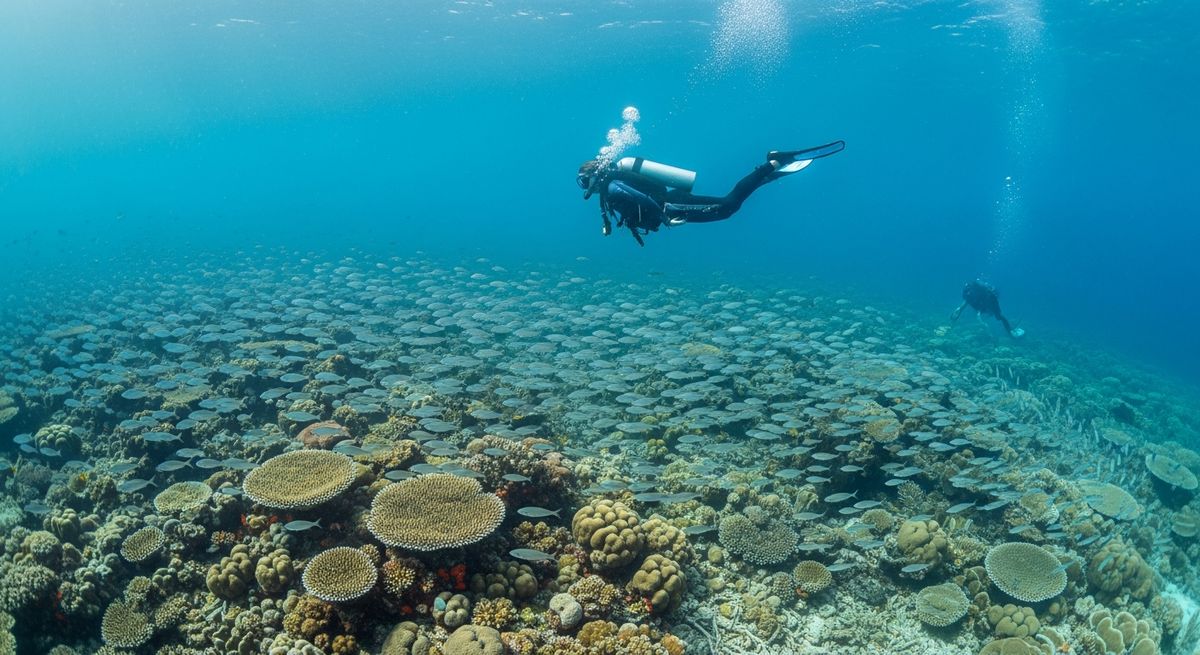
Kinasi Pass - Mafia Island

Mirlo. If you're going to dive in the Loyalty Islands, make this one a priority. We love a good channel dive, and Mirlo delivers with serious style. Forty-five minutes out into Bayes Pass, and you're dropping into a world of big fish and even bigger gorgonian fans. We’re talking about faults in the reef so wide you could drive a truck through them, lined with these ancient, purple-red giants. Keep your eyes peeled, because Mirlo is all about the pelagics. Schools of fusiliers are usually so thick they shimmer like liquid silver, parting only for the grey sharks that cruise through. We often see huge jacks and barracudas, sometimes even a tiger shark if you hit it right. The current can be brisk, which keeps the water moving and the visibility hovering around 30 metres, so it’s a site best suited for confident divers comfortable with a drift. You'll spend most of your time mesmerised by the sheer scale of the reef and the density of the schooling fish.

Location
Mafia Island, Tanzania, Indian Ocean & East Africa
Coordinates
-7.953600, 39.797100
Type
drift

Marine Protected Area: Mangrove

Best Time to Dive in Mafia Island

The warmest water temperatures in Mafia Island occur in January, averaging 28.8°C. The coolest conditions are in December at 28.8°C.

Monthly Water Temperatures

  • January: 28.8°C (air: 27.8°C)
  • February: 28.8°C (air: 28.0°C)
  • March: 28.8°C (air: 27.8°C)
  • April: 28.8°C (air: 27.0°C)
  • May: 28.8°C (air: 26.9°C)
  • June: 28.8°C (air: 26.0°C)
  • July: 28.8°C (air: 25.2°C)
  • August: 28.8°C (air: 25.0°C)
  • September: 28.8°C (air: 25.3°C)
  • October: 28.8°C (air: 26.1°C)
  • November: 28.8°C (air: 27.0°C)
  • December: 28.8°C (air: 27.7°C)

Nearby Dive Sites in Mafia Island

Nearest Dive Centres to Kinasi Pass

Marine Life in Mafia Island

Home to 165 recorded species including 94 hard corals, 63 reef fish, 3 sharks & rays, 2 jellyfish, 1 other, 1 whales & dolphins.

Notable Species

Recommended Packing List for Kinasi Pass

Based on average water temperature of 28.8°C.

  • Shorty or Rashguard - warm 29°C water needs minimal exposure protection
  • Mask - essential for every dive
  • Fins
  • BCD - buoyancy compensator
  • Regulator - your most safety-critical piece of gear
  • Dive Computer - tracks depth, time, and NDL
  • Surface Marker Buoy (SMB) - essential for boat pickups
  • Dive Torch - useful for crevices and colour at depth
  • Underwater Camera - capture your diving memories

Frequently Asked Questions

What is the maximum depth and typical visibility at Kinasi Pass dive site?
The maximum depth at Kinasi Pass is 21 meters. Divers can typically expect an average visibility of 14 meters, offering clear views of the exciting underwater topography.
What kind of marine life and underwater features can divers expect to see at Kinasi Pass?
Divers at Kinasi Pass can expect to encounter resident giant groupers, giant reef rays, barracuda, and big schools of fish. Keep an eye out for sporadic sightings of rarer creatures like eagle rays and cobia, adding to the thrill of this marine life rich site. The site itself features exciting drift through rocky topography, along with impressive caverns and rock formations, including the famous 'chicken' pinnacle.
How challenging is diving Kinasi Pass, and what level of diver is it recommended for?
Diving Kinasi Pass is considered an intermediate-level dive due to its exciting drift through rocky topography. It is recommended for divers who are comfortable with drift diving conditions.
When is the best time of year to dive Kinasi Pass for optimal conditions and marine encounters?
The provided data does not specify the best time of year for optimal conditions or marine encounters at Kinasi Pass. For general information on when to dive in the region, please consult additional resources.
Are there any specific scuba diving certifications required or highly recommended for Kinasi Pass?
While no specific certifications are explicitly required in the provided data, given that Kinasi Pass is an intermediate drift dive, a drift diving specialty certification or experience with drift diving is highly recommended. This will ensure you are comfortable and safe navigating the currents and rocky topography.
What are the typical current conditions and water temperatures experienced when diving Kinasi Pass?
Kinasi Pass is well known for its exciting drift through rocky topography, indicating that divers should expect typical current conditions associated with a drift dive. The provided data does not specify the typical water temperatures experienced at this site.