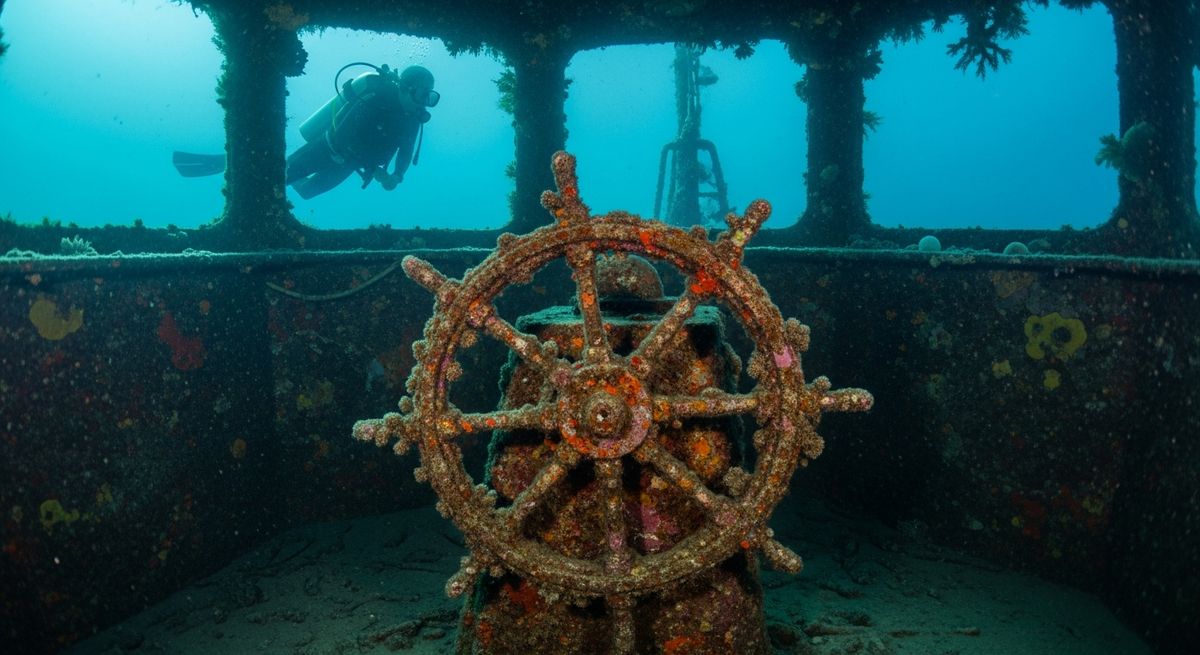
BYRON I
Protected Area
EKVOLI GEROPOTAMOU MESARAS
Why dive here
BYRON I is a wreck dive where divers can encounter sea turtles. Water ranges 17-27°C, warmest July, August, September.
We’re going to be straight with you: Byron I isn’t going to blow your mind with coral gardens. This is Crete, not the Red Sea. But if you appreciate a good wreck story, she delivers. This carrier vessel, built in Belfast in 1963, came to an ignoble end in 1985, driven ashore during a storm. Now, she rests broken, with her stern section in just four metres of water. It’s shallow, warm, and perfect for extended bottom times. We love finning over the vast decks, imagining the cargo she once carried. The sheer scale of her structure is impressive, even fragmented. Look closely in the nooks and crannies of the hull plates; damselfish flit in and out, and we’ve spotted moray eels tucked away, often in the same spot, year after year. It’s a fascinating glimpse into history, a calm dive, and a real chance to appreciate how quickly the sea reclaims its own. Head out early to avoid any day-tripper boat traffic, and take your time exploring.
Typical BYRON I Dive Profile
Illustrative profile based on site depth and type. Actual dive profiles vary - always follow your dive computer and training.
Safety Notes
Wreck site - avoid penetration without wreck diving certification. Watch for sharp metal and entanglement hazards.
BYRON I Wreck History
Year Sunk
1985
Vessel Type
cargo ship
Cause
unknown
The carrier vessel BYRON I was a product of the legendary Harland & Wolff shipyard in Belfast, the same builders responsible for the RMS Titanic. Launched in 1963, the ship served for over two decades before meeting its end in the warm waters of the Mediterranean. In January 1985, while on a passage from Gdynia, Poland, to India, the vessel was at a bunkering station off the coast of Crete when it sank. The exact circumstances of its loss remain unclear, adding a layer of mystery to its story.
Resting at an incredibly shallow depth of just 4 meters, the BYRON I is less of a deep wreck dive and more of a sun-drenched underwater playground. Its accessibility makes it a perfect site for novice divers, snorkelers, and underwater photographers. The shallow depth allows for long, relaxed bottom times and excellent light penetration, illuminating the ship's structure and the vibrant marine life that has colonized it. It's a fantastic opportunity to explore a sizeable wreck without the need for advanced certifications or deep-diving equipment.
Nearest Dive Centres to BYRON I
Dive shops near BYRON I
Mare Sud Diving Center
Phoenixdiveclub
Dive2Gether
POSEIDON DIVING CLUB
Reviews for BYRON I
Conditions
Ocean conditions, forecast and tides for BYRON I
BYRON I Ocean Conditions
Monthly averages for BYRON I, sourced from Open-Meteo marine data + Copernicus Marine (EU) - nearest station: Open-Meteo marine grid (35.42, 24.79) (35km away)
October Averages
Sea Temperature
24°C
75°F · Range: 22.3–25.7°C
Current Speed
4 cm/s
Direction: S (180°)
Chlorophyll-a
0.086 mg/m³
Very clear (oligotrophic)
Salinity
39.3 PSU
Based on 4 years of monitoring data · Data sources: Open-Meteo marine data + Copernicus Marine (EU)
Plan & book
Ways to dive Crete, from day trips to liveaboards.
Day trips & courses
via GetYourGuideGuided dives, courses and snorkel trips with instant booking.
Find dive trips in CretePlaces to stay
via Booking.comHotels and dive resorts near Crete.
Search stays in CreteDive insurance
Most travel insurance excludes or limits scuba. Check what you need before you go.
Dive insurance explainedPartner links: we may earn a commission if you book, at no extra cost to you. How we make money
Where to Stay near BYRON I
Prices from Booking.com. We may earn a commission at no extra cost to you.