BARRISTER
Protected Area
Ardmore Head SAC
Why dive here
With 185+ marine species recorded in the area - including blue sharks, dolphins, dwarf minke whales, humpback whales and ocean sunfish (mola mola) - BARRISTER offers some of South Coast's richest wreck diving. Water ranges 9-15°C, warmest July, August, September.
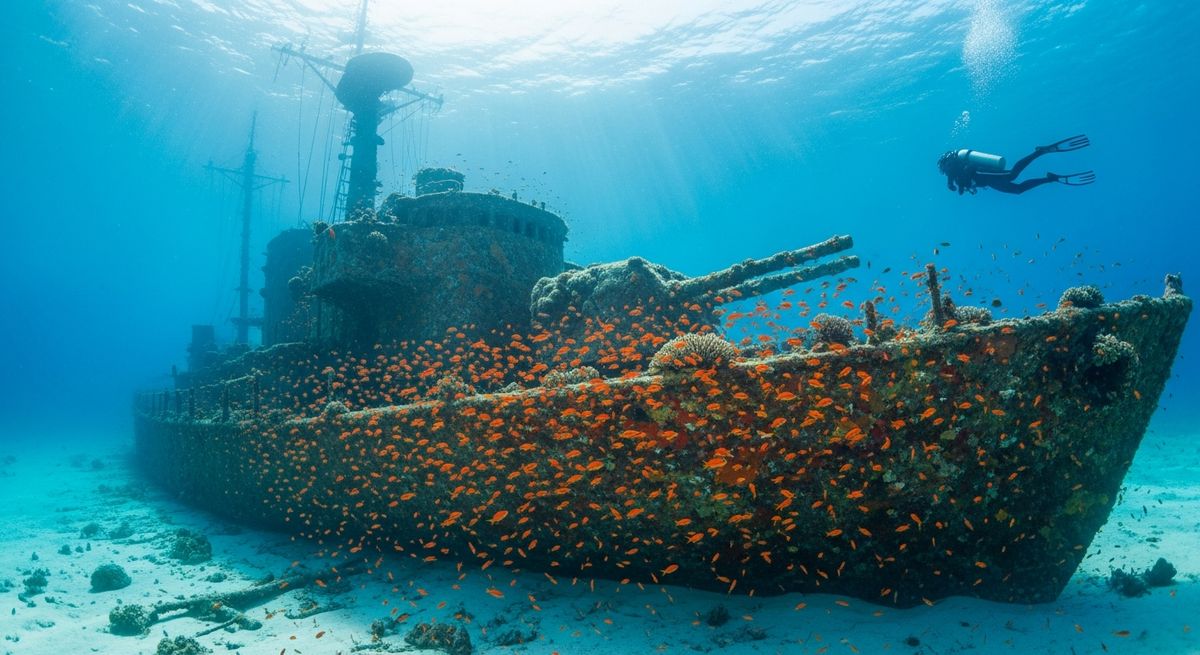
Diving the *Barrister* is like dropping into a moment frozen in time. She was a steamship, sunk by a U-boat in 1917, and even now, you can feel that history. We love the way the wreck lies, upright and mostly intact, at a manageable 19 metres. It makes for an easy dive, letting you really soak in the details. The sheer scale of her is impressive, at 77 metres long. We particularly enjoy poking around the bow section, where the anchor chains spill out into the sand, and the stern, looking for the massive propeller shaft. Schools of pollock often swirl through the open holds, and we've seen conger eels peering out from gaps in the plating. Look closely at the boilers – they’re huge, and often home to crabs tucked into every crevice. Visibility here can be decent, especially on an incoming tide, giving you that classic wreck dive atmosphere. It’s a site that tells a story, perfect for divers who appreciate maritime history and a good, solid wreck to explore.
Typical BARRISTER Dive Profile
Illustrative profile based on site depth and type. Actual dive profiles vary - always follow your dive computer and training.
Safety Notes
Depth of 19m - Advanced Open Water certification recommended.
Wreck site - avoid penetration without wreck diving certification. Watch for sharp metal and entanglement hazards.
Cold water this month (avg 14°C). Drysuit or thick wetsuit (7mm+) recommended.
Always perform a 3-minute safety stop at 5m before surfacing.
BARRISTER Wreck History
Year Sunk
1917
Vessel Type
cargo ship
Cause
torpedo
The SS Barrister was a steamship built for the Charente Steamship Company, more famously known as the Harrison Line. Launched in 1915 in Glasgow, she entered service during the height of the First World War. Her career was short-lived; on May 11, 1917, while sailing off the southern coast of Ireland, she was attacked and sunk by a German U-boat, a common fate for merchant vessels of the era.
Today, the Barrister lies at a very accessible depth of 19 metres, making her an excellent dive for a wide range of skill levels. The wreck is well-broken due to the passage of time and its relatively shallow location, but key features like her three boilers and triple-expansion engine are still identifiable. Exploring the scattered remains provides a fascinating insight into the construction of early 20th-century steamships and serves as a tangible connection to Ireland's wartime maritime history.
Reviews for BARRISTER
Conditions
Ocean conditions, forecast and tides for BARRISTER
BARRISTER Ocean Conditions
Monthly averages for BARRISTER, sourced from Open-Meteo marine data - nearest station: Open-Meteo marine grid (51.71, -8.38) (9km away)
October Averages
Sea Temperature
14°C
57°F · Range: 12.3–14.8°C
Air Temperature
12°C
54°F
Wind Speed
7.84 m/s
15.2 knots
Atmospheric Pressure
1008.6 hPa
Based on 4 years of monitoring data · Data sources: Open-Meteo marine data
Plan & book
Ways to dive South Coast, from day trips to liveaboards.
Day trips & courses
via GetYourGuideGuided dives, courses and snorkel trips with instant booking.
Find dive trips in South CoastPlaces to stay
via Booking.comHotels and dive resorts near South Coast.
Search stays in South CoastDive insurance
Most travel insurance excludes or limits scuba. Check what you need before you go.
Dive insurance explainedPartner links: we may earn a commission if you book, at no extra cost to you. How we make money
Where to Stay near BARRISTER
Prices from Booking.com. We may earn a commission at no extra cost to you.