BETELGEUSE
Protected Area
Glengarriff Harbour and Woodland SAC
Why dive here
With 185+ marine species recorded in the area - including blue sharks, dolphins, dwarf minke whales, humpback whales and ocean sunfish (mola mola) - BETELGEUSE offers some of South Coast's richest wreck diving. Water ranges 9-15°C, warmest July, August, September.
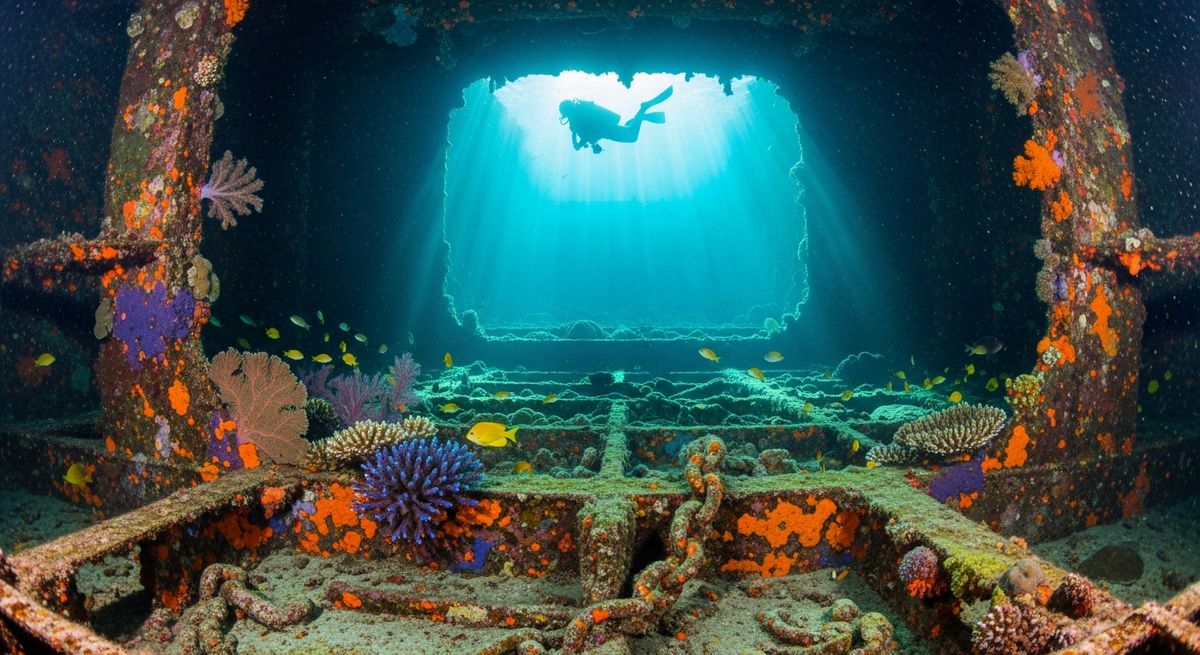
The Betelgeuse is a grim reminder of maritime tragedy, but for us, it's also one of Ireland's most compelling wreck dives. Lying at 30 metres, she’s a huge, broken tanker, utterly mangled by the explosion that sank her in 1979. We love the sheer scale of the devastation here. Bow and stern sections are largely intact, but the midships are a twisted mess of steel plates, pipes, and machinery. It feels eerie, moving through the contorted metal, especially when the visibility drops and the light struggles to penetrate. This isn't a rummage-through-the-holds kind of wreck; it's about appreciating the raw power of the incident. Shoals of pollock drift lazily through the larger openings, and conger eels peer out from behind crumpled bulkheads. The sheer size means you'll need multiple dives to even begin to get a feel for it. We’d suggest focusing on the stern section first, where the rudder and propeller are often visible, then working your way towards the chaos of the middle. It’s a serious dive, suited to experienced wreck divers comfortable with deep water and potentially variable conditions. The Betelgeuse demands respect, and she rewards it with an experience you won't easily forget.
Typical BETELGEUSE Dive Profile
Illustrative profile based on site depth and type. Actual dive profiles vary - always follow your dive computer and training.
Safety Notes
Depth of 30m - Advanced Open Water certification recommended.
Wreck site - avoid penetration without wreck diving certification. Watch for sharp metal and entanglement hazards.
Cold water this month (avg 14°C). Drysuit or thick wetsuit (7mm+) recommended.
Always perform a 3-minute safety stop at 5m before surfacing.
BETELGEUSE Wreck History
Year Sunk
1979
Vessel Type
tanker
Cause
fire
The story of the French oil tanker Betelgeuse is one of the most tragic in modern Irish maritime history. On January 8, 1979, while discharging a cargo of crude oil at the Whiddy Island terminal in Bantry Bay, the vessel was torn apart by a catastrophic series of explosions and a subsequent fire. The disaster claimed the lives of all 42 French crew members, seven Irish terminal workers, and one British national. The force of the blast was immense, breaking the 61,000-ton tanker's back and scattering wreckage across the seabed.
Today, the remains of the Betelgeuse lie in approximately 30 meters of water, serving as a somber memorial to those who perished. Diving on the wreck is a poignant experience, revealing a vast and twisted debris field rather than an intact ship. The sheer scale of the destruction is humbling. Divers can explore sections of the hull, tangled pipework, and massive pieces of superstructure. The site is a challenging dive due to depth and potential currents, but for experienced divers, it offers a powerful glimpse into the aftermath of a major disaster and stands as a significant, if solemn, piece of Irish history.
Nearest Dive Centres to BETELGEUSE
Dive shops near BETELGEUSE
View all dive centres in South CoastReviews for BETELGEUSE
Conditions
Ocean conditions, forecast and tides for BETELGEUSE
BETELGEUSE Ocean Conditions
Monthly averages for BETELGEUSE, sourced from Open-Meteo marine data - nearest station: Open-Meteo marine grid (51.71, -8.38) (9km away)
October Averages
Sea Temperature
14°C
57°F · Range: 12.3–14.8°C
Air Temperature
12°C
54°F
Wind Speed
7.84 m/s
15.2 knots
Atmospheric Pressure
1008.6 hPa
Based on 4 years of monitoring data · Data sources: Open-Meteo marine data
Plan & book
Ways to dive South Coast, from day trips to liveaboards.
Day trips & courses
via GetYourGuideGuided dives, courses and snorkel trips with instant booking.
Find dive trips in South CoastPlaces to stay
via Booking.comHotels and dive resorts near South Coast.
Search stays in South CoastDive insurance
Most travel insurance excludes or limits scuba. Check what you need before you go.
Dive insurance explainedPartner links: we may earn a commission if you book, at no extra cost to you. How we make money
Where to Stay near BETELGEUSE
Prices from Booking.com. We may earn a commission at no extra cost to you.