CRETEBOOM - West Coast

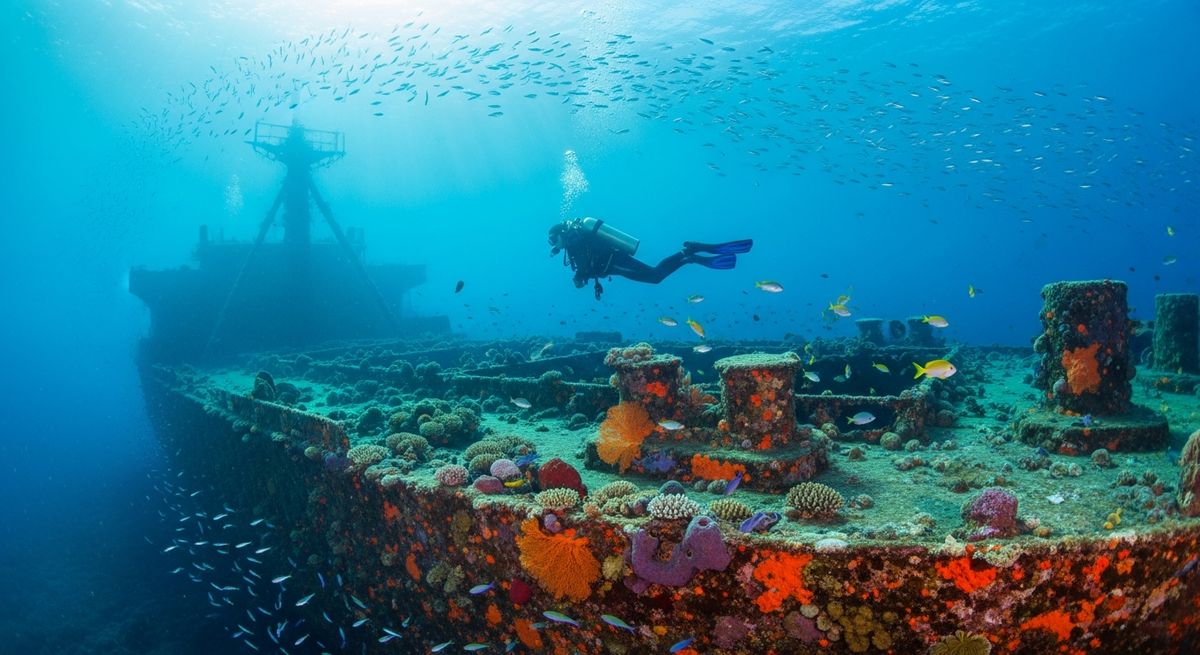
The Creteboom is a fascinating piece of history, and we love how unique it is. This isn't your typical steel wreck; she was built in 1919 using ferroconcrete, a response to the steel shortages of the time. You really feel that odd, almost stone-like texture as you run your hand along her hull. She’s a tug, 38 metres long, lying broken but still clearly defined on the seabed. The bow section is the most intact, with a clear outline of where the wheelhouse once stood. We’ve found wolfish lurking in the shadowy nooks of the engine room – keep an eye out for their grumpy faces. Conger eels are often coiled in the darker corners, and the concrete surfaces are now carpeted with dead man's fingers and anemones, which glow softly in your torch beam. Visibility here can be temperamental, as is common on the West Coast, so picking a calm day with minimal swell is key for the best experience. We’d suggest diving this one on a slack tide to properly explore the structure and appreciate its unusual construction. It’s a cracker for those who appreciate maritime history and something a little bit different.

Location
West Coast, Ireland, Mediterranean & Europe
Coordinates
54.135860, -9.138166
Type
wreck
Maximum Depth
0m

Marine Protected Area: Killala Bay/Moy Estuary SAC

Best Time to Dive in West Coast

The warmest water temperatures in West Coast occur in January, averaging 8.9°C. The coolest conditions are in December at 8.9°C.

Monthly Water Temperatures

  • January: 8.9°C (air: 7.2°C)
  • February: 8.9°C (air: 8.0°C)
  • March: 8.9°C (air: 8.0°C)
  • April: 8.9°C (air: 9.8°C)
  • May: 8.9°C (air: 12.0°C)
  • June: 8.9°C (air: 14.2°C)
  • July: 8.9°C (air: 15.2°C)
  • August: 8.9°C (air: 15.9°C)
  • September: 8.9°C (air: 14.8°C)
  • October: 8.9°C (air: 12.4°C)
  • November: 8.9°C (air: 10.3°C)
  • December: 8.9°C (air: 8.1°C)

Nearby Dive Sites in West Coast

Nearest Dive Centres to CRETEBOOM

Marine Life in West Coast

Home to 183 recorded species including 86 reef fish, 20 sharks & rays, 15 whales & dolphins, 12 other, 10 seagrass & algae, 8 crabs & lobsters.

Notable Species

  • dogfish (Scyliorhinus canicula) - Sharks & Rays
  • Haddock (Melanogrammus aeglefinus) - Reef Fish
  • hake (Merluccius merluccius) - Reef Fish
  • grey gurnard (Eutrigla gurnardus) - Reef Fish
  • whiting (Merlangius merlangus) - Reef Fish
  • Split (Scomber scombrus) - Reef Fish
  • megrim (Lepidorhombus whiffiagonis) - Reef Fish
  • Pollock (Trachurus trachurus) - Reef Fish
  • Common dragonet (Callionymus lyra) - Reef Fish
  • poor cod (Trisopterus minutus) - Reef Fish
  • blue whiting (Micromesistius poutassou) - Reef Fish
  • Boarfish (Capros aper) - Reef Fish
  • Protestant (Clupea harengus) - Reef Fish
  • lesser argentine (Argentina sphyraena) - Reef Fish
  • Soldier (Chelidonichthys cuculus) - Reef Fish
  • Angler (Lophius piscatorius) - Reef Fish
  • dab (Limanda limanda) - Reef Fish
  • Cape Shark (Squalus acanthias) - Sharks & Rays
  • sprat (Sprattus sprattus) - Reef Fish
  • Bastard Sole (Microchirus variegatus) - Reef Fish

Recommended Packing List for CRETEBOOM

Based on average water temperature of 8.9°C.

  • Drysuit - water at 9°C demands a drysuit with thermal undergarments
  • Hood & Gloves (7mm+) - critical to prevent heat loss
  • Mask - essential for every dive
  • Fins
  • BCD - buoyancy compensator
  • Regulator - your most safety-critical piece of gear
  • Dive Computer - tracks depth, time, and NDL
  • Surface Marker Buoy (SMB) - essential for boat pickups
  • Dive Torch - useful for crevices and colour at depth
  • Underwater Camera - capture your diving memories

Frequently Asked Questions

What is the maximum depth for diving the SS Crete Boom wreck in the River Moy?
The SS Crete Boom wreck is listed with a depth of 0m. This indicates the wreck is either at the surface, partially exposed, or in extremely shallow water, making it accessible for exploration without significant depth considerations. For more details on this unique site, visit the SS Crete Boom dive site page.
What kind of marine life and features can divers expect to see when exploring the SS Crete Boom?
Divers exploring the SS Crete Boom can expect to encounter the remains of a unique ferroconcrete tug vessel, measuring 38.1m x 8.2m. Sunk on September 22, 1937, this wreck is classified as showing a portion of its hull or superstructure. While specific marine life is not detailed in the available data, the wreck itself provides an interesting historical structure to explore.
How challenging is diving the SS Crete Boom wreck, and is it suitable for beginner divers?
Diving the SS Crete Boom is classified as having an intermediate difficulty. This suggests that while it may not present extreme challenges, it is generally not recommended for absolute beginner divers. Divers should possess appropriate experience and skills for intermediate wreck diving.
What are the best times of year to dive the SS Crete Boom for optimal conditions?
Information regarding the best times of year to dive the SS Crete Boom for optimal conditions is not available in the provided data. Factors such as visibility, water temperature, and currents can vary seasonally. For general guidance on dive planning, you might consult our When to Dive resource.
What scuba diving certifications are required to dive the SS Crete Boom wreck?
While specific certification requirements are not explicitly stated for the SS Crete Boom, its classification as an intermediate difficulty dive implies that divers should hold certifications appropriate for such conditions. This typically means having advanced open water certification or specialized wreck diving training. Always ensure you are adequately trained and experienced for the dive conditions.
What are the typical current and water conditions like at the SS Crete Boom dive site in the River Moy?
Details regarding the typical current and water conditions at the SS Crete Boom dive site are not provided in the available data. Divers should always check local conditions and forecasts before planning their dive.