ELEFTHERIOS M TRICOGLU - West Coast

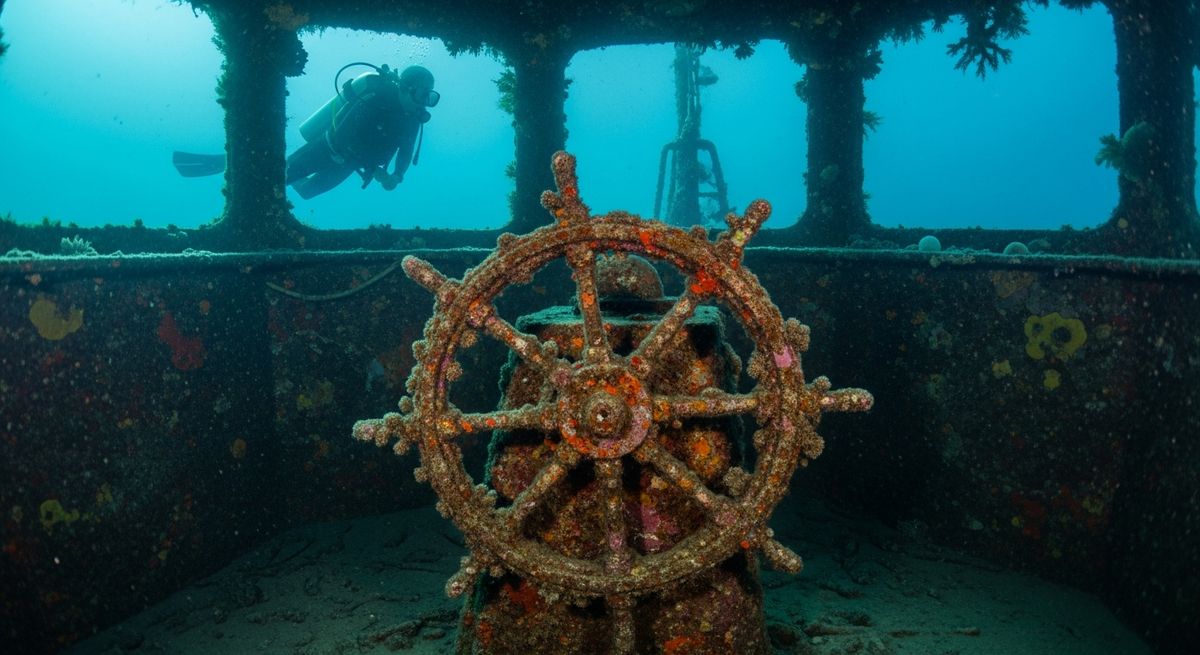
The Eleftherios M Tricoglu wreck is a genuine piece of history, and we love diving it. This isn't a deep dive, sitting in just four metres of water off Aranmore Island, but it’s packed with atmosphere. Built in 1894, this steamship met its end in a fierce storm in 1926, and you can still feel that drama when you're exploring its remains. What makes it special for us is the sheer scale of the wreck for such a shallow dive. Its 92-metre length stretches out, a ghostly spine in the clear Irish water. You'll see parts of the masts still standing proud, like skeletal fingers reaching for the surface. The bow and stern sections are distinct, offering fantastic swim-throughs where schools of small fish dart in and out of the corroded metal. We've found conger eels tucked into the darker recesses, and the whole structure is carpeted in colourful anemones and sponges. Visibility can be excellent on a calm day, and the ambient light filtering through the shallow water makes for some beautiful photography. This is a perfect site for newer wreck divers or anyone who appreciates a historical wreck that you can truly immerse yourself in without depth limitations. Go at high tide for the best visibility and less surge.

Location
West Coast, Ireland, Mediterranean & Europe
Coordinates
54.988335, -8.492666
Type
wreck
Maximum Depth
4m

Marine Protected Area: Rutland Island and Sound SAC

Best Time to Dive in West Coast

The warmest water temperatures in West Coast occur in January, averaging 8.9°C. The coolest conditions are in December at 8.9°C.

Monthly Water Temperatures

  • January: 8.9°C (air: 7.2°C)
  • February: 8.9°C (air: 8.0°C)
  • March: 8.9°C (air: 8.0°C)
  • April: 8.9°C (air: 9.8°C)
  • May: 8.9°C (air: 12.0°C)
  • June: 8.9°C (air: 14.2°C)
  • July: 8.9°C (air: 15.2°C)
  • August: 8.9°C (air: 15.9°C)
  • September: 8.9°C (air: 14.8°C)
  • October: 8.9°C (air: 12.4°C)
  • November: 8.9°C (air: 10.3°C)
  • December: 8.9°C (air: 8.1°C)

Nearby Dive Sites in West Coast

Nearest Dive Centres to ELEFTHERIOS M TRICOGLU

Marine Life in West Coast

Home to 183 recorded species including 86 reef fish, 20 sharks & rays, 15 whales & dolphins, 12 other, 10 seagrass & algae, 8 crabs & lobsters.

Notable Species

  • dogfish (Scyliorhinus canicula) - Sharks & Rays
  • Haddock (Melanogrammus aeglefinus) - Reef Fish
  • hake (Merluccius merluccius) - Reef Fish
  • grey gurnard (Eutrigla gurnardus) - Reef Fish
  • whiting (Merlangius merlangus) - Reef Fish
  • Split (Scomber scombrus) - Reef Fish
  • megrim (Lepidorhombus whiffiagonis) - Reef Fish
  • Pollock (Trachurus trachurus) - Reef Fish
  • Common dragonet (Callionymus lyra) - Reef Fish
  • poor cod (Trisopterus minutus) - Reef Fish
  • blue whiting (Micromesistius poutassou) - Reef Fish
  • Boarfish (Capros aper) - Reef Fish
  • Protestant (Clupea harengus) - Reef Fish
  • lesser argentine (Argentina sphyraena) - Reef Fish
  • Soldier (Chelidonichthys cuculus) - Reef Fish
  • Angler (Lophius piscatorius) - Reef Fish
  • dab (Limanda limanda) - Reef Fish
  • Cape Shark (Squalus acanthias) - Sharks & Rays
  • sprat (Sprattus sprattus) - Reef Fish
  • Bastard Sole (Microchirus variegatus) - Reef Fish

Recommended Packing List for ELEFTHERIOS M TRICOGLU

Based on average water temperature of 8.9°C.

  • Drysuit - water at 9°C demands a drysuit with thermal undergarments
  • Hood & Gloves (7mm+) - critical to prevent heat loss
  • Mask - essential for every dive
  • Fins
  • BCD - buoyancy compensator
  • Regulator - your most safety-critical piece of gear
  • Dive Computer - tracks depth, time, and NDL
  • Surface Marker Buoy (SMB) - essential for boat pickups
  • Dive Torch - useful for crevices and colour at depth
  • Underwater Camera - capture your diving memories

Frequently Asked Questions

What is the maximum depth of the ELEFTHERIOS M TRICOGLU shipwreck dive site?
The ELEFTHERIOS M TRICOGLU shipwreck dive site has a maximum depth of 4 meters. This relatively shallow depth makes it accessible for many divers, offering a unique opportunity to explore a historical wreck. You can find more details about this specific wreck at ELEFTHERIOS M TRICOGLU.
What kind of marine life and wreck features can divers expect to see at the ELEFTHERIOS M TRICOGLU dive site?
Divers exploring the ELEFTHERIOS M TRICOGLU shipwreck can expect to see the remains of a steam ship vessel, which was built in 1894 and sank in 1926. Notably, the wreck is classified as showing mast/masts, indicating prominent structural features still visible. While specific marine life is not detailed in the provided information, wrecks often become artificial reefs attracting various species over time.
How difficult is the ELEFTHERIOS M TRICOGLU shipwreck to dive, and is it suitable for beginners?
The ELEFTHERIOS M TRICOGLU shipwreck is classified as having an intermediate difficulty level for diving. Due to this rating, it may not be suitable for absolute beginners without appropriate supervision or prior experience with similar conditions. Divers should ensure they have the necessary skills and certifications for intermediate wreck dives before planning their visit.
What are the best times of year or conditions to dive the ELEFTHERIOS M TRICOGLU shipwreck for optimal visibility and experience?
The provided data does not specify the best times of year or optimal conditions for diving the ELEFTHERIOS M TRICOGLU shipwreck to ensure optimal visibility and experience. For general guidance on planning your dives, you might consult our When to Dive section. However, checking local conditions for Ireland's West Coast with local dive operators is always recommended.
What scuba diving certifications are required to dive the ELEFTHERIOS M TRICOGLU shipwreck?
Given the ELEFTHERIOS M TRICOGLU shipwreck is rated as an intermediate dive, divers would typically need at least an Advanced Open Water certification or equivalent, along with specialized wreck diving training, depending on the specific nature of the dive. Always consult with local dive operators in Ireland for precise certification requirements and any specific prerequisites for this site.
What are the typical current and visibility conditions at the ELEFTHERIOS M TRICOGLU dive site?
The provided data does not include specific information regarding the typical current and visibility conditions at the ELEFTHERIOS M TRICOGLU dive site. Divers planning to visit this wreck should consult local dive centers or resources for up-to-date reports on environmental factors before their dive. Understanding these conditions is crucial for a safe and enjoyable experience.