HMS RACOON - West Coast

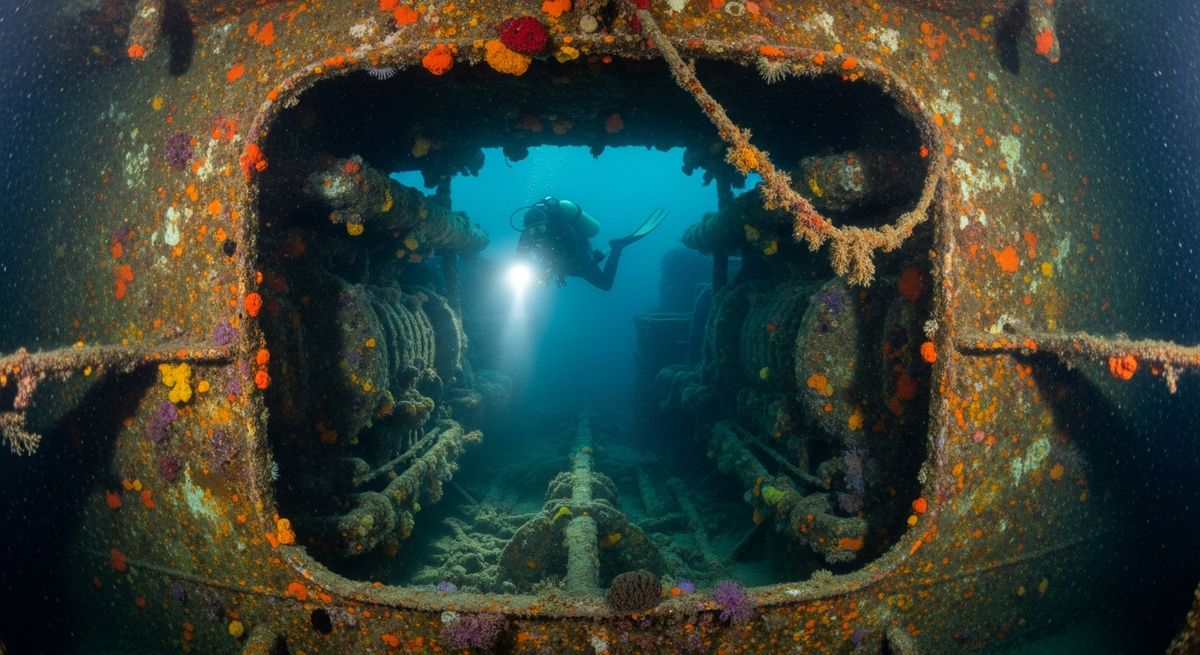
The HMS Racoon sits deep on the seabed off the West Coast of Ireland, a stark reminder of a brutal January storm in 1918. We’ve always found deep wrecks in these parts to be particularly atmospheric, and this destroyer is no exception. Lying mostly intact at 43 metres, she’s a dive for those comfortable with depth and perhaps a bit of current – conditions here can shift quickly. What makes the Racoon stand out for us isn't just her history, but the way she's become part of the seabed. As you descend, the visibility can range from a crisp 15 metres to a murkier 5 metres, lending a real sense of exploration. We’ve finned past the gun mounts, now encrusted with colourful anemones, and peered into the gaping engine room, where you might spot a ling lurking in the shadows. Look closely at the superstructure; you’ll see the intricate work of hundreds of small cup corals. The prop shafts are still there, a massive feature on the stern, and often shrouded by schools of pollack. This isn’t a penetration dive for us, more a chance to appreciate a piece of naval history reclaimed by the Atlantic. It's a sombre, beautiful dive, best suited for experienced cold-water wreck enthusiasts who appreciate the quiet power of a deep, historical site.

Location
West Coast, Ireland, Mediterranean & Europe
Coordinates
54.333332, -9.500000
Type
wreck
Maximum Depth
43m

Marine Protected Area: Illanmaster SPA

Best Time to Dive in West Coast

The warmest water temperatures in West Coast occur in January, averaging 8.9°C. The coolest conditions are in December at 8.9°C.

Monthly Water Temperatures

  • January: 8.9°C (air: 7.2°C)
  • February: 8.9°C (air: 8.0°C)
  • March: 8.9°C (air: 8.0°C)
  • April: 8.9°C (air: 9.8°C)
  • May: 8.9°C (air: 12.0°C)
  • June: 8.9°C (air: 14.2°C)
  • July: 8.9°C (air: 15.2°C)
  • August: 8.9°C (air: 15.9°C)
  • September: 8.9°C (air: 14.8°C)
  • October: 8.9°C (air: 12.4°C)
  • November: 8.9°C (air: 10.3°C)
  • December: 8.9°C (air: 8.1°C)

Nearby Dive Sites in West Coast

Nearest Dive Centres to HMS RACOON

Marine Life in West Coast

Home to 183 recorded species including 86 reef fish, 20 sharks & rays, 15 whales & dolphins, 12 other, 10 seagrass & algae, 8 crabs & lobsters.

Notable Species

  • dogfish (Scyliorhinus canicula) - Sharks & Rays
  • Haddock (Melanogrammus aeglefinus) - Reef Fish
  • hake (Merluccius merluccius) - Reef Fish
  • grey gurnard (Eutrigla gurnardus) - Reef Fish
  • whiting (Merlangius merlangus) - Reef Fish
  • Split (Scomber scombrus) - Reef Fish
  • megrim (Lepidorhombus whiffiagonis) - Reef Fish
  • Pollock (Trachurus trachurus) - Reef Fish
  • Common dragonet (Callionymus lyra) - Reef Fish
  • poor cod (Trisopterus minutus) - Reef Fish
  • blue whiting (Micromesistius poutassou) - Reef Fish
  • Boarfish (Capros aper) - Reef Fish
  • Protestant (Clupea harengus) - Reef Fish
  • lesser argentine (Argentina sphyraena) - Reef Fish
  • Soldier (Chelidonichthys cuculus) - Reef Fish
  • Angler (Lophius piscatorius) - Reef Fish
  • dab (Limanda limanda) - Reef Fish
  • Cape Shark (Squalus acanthias) - Sharks & Rays
  • sprat (Sprattus sprattus) - Reef Fish
  • Bastard Sole (Microchirus variegatus) - Reef Fish

Recommended Packing List for HMS RACOON

Based on average water temperature of 8.9°C.

  • Drysuit - water at 9°C demands a drysuit with thermal undergarments
  • Hood & Gloves (7mm+) - critical to prevent heat loss
  • Mask - essential for every dive
  • Fins
  • BCD - buoyancy compensator
  • Regulator - your most safety-critical piece of gear
  • Dive Computer - tracks depth, time, and NDL
  • Surface Marker Buoy (SMB) - essential for boat pickups
  • Dive Torch - useful for crevices and colour at depth
  • Underwater Camera - capture your diving memories

Frequently Asked Questions

What is the maximum depth of the HMS Racoon wreck dive?
The maximum depth for diving the HMS Racoon wreck is 43 meters. This makes it a significant deep dive, suitable for divers with appropriate training and experience.
What kind of marine life and wreck features can divers expect to see on the HMS Racoon?
The HMS Racoon is a destroyer vessel, built in 1910, measuring 81.1m x 8.5m. Divers can expect to explore its significant wreck features, including the structure of a large destroyer and its powerful steam turbine engines with twin shafts. While specific marine life isn't detailed in the provided context, wrecks often become artificial reefs, attracting various species over time. For more general information on marine life, visit our wildlife database.
How challenging is diving the HMS Racoon wreck, considering its location and conditions?
Diving the HMS Racoon wreck is classified as an intermediate difficulty dive. Its maximum depth of 43 meters requires divers to have advanced training and experience in deep diving and wreck penetration techniques. Divers should be prepared for potential challenges associated with deeper dives in the West Coast of Ireland.
When is the best time of year to dive the HMS Racoon wreck, and what are the tidal considerations?
The provided data does not specify the best time of year to dive the HMS Racoon wreck or any specific tidal considerations. For general guidance on seasonal diving conditions, you might consult our when to dive section. We recommend checking local dive operator information for current conditions and optimal diving periods in the Ireland region.
What diving certifications are typically required to dive the HMS Racoon wreck?
Given the HMS Racoon wreck's intermediate difficulty and maximum depth of 43 meters, divers would typically need certifications such as Advanced Open Water Diver, Deep Diver, and potentially Wreck Diver specialties. These certifications ensure divers have the necessary skills and experience to safely explore such a deep and complex wreck. Always consult with local dive centers for specific requirements.
What are the typical underwater currents and visibility like at the HMS Racoon dive site?
The provided data does not include specific information regarding typical underwater currents or visibility conditions at the HMS Racoon dive site. Conditions can vary significantly based on weather and local marine factors. It is always advisable to check with local dive operators in the West Coast of Ireland for up-to-date reports on currents and visibility before planning your dive.