ALBATROS
Protected Area
Reserva Marina de Levante de Mallorca-Cala Ratjada
Why dive here
With 148+ marine species recorded in the area - including dolphins, octopuses, sea turtles, sperm whales and cuttlefish - ALBATROS offers some of Balearic Islands's richest wreck diving. Water ranges 15-29°C, warmest July, August, September.
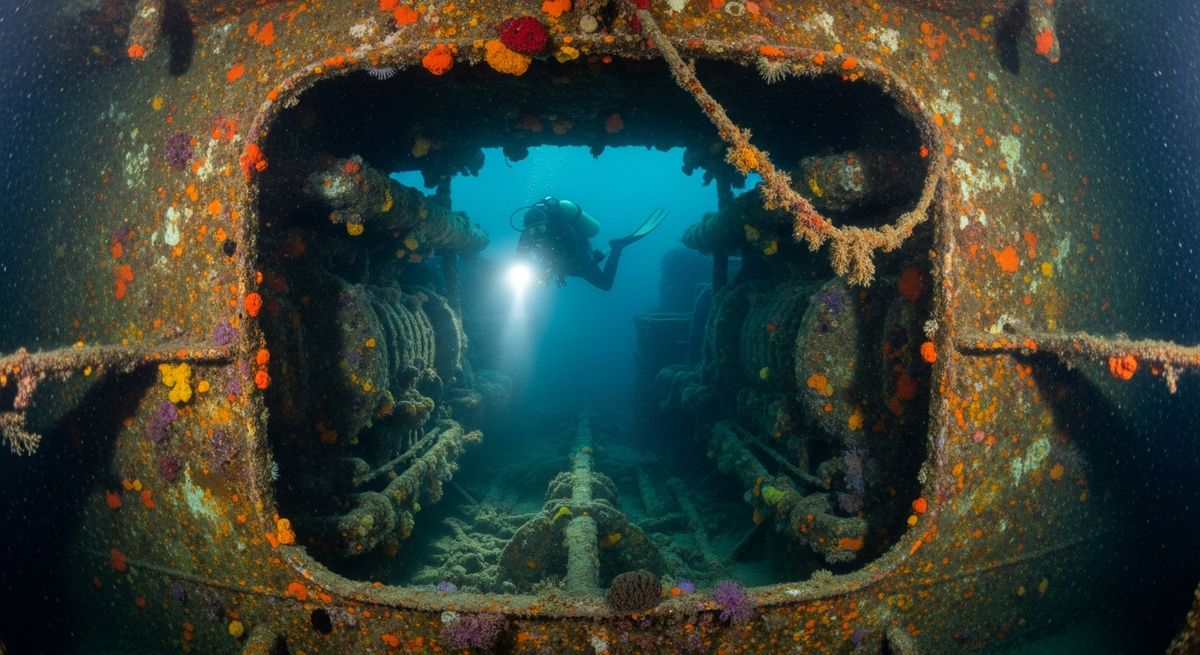
The Albatros, now that's a wreck with a story, even if it’s a bit of a tragedy. This old steamship, 89 metres long, ran aground in '69. You find it sitting upright at a comfortable 10 metres, which makes it perfect for a long, relaxed dive. We love that you can spend ages just cruising over the deck, peeking into what's left of the superstructure. What really gets us about the Albatros is the light. Even on an overcast day, the sun finds its way through the water, illuminating patches of the hull. You'll often see schools of sea bream drifting through the shadows, and we've spotted some impressively sized moray eels tucked away in the darker corners of the engine room. It’s not a site for big pelagics, but the sheer scale of the wreck, so shallow, means you feel like you’re exploring history rather than just observing it. Our favourite part? The bow, where the chain still stretches out, slowly being claimed by the Mediterranean. It’s a gentle dive, suited for anyone who loves wrecks without the pressure of deep water or strong currents.
Typical ALBATROS Dive Profile
Illustrative profile based on site depth and type. Actual dive profiles vary - always follow your dive computer and training.
Safety Notes
Wreck site - avoid penetration without wreck diving certification. Watch for sharp metal and entanglement hazards.
ALBATROS Wreck History
Year Sunk
1969
Vessel Type
cargo ship
Cause
grounding
Built in Norway in 1950, the SS Albatros served as a reliable steamship for nearly two decades. In the autumn of 1969, under the ownership of Garibship Nav Ltd., she embarked on what would be her final voyage, a passage from the bustling port of Barcelona, destined for Constantza on the Black Sea.
On October 25, 1969, her journey was cut short in the waters of the Balearic Islands. The vessel ran hard aground on a rocky seabed, sustaining fatal damage that sent her to the bottom. Today, the Albatros rests in a mere 10 meters of water, making it a spectacular and accessible wreck dive. Its shallow depth allows for long bottom times and bathes the wreckage in natural light, revealing a structure that has become a thriving artificial reef, teeming with Mediterranean marine life. It's a perfect site for novice wreck divers and underwater photographers alike.
Nearest Dive Centres to ALBATROS
Dive shops near ALBATROS
Mero Diving
Skualo
Dive & Fun Font de sa Cala
Dive & Fun Font de Sa Cala
Albatros Diving
Can Pep Thomàs
Reviews for ALBATROS
Conditions
Ocean conditions, forecast and tides for ALBATROS
ALBATROS Ocean Conditions
Monthly averages for ALBATROS, sourced from Open-Meteo marine data + Copernicus Marine (EU) - nearest station: Open-Meteo marine grid (39.52, 2.73) (12km away)
October Averages
Sea Temperature
24°C
75°F · Range: 21.3–25.9°C
Current Speed
26.93 cm/s
Direction: NE (31.3°)
Chlorophyll-a
0.141 mg/m³
Clear water
Salinity
37 PSU
Based on 4 years of monitoring data · Data sources: Open-Meteo marine data + Copernicus Marine (EU)
Plan & book
Ways to dive Balearic Islands, from day trips to liveaboards.
Day trips & courses
via GetYourGuideGuided dives, courses and snorkel trips with instant booking.
Find dive trips in Balearic IslandsPlaces to stay
via Booking.comHotels and dive resorts near Balearic Islands.
Search stays in Balearic IslandsDive insurance
Most travel insurance excludes or limits scuba. Check what you need before you go.
Dive insurance explainedPartner links: we may earn a commission if you book, at no extra cost to you. How we make money
Where to Stay near ALBATROS
Prices from Booking.com. We may earn a commission at no extra cost to you.