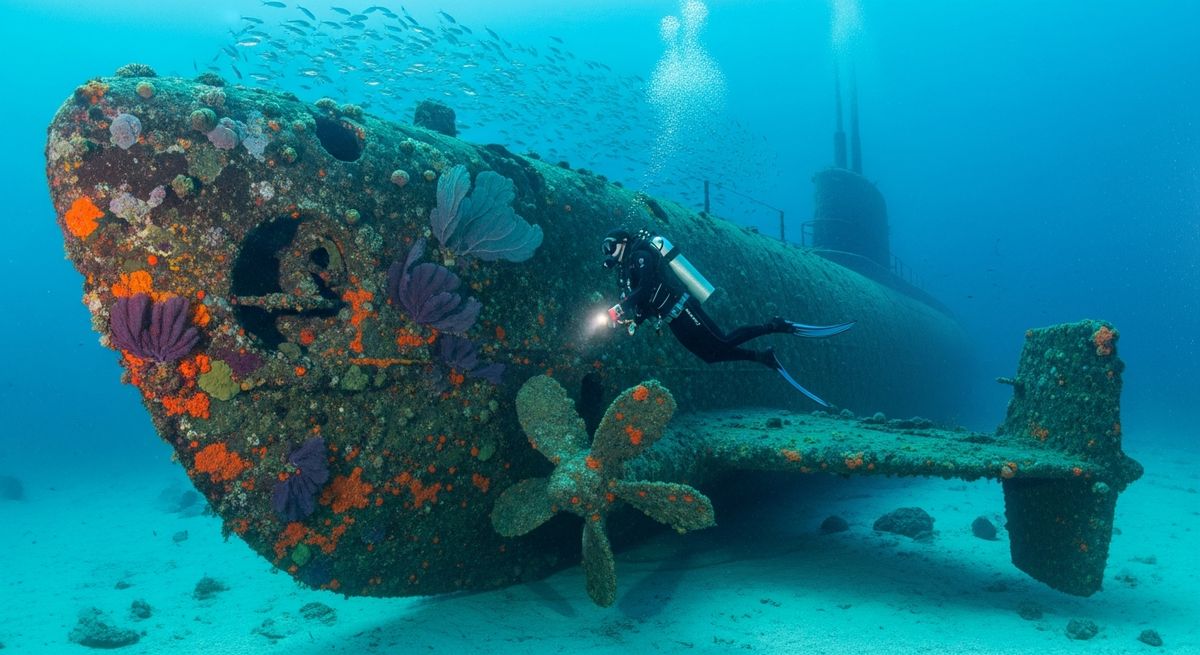
YDRA - Tabarka

The YDRA wreck off Tabarka is a solid dive, especially for those who appreciate a big piece of history lying on the seabed. This former carrier vessel, a substantial 153.9 meters long, went down in 1983 after a fire, but the crew made it out safely. We’ve found the sheer scale of it impressive; you can spend a good chunk of a dive just exploring the superstructure, which still offers plenty of points of interest. Over the years, the wreck has become a home for various Mediterranean fish, and we often spot schooling fish weaving through the collapsed sections. It’s a great pick for wreck enthusiasts, offering a sense of exploration without being overly challenging.

Location
Tabarka, Tunisia, Mediterranean & Europe
Coordinates
37.266666, 10.066667
Type
wreck
Maximum Depth
0m

Marine Protected Area: Lagune de Ghar El Melh et delta de la medjerda

Best Time to Dive in Tabarka

The warmest water temperatures in Tabarka occur in January, averaging 16.7°C. The coolest conditions are in December at 16.7°C.

Monthly Water Temperatures

  • January: 16.7°C (air: 14.4°C)
  • February: 16.7°C (air: 14.5°C)
  • March: 16.7°C (air: 14.8°C)
  • April: 16.7°C (air: 16.1°C)
  • May: 16.7°C (air: 18.8°C)
  • June: 16.7°C (air: 22.7°C)
  • July: 16.7°C (air: 26.0°C)
  • August: 16.7°C (air: 26.7°C)
  • September: 16.7°C (air: 25.3°C)
  • October: 16.7°C (air: 22.6°C)
  • November: 16.7°C (air: 19.2°C)
  • December: 16.7°C (air: 16.1°C)

Nearby Dive Sites in Tabarka

Nearest Dive Centres to YDRA

Marine Life in Tabarka

Home to 162 recorded species including 104 reef fish, 20 sharks & rays, 7 octopus & squid, 6 other, 5 whales & dolphins, 4 crabs & lobsters.

Notable Species

Recommended Packing List for YDRA

Based on average water temperature of 16.7°C.

  • Wetsuit (5-7mm) - recommended for 17°C water
  • Hood & Gloves (3-5mm) - helps retain warmth
  • Mask - essential for every dive
  • Fins
  • BCD - buoyancy compensator
  • Regulator - your most safety-critical piece of gear
  • Dive Computer - tracks depth, time, and NDL
  • Surface Marker Buoy (SMB) - essential for boat pickups
  • Dive Torch - useful for crevices and colour at depth
  • Underwater Camera - capture your diving memories

Frequently Asked Questions

What is the maximum depth for diving at Lake Hydra, and are there different depth zones or thermoclines?
The YDRA dive site, located in Tabarka, Tunisia, has a listed depth of 0m, indicating it is a very shallow wreck, potentially even partially exposed. The provided data does not specify different depth zones or thermoclines for this site.
What kind of underwater attractions and marine life can divers expect to see at Lake Hydra?
Divers at the YDRA dive site can explore the impressive remains of a carrier vessel, measuring 153.9m x 18.9m, which sank on January 20, 1983. This wreck is classified as showing a portion of its hull or superstructure. Specific details regarding marine life are not provided in the available data, but you can explore general marine life information in our wildlife database.
How challenging is diving at Lake Hydra, and is it suitable for beginner divers?
Diving at the YDRA wreck is classified as intermediate difficulty. While its 0m depth makes it very shallow, the intermediate rating suggests it may present challenges such as strong currents, complex wreck structures, or other conditions requiring more experience. Therefore, it may not be ideal for absolute beginner divers, who should gain more experience before attempting this site.
What are the best months or seasons to dive at Lake Hydra for optimal visibility and water conditions?
The available data for the YDRA dive site does not specify the best months or seasons for optimal visibility and water conditions. For general guidance on diving seasons in the region, you may consult our when-to-dive section.
What scuba diving certifications are required to dive at Lake Hydra?
While specific certification requirements for the YDRA dive site are not explicitly stated, its classification as an intermediate difficulty dive suggests that divers should possess at least an Open Water certification and ideally have experience with wreck diving or similar challenging conditions. Always consult with a local dive operator for precise requirements.
Are there any significant currents or specific water conditions divers should be aware of at Lake Hydra?
The provided data for the YDRA dive site does not contain information regarding significant currents or specific water conditions that divers should be aware of. Divers are always advised to check local conditions with a dive center in Tabarka, Tunisia before planning their dive.