AALESUND (POSSIBLY)
Protected Area
Wight-Barfleur Reef
Why dive here
With 176+ marine species recorded in the area - including blue sharks, dolphins, dwarf minke whales, humpback whales and ocean sunfish (mola mola) - AALESUND (POSSIBLY) offers some of Cornwall & Devon's richest wreck diving. Water ranges 10-18°C, warmest July, August, September.
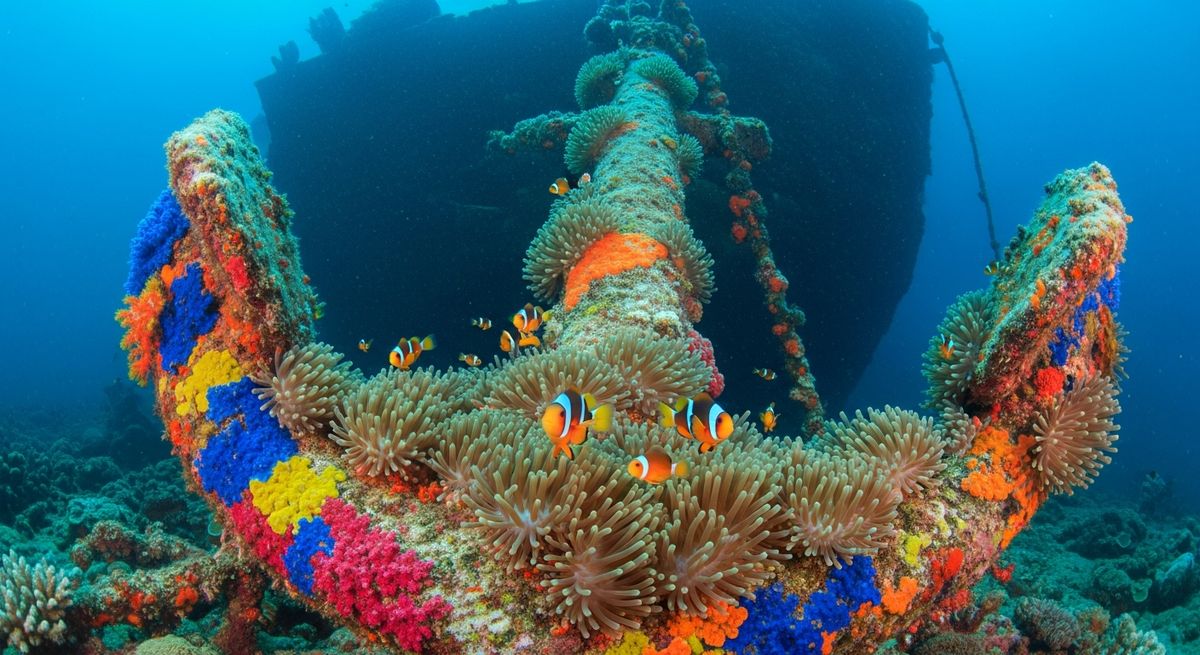
The *Aalesund* is a proper historical wreck, and we reckon it’s one of the best deeper dives in this part of Cornwall. Dropping down onto her at 37 metres, you hit an iron hull that’s surprisingly intact for a ship sunk in 1918. We love the way the light filters through the superstructure, creating these moody shadows around the single boiler, which stands proud and really gives you a sense of her scale. Exploration is the name of the game here. You can pick your way along her 44.5-metre length, peering into cargo holds now colonised by thick carpets of plumose anemones – pure white against the dark iron. Our favourite detail is the triple-expansion engine, a marvel of turn-of-the-century engineering, now home to inquisitive conger eels. We’ve had some fantastic encounters with schools of pollack swirling around the bow, and occasionally a curious grey seal will pop by for a look. This is a dive for experienced wreck enthusiasts, offering a respectful peek into maritime history and a chance to truly immerse yourself in a thriving artificial reef.
Typical AALESUND (POSSIBLY) Dive Profile
Illustrative profile based on site depth and type. Actual dive profiles vary - always follow your dive computer and training.
Safety Notes
Deep dive (37m) - monitor air consumption closely. Advanced certification recommended.
Wreck site - avoid penetration without wreck diving certification. Watch for sharp metal and entanglement hazards.
Always perform a 3-minute safety stop at 5m before surfacing.
AALESUND (POSSIBLY) Wreck History
Year Sunk
1918
Vessel Type
cargo ship
Cause
torpedo
The iron-hulled steamship Aalesund was built in 1890 in Stavanger, Norway, and served as a merchant vessel for the Norwegian company Dampsk. Akties. Its career came to a violent end during the height of World War I. On January 23, 1918, while sailing off the coast of Cornwall, the neutral Norwegian vessel was attacked and sunk, almost certainly by a torpedo from a German U-boat. This was a common fate for neutral shipping in the unrestricted submarine warfare campaign of the time.
Resting at a depth of 37 meters, the Aalesund is now a classic UK wreck dive for advanced and technical divers. The ship is well-preserved for its age, with key features like its single boiler and triple-expansion engine still identifiable. Exploring the iron hull, divers can witness over a century of colonization by marine life, including colorful anemones and schools of fish that have made the historic vessel their home. The depth and conditions require proper training and equipment, but the reward is a fascinating dive into maritime history.
Nearest Dive Centres to AALESUND (POSSIBLY)
Dive shops near AALESUND (POSSIBLY)
View all dive centres in Cornwall & DevonReviews for AALESUND (POSSIBLY)
Conditions
Ocean conditions, forecast and tides for AALESUND (POSSIBLY)
AALESUND (POSSIBLY) Ocean Conditions
Monthly averages for AALESUND (POSSIBLY), sourced from Open-Meteo marine data - nearest station: Open-Meteo marine grid (50.44, -2.73) (3km away)
October Averages
Sea Temperature
17°C
62°F · Range: 15.1–17.5°C
Air Temperature
13°C
56°F
Wind Speed
8.14 m/s
15.8 knots
Atmospheric Pressure
1011 hPa
Based on 4 years of monitoring data · Data sources: Open-Meteo marine data
Plan & book
Ways to dive Cornwall & Devon, from day trips to liveaboards.
Day trips & courses
via GetYourGuideGuided dives, courses and snorkel trips with instant booking.
Find dive trips in Cornwall & DevonPlaces to stay
via Booking.comHotels and dive resorts near Cornwall & Devon.
Search stays in Cornwall & DevonDive insurance
Most travel insurance excludes or limits scuba. Check what you need before you go.
Dive insurance explainedPartner links: we may earn a commission if you book, at no extra cost to you. How we make money
Where to Stay near AALESUND (POSSIBLY)
Prices from Booking.com. We may earn a commission at no extra cost to you.