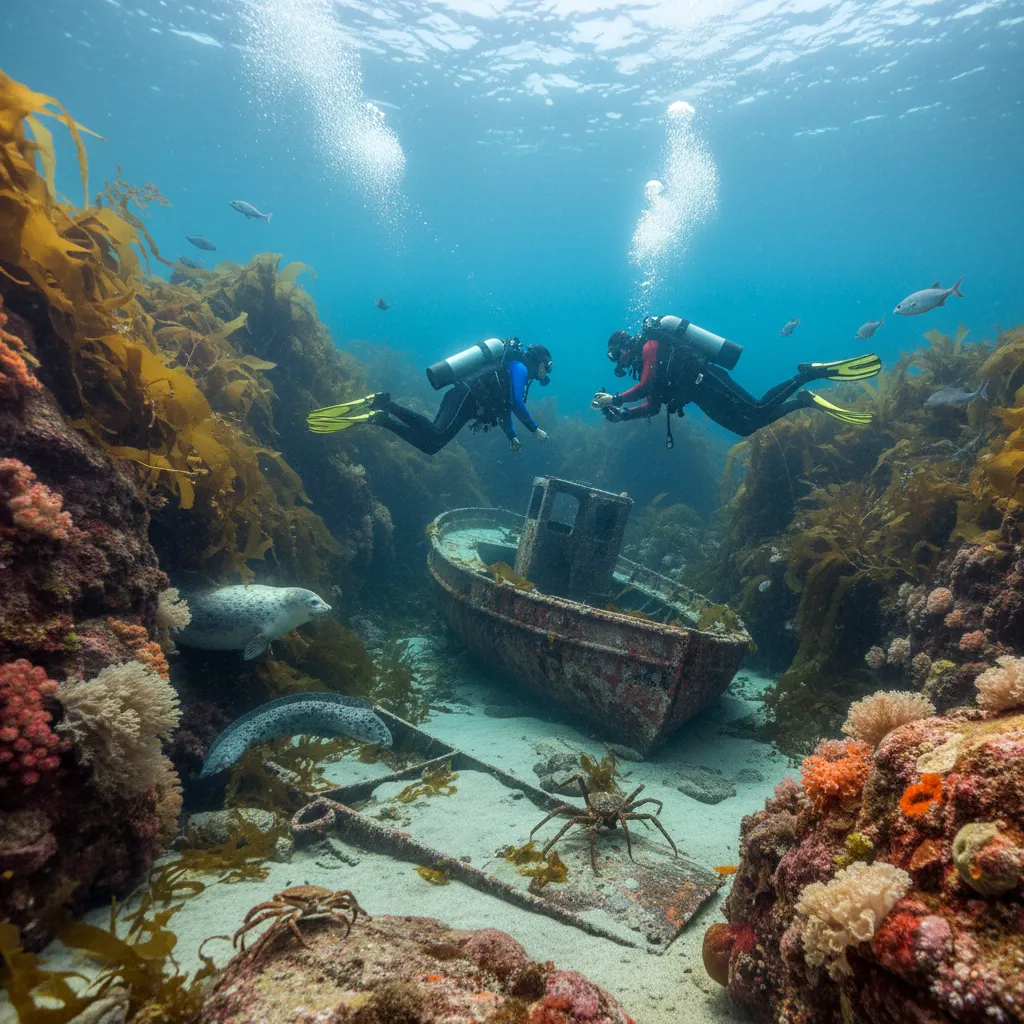
Diving in Cornwall & Devon
Why dive here
Cornwall & Devon offers some of United Kingdom's richest diving, with 176+ marine species recorded in the area - including blue sharks, dolphins, dwarf minke whales, humpback whales and ocean sunfish (mola mola). Water sits around 10°C.
Forget the tropical brochures for a minute. We love a good challenge, and the UK’s southwest coast, particularly Cornwall and Devon, delivers something genuinely unique. This isn't about big pelagics or technicolor coral; it's about history, rugged beauty, and a surprising abundance of temperate marine life. Diving here is all about the wreck. They line the coast, hundreds of them, from ancient sailing vessels to more modern freighters. Dropping onto a site like the **SS James Eagan Layne**, resting at 20m, you feel the weight of history. The visibility can vary, sure, but on a good day, sunlight filters through the kelp, illuminating shoals of bib darting through the rusted hull, and you’ll spot a common lobster peering out from a crevice. It’s atmospheric, a real dive into the past. We often find ourselves scanning the seabed for sand eels, and if you're lucky, you might even catch a glimpse of a porbeagle cruising by offshore, particularly in late summer. For macro enthusiasts, the sea fans and sponges are home to an impressive array of nudibranchs, and we’ve spent many a decompression stop watching transparent gobies flit around rocky outcrops. Conditions can be brisk, especially outside of summer, but the rewards are always there. Bring a good drysuit, be ready for some current on certain sites, and you'll come away with some incredible memories.
Cornwall & Devon Dive Site Map
Dive sites and dive centres in Cornwall & Devon
Cornwall & Devon Dive Sites
2,227 dive sites in Cornwall & Devon
12
The 12, an unidentified wreck lying at 49m, is a deep dive for experienced cold-water wreck enthusiasts off the Cornish coast. We’ve found her to be well-preserved, with interesting structural features still intact, giving you plenty to explore. Visibility here can be variable, but when it’s good, the resident conger eels, lobsters, and jewel anemones really put on a show. This site suits divers comfortable with technical depths and the often-challenging conditions of the English Channel.
20
Diving the '20' in Cornwall means exploring a dangerous wreck, submerged at a shallow 5m. This site is really for experienced divers who understand the risks involved with unstable structures. What you'll find here is a challenging wreck dive, where the real draw is the wreck itself and the way it’s been colonised by various species. It’s an interesting spot for those looking for a technical wreck dive rather than a creature hunt.
A2
The A2, a submarine resting at a mere one metre, is less a dive and more an intertidal snorkel, but it’s a fascinating bit of history nonetheless. We’ve found her often partially exposed at low tide, a barnacle-encrusted hull hinting at what lies beneath. What you get here is a chance to explore a wreck right from shore, peering into the shadowy nooks and crannies where small crabs scuttle and blennies dart. It’s perfect for a leisurely explore with a mask and snorkel on a calm day, especially if you’re into the historical angle without the full scuba kit.
AALESUND (POSSIBLY)
The *Aalesund* is a proper historical wreck, and we reckon it’s one of the best deeper dives in this part of Cornwall. Dropping down onto her at 37 metres, you hit an iron hull that’s surprisingly intact for a ship sunk in 1918. We love the way the light filters through the superstructure, creating these moody shadows around the single boiler, which stands proud and really gives you a sense of her scale. Exploration is the name of the game here. You can pick your way along her 44.5-metre length, peering into cargo holds now colonised by thick carpets of plumose anemones – pure white against the dark iron. Our favourite detail is the triple-expansion engine, a marvel of turn-of-the-century engineering, now home to inquisitive conger eels. We’ve had some fantastic encounters with schools of pollack swirling around the bow, and occasionally a curious grey seal will pop by for a look. This is a dive for experienced wreck enthusiasts, offering a respectful peek into maritime history and a chance to truly immerse yourself in a thriving artificial reef.
ABRAHAM COVE
Abraham Cove’s fishing vessel, sunk in 1983, is one of those wrecks we keep coming back to. It’s not about size here, the wreck is only 10.7m, but about the intimate exploration. We often find the visibility surprisingly good, especially on a settled day with a gentle swell, making the descent feel less like a plunge into the unknown and more like dropping into a well-lit aquarium. The wreck itself is mostly intact, resting on its side, and you can still make out the wheelhouse and the stern. Look for the prop, it’s often covered in jewel anemones, a vivid splash of orange and pink against the grey steel. Around the hull, we always spot bib and pollack darting in and out of the shadows. It’s a site that rewards a slow, methodical dive, allowing you to really soak in the details and the life that has made this fishing boat its home. Our favourite time to dive it is on a slack tide, giving you plenty of time to poke around without fighting the current.
ACADIAN
We love the Acadian for its solemn history and surprisingly intact structure. She went down fast after a U-boat torpedo hit her in 1918, taking 25 souls with her. That sense of history hangs heavy when you descend onto her 34-metre deck. The bow is particularly striking, often standing proud with a ghostly elegance, while the stern is more broken up, scattered with debris that makes for excellent rummaging. We’ve found conger eels are almost a given here, their heads peeking out from dark corners, and the occasional anglerfish, perfectly camouflaged, hugging the metalwork. The visibility can be hit or miss, as with much of the UK, but on a good day, the light filtering down through the green water gives the wreck an ethereal glow. Our best advice? Check the tides, aim for slack water, and bring a good torch – there’s plenty to illuminate inside her holds.
ACADIAN
The Acadian is one of those wrecks that just keeps giving, despite being down for over a century. Lying at 38 metres, she’s a deep dive and often comes with a bit of a current, so we'd only recommend it for experienced divers comfortable in those conditions. But the rewards are worth it. We particularly love dropping onto her bow, where the anchor chain still stretches out, leading you down the length of the ship. Her two boilers are a real focal point, huge cylinders encrusted with dead man's fingers and anemones. You’ll often find conger eels peering out from gaps in the plates. The triple expansion engine is also impressive, a jumble of metal now home to lobsters and crabs. Visibility here can swing dramatically, from 20 metres on a good day to a murky five, so picking your weather window is key. Even in poorer vis, the sheer scale of the Acadian makes for an atmospheric dive, her history palpable as you drift over her decks.
ACHIEVEMENT
The *Achievement*, a yacht that found its final resting place in 1984, isn't a grand, deep wreck, but it’s still one of our favourite shallow dives in the area, especially when the conditions are right. Lying in just 6 metres of water, often less at low tide, this 7.6-meter vessel is a testament to how quickly the sea reclaims things. We’ve spent many an hour here just pottering about, watching the light play through the kelp on a sunny day. What really makes the *Achievement* special is its accessibility and the sheer density of life for such a small wreck. The ribs of the hull are now home to nudibranchs the colour of sunset, and we always find spider crabs scuttling across the remaining decking. It’s a site that really rewards a slow, careful exploration, peering into every crevice for blennies or a curious wrasse. This is a brilliant spot for newer divers looking to get a feel for wreck diving without the depth, or for photographers wanting to capture macro life in good light. Just pick a calm day with minimal swell, and you’ll love it.
ACTIVE
Diving the *Active* is like stepping into a cold water time capsule. This 1874 steamship, resting at 27 metres, is a proper chunk of history off Cornwall. We love how much of her remains, especially the bow section – it’s still very recognisable, and you can really get a sense of her original form. The hull provides plenty of cover for lobster and crab, and we’ve often seen big conger eels tucked into the deeper recesses. She went down in 1881 after hitting Stag Rocks, and the wreck now hosts dense growths of plumose anemones, their white tentacles waving gently in the mild currents. Visibility here can be tricky, often a good 10-15 metres, but when it’s clearer, the scale of the wreck is impressive, spread across a rocky seabed. Our tip: aim for slack water on a neap tide. It makes exploring the interior sections much more comfortable. This is a site for experienced wreck divers who appreciate maritime history and aren’t afraid of a bit of gloom. It's a real slice of the past, wonderfully colonised by local marine life.
ADA
The ADA is a proper bit of history off Anvil Point, a sailing vessel sunk by gunfire back in 1917. She sits at 40 metres, upright and largely intact, a testament to her sturdy 1872 build. We often find her deck colonised by plumose anemones, their white tentacles swaying in the current, and you’ll likely spot conger eels tucked into any available crevice. While the visibility can be typical UK murk, on a good day, exploring her 31-metre length gives a real sense of her past. It’s a dive for those who appreciate wrecks with a story, and don't mind a bit of depth.
ADA MARY
The Ada Mary isn't about depth or big pelagics, it’s about accessibility and history. Resting in just two metres of water, this barge, scuttled back in '58, is perfect for a long, relaxed dive or even a snorkel on a calm day. We love how the shallow depth lets sunlight flood the wreck, illuminating the structure and the surprising amount of life that's made it home. You'll spend your time exploring the skeletal remains of the hull, perhaps finning through a hatch or two if the tide is right. Look closely, and you'll spot crabs scuttling amongst the plates, blennies peeking from crevices, and anemones clinging to every available surface. It’s a fantastic spot for macro photography, especially when the sun is high and those shallow shadows really pop. Our tip: go at slack tide for the clearest views and easiest navigation around the exposed sections. It’s a great confidence builder for newer divers looking for their first wreck experience, or simply a chilled-out dive when you don't fancy a long boat trip.
ADDAX
Dropping onto the Addax, you’re met with the ghostly outline of a smack vessel, lost to a German U-boat back in 1918. At 52 metres, it’s a deep dive, making it one for experienced wreck enthusiasts who are comfortable with decompression. The wreck itself is reasonably intact for its age, with plenty of nooks where you’ll often find conger eels peering out and crabs scuttling over the plates. Visibility can be hit or miss in these waters, but when it's good, you get a real sense of its history, often with schools of pollack circling above. It’s a somber site, a true piece of wartime history resting on the seabed.
Show all 2,227 dive sites in Cornwall & Devon
- ADOLF VINNEN
- ADON
- ADUR II
- ADVANTI
- AEGIR
- AENEAS (PROBABLY)
- AENEAS (STERN SECTION)(POSSIBLY)
- AEOLIAN SKY
- AEOLUS (PROBABLY)
- AFFLECK
- AFON DULAIS
- AGENORIA
- AGHIOS SPYRIDON (POSSIBLY)
- AGRION
- AILSA CRAIG (PROBABLY)
- AJAX
- ALABAMA
- Alaunia (Wreck)
- ALBATROS
- ALBATROSS
- ALBERT
- ALBERT C FIELD (PROBABLY)
- ALDERSHOT
- ALERT
- ALEXANDROVNA
- ALEX VAN OPSTAL
- Alex Van Opstel (Wreck)
- ALEYNA
- ALFRED EMMA
- ALGARVE
- ALGERIAN
- ALGIERS
- ALICE
- ALICE MARIE
- ALISON (POSSIBLY)
- ALLEGRITY
- ALLY MARIE
- ALMOND BRANCH (POSSIBLY)
- ALTAIR
- ALYANI
- AMADEUS
- AMBASSADOR
- AMBASSADRICE
- AMBIORIX
- AMELIE (PROBABLY)
- AMELIE-SUZANNE
- AMIABLE LUCITTE
- AMIRAL ZEDE
- AMIRANTE
- AMY
- ANDIANO
- ANDOLA
- ANDORA STAR
- ANDROMEDA
- ANGELENA BM 271
- ANGELE (POSSIBLY)
- ANGELISE 2
- ANNA CHRISTINE
- ANNA LOUISE
- ANNA SOFIE
- ANNA SOPHIE
- ANNIE YVONNE
- ANT
- ANTIGUA STAR
- ANTILOPE
- ANTOINETTE
- ANTONIO
- ANTONIO (PROBABLY)
- ANTWERPEN (PROBABLY)
- APACHE
- APARIMA
- APOTEK
- Aquasport International
- ARAB
- ARACATACA
- ARANDORA STAR
- ARCHIPEL
- ARCTIC DAWN
- ARCTIC EXPLORER
- ARCTIC PIONEER
- ARDANGORM
- Arena Swimming Pool
- ARFON
- ARIAN
- ARIEL
- ARISTOS
- ARMANDE
- ARMAS
- ARMENIER
- Arno
- ARNO (POSSIBLY)
- ARROGANT
- ARTHURTOWN
- ARVOR
- ASABA (POSSIBLY)(PART OF)
- ASBORG
- ASHANTI (POSSIBLY)
- ASHMUN J CLOUGH (POSSIBLY)
- ATHEN
- ATHINA B
- ATLANTIC DOLPHIN
- ATLAS (PROBABLY)
- AUGUSTE AND LOUISE
- AUSTRALBUSH (POSSIBLY)
- AVALANCHE
- AVALANCHE
- AVALON G II
- Axwell
- AXWELL
- AZEMMOUR
- AZEMMOUR
- BADEN (POSSIBLY)
- BADGER (PROBABLY)
- Balaclava Bay
- BALANCE
- BALHOLM
- Ballsaddle Rock
- BALTIC SURVEYOR
- BALVENIE (POSSIBLY)
- BAMSE
- BAMSE
- BAMSE (PROBABLY)
- BANTRY
- BARCAROLLE
- BARD (POSSIBLY)
- BARMSTON
- Barn Hill
- BARON GARIOCH
- BARON SALTOUN
- BARRACUDA
- BARRACUDA
- Barrels
- BARRYMAN
- BARSAC
- BASIL-2
- BATH CITY (POSSIBLY)
- BAYAWAHHA
- BAYCHATTAN
- BAYGITANO
- BAYONNE
- BEATA
- BEATRICE
- BEATRICE MAUD
- BEECHTREE
- BEHREND
- BELFORT
- BELLA
- BELLE COLOMBE
- BELLEROCK
- BELLE ROCK (POSSIBLY)
- BELLONA
- BELLUCIA
- BELMONT
- BEN BLANCHE
- BENGROVE (PROBABLY)
- BENIN
- BENININ (POSSIBLY)
- BEN OLIVER
- BEN REIN
- BENVENUE (PROBABLY)
- BERAR
- BESSIE STEPHENS
- BESS MITCHELL
- BETSY ANNA
- BETTANN (BOW SECTION)
- BETTANN (STERN SECTION)
- BETTY R
- BEVERLEY ANN (POSSIBLY)
- BEYECHARELLE
- Bideford Bar
- BINNENDIJK
- Bishops and Clerks
- BISHOPSTON
- BIZON (POSSIBLY)
- BIZON (PROBABLY)
- BLACK HAWK (AFT SECTION)
- BLACK HAWK (FWD SECTION)
- Black Hawk Liberty (Wreck)
- Black Rock
- BLEAMOOR (PROBABLY)
- BLESK
- BLU ARGENT
- BLUE ANGEL
- BLUE BELL
- BLUE FIN
- BLUE MARLIN
- BLUE MINK
- BLUE SONATA
- BLUE TARTA
- BLUMENTHAL
- BOB
- BOBBYB
- BOBIE
- BOGSTAD
- BOHERA
- BOKN (POSSIBLY)
- Bola Bleiddyn
- BOMA
- Bombarden Unit (Wreck)
- BONAFIDE
- BONITA
- BONNE SAINTE RITA
- BONNIE GIRL
- BORDERDENE
- BORDER KNIGHT
- BORGNY
- BORGNY
- BORGUND I (POSSIBLY)
- BORU OF NEYLAND
- Bouley Bay
- BOURNEMOUTH
- Bovisand Bay
- BOYNE
- BOY TOBY (POSSIBLY)
- BRAAT II
- BRABANT
- Bracklesham Bay Landing Craft
- Bracklesham Bay Valentine Tank
- BRAEDALE (PROBABLY)
- BRANDON
- BRAVA
- Brazen Ward
- BREAKAWAY OF YARE
- Breakwater Beach
- BREMENRY
- BRENDA
- BREST
- BRESTOIS
- BRETAGNE
- BRETONNE (PROBABLY)
- BRETT
- BRETTON HALL
- BRIALAN
- BRIGHTER HOPE
- BRIGHTON
- BRIGITTA
- BRISEIS
- BRISK (PROBABLY)
- BRITANNIA
- BRITANNIA (POSSIBLY)
- BRITANNIA (PROBABLY)
- BRITISH COMMERCE
- BRITISH INVENTOR (BOW SECTION)
- British Inventor (Wreck)
- Britsum
- BRITSUM
- BROADHURST (PROBABLY)
- BROADHURST (PROBABLY)
- BROADMAYNE (PART OF)
- Broderick
- BROOMHILL
- BROOMHILL (PROBABLY)
- BRUNETTE
- BRUNHILDA
- BUCHANNESS
- Buckland Lake
- Buckland Lake Reserve
- BUESTEN
- BUFFALO
- BUYRON BESTUM
- BUZUZLO (EX WESTON)
- C 19
- CAB
- CABANA (POSSIBLY)
- CABENDA
- CADUCEUS
- CAIRNDHU
- CALVADOS
- Calvados rocks
- CAMARADE
- CAMARET
- CAMBERWELL
- CAMBRIAN
- CAMBRIAN (PART OF)
- CAMBRIAN PRINCESS (PROBABLY)
- CAMBRONNE
- CAMELOT CHALLENGER (POSSIBLY)
- CAMPEADOR
- CAMPEADOR 5 (BOW SECTION)(PROBABLY)
- CAMPEN
- CAMSWAN
- Candia
- CANDIA
- CANTABRIA
- CANTERBURY BELL
- CAPABLE
- CAPITAINE COOK
- CAPRI
- CAPTAIN NIKO
- CARARE
- CARASA (POSSIBLY)
- CARASA (POSSIBLY)
- CARBINEER
- CARBON
- CARBON
- CARENTAN
- CAREW CASTLE
- CARISTOGA III
- CARMARAND
- CARMARTHEN
- Carmine Filomena
- CARMINE FILOMENA
- Carn Base
- CARNSEW
- CAROL ANNE
- CAROLINE SUSAN
- CAROLUS
- CARONI RIVER
- CARONI RIVER (PART OF)
- CARPETBAGGERS
- Carreg Gloyn
- Carreg Rhoson
- CARRIER
- CARROUEST ONE (POSSIBLY)
- CARROUEST ONE (POSSIBLY)
- Carters Rock
- Casper 2
- CASTLE CRAG
- CASTLEREAGH
- CASTOR 1
- CATHERINE ALLEN
- CATO (POSSIBLY)
- CATRINA
- CATTEWATER
- Caulonia
- CAVALLO
- Cawsand Bay
- CELTIC
- CENTURION
- CERES
- CERES (POSSIBLY)
- Challaborough Bay
- CHALOUPE 112
- CHANNEL QUEEN
- CHANTEREYNE
- CHANZI
- CHARLES MARTEL
- CHARLES MORGAN
- CHARLOTTE SOPHIA
- CHARLWOOD
- CHARLYNNE II (PROBABLY)
- CHARMANT
- CHARMING BETTY
- CHARTER
- CHASSEUR 6
- CHASSEUR 7
- CHATBURN (POSSIBLY)
- CHATEAU YQEM
- CHELARIS J
- CHESHIRE (POSSIBLY)
- CHORLEY
- CHRISANDE
- CHRISTMAS
- CHRISTOFFEL COLOMBUS (POSSIBLY)
- CHURCH ROCKS
- CID
- CIESZYN
- CIGALLE
- CINDERELLA
- CINQ FRERES
- Cita
- CITTA DE BARI
- City of Brisbane
- CITY OF BRISBANE
- CITY OF EXETER
- CITY OF GHENT
- CITY OF GHENT (POSSIBLY)
- CITY OF GLASGOW
- City of London
- CITY OF MEXICO
- CITY OF MEXICO
- CITY OF SWANSEA
- CITY OF SWANSEA (PROBABLY)
- City of Waterford
- CITY OF WATERFORD
- CLAN APLINE
- CLAN CAMERON (POSSIBLY)
- CLANGULA (PROBABLY)
- Clan Macmillan
- CLAN MACMILLAN
- CLAN MACVEY
- CLAN MALCOLM
- CLAN STUART
- CLAREEN
- CLAREMONT
- CLARINDA
- CLARRIE
- CLAUDE
- CLEDDY (PROBABLY)
- CLIBURN
- Clodmoor
- CLODMOOR
- CLODMOOR (PROBABLY)
- Club des Smogglers
- CLYDE
- COLORADO
- COLORADO (POSSIBLY)
- COMMANDANT BARATIER
- COMMANDANT MARCHAND
- COMMERCE
- COMPEADOR (POSSIBLY)
- CONCH
- CONCH
- CONCRETE BARGE 39
- CONLEA
- CONSTANCE
- COQUETDALE
- COQUETDALE (PROBABLY)
- CORAIL
- CORAL
- CORBET WOODALL
- CORESTES 11
- CORINNA
- CORNELIA
- CORNISH LASS
- CORNUCOPIA (POSSIBLY)
- CORONATION INSHORE
- CORONATION OFFSHORE
- CORSAIRE
- CORUNDUM (PROBABLY)
- COSRAY 10
- COTTINGHAM
- Countess of Erne
- COURAGE
- COURIER
- CREAG MHOR
- CREDO DU MARIN
- CREDO IN DEUM
- Cribbar
- Criccieth Castle
- CRISTINA
- CROMDALE
- Cromhall Quarry
- Crown Hill Bay
- CRUSADER
- CRUSADER
- CS41
- Cuba
- CUBA
- CUBA
- CUBANA
- Cuckoo
- CUCKOO
- CUO
- CZAR
- D1
- DAGEID
- DAGENHAM
- DAGMAR
- DAGMAR
- DALEGARTH FORCE (PROBABLY)
- Dale Pembrokeshire
- DALHOUSIE (POSSIBLY)
- DALLAS CITY (POSSIBLY)
- DAMBUSTER
- Dane Rock
- DAWN GLEANER
- DAYLESFORD
- DE BOOT
- DEENES
- DEFENDER
- DE HOOP (HOPE)
- DEL RIO
- DEMETRIOS
- DENISE
- DENISE GABRIEL
- DEN OF SEATON
- DENROW (SM198)
- DEPUTIE GASTON DUMESNIL (POSSIBLY)
- DERNA (PROBABLY)
- DEUCALION
- DEUCALION (POSSIBLY)
- DIADEM OF BURSLEDON (PROBABLY)
- DIAMENT
- DIE FRAU METTA CATHARINA VON FLENSBURG
- DILIGENT
- DINA (POSSIBLY)
- DINARD (POSSIBLY)
- DISPATCH (POSSIBLY)
- DITTISHAM CASTLE
- Dive Newquay
- DOHE
- DO IT AGAIN
- Dolphin Sand
- DONEGAL
- DONEGAL (POSSIBLY)
- DON LORENZO
- DOOMEY D
- DORA
- Dorothea Quarry
- DOROTHY E
- Dosthill Quarry
- Dosthill Quarry
- DOUBLE VISION
- DRAGON
- Drake's Island
- Dresden
- DRESDEN
- DROMORE
- DR RUDOLF WAHRENDORFF
- DRUMCREE
- DRYAD
- DUCHESS OF CORNWALL
- DUDDON (PROBABLY)
- DUDLEY ROSE
- DUEN (POSSIBLY)
- DUKE OF BUCCLEUCH
- DULCE T
- DUMFRIES
- DUMFRIES
- DUMFRIES
- DUNGRANGE
- DUNLIN
- DUNSINANE
- DUTTON
- E-13
- EARL OF ABERGAVENNY
- Eastern Kings
- EASTFIELD
- EAST POINT
- EBBER LANE
- Eccleston Delph
- ECHO
- Eddystone Lighthouse
- EDELWEISS
- EDEN
- EDEN
- EDEN FORCE
- Edenwood
- EDENWOOD
- EDIRNE
- EDUARD (POSSIBLY)
- EILEEN (LO 27)
- EINAR JARL
- ELDON PARK
- ELEANOR
- ELENA R
- Elena R (Wreck)
- ELFORD
- ELISHANNE
- ELIZABETH CAROLINE
- ELIZABETH ROBERTSON (POSSIBLY)
- EL KAHIRA
- ELMCREST
- ELMCREST (POSSIBLY)
- ELMDALE
- ELNA E
- ELSA
- ELSA
- ELSA (POSSIBLY)
- ELTHAM
- EMILY
- EMILY EVESON
- EMLYNVERNE
- EMPIRE BROADSWORD
- EMPIRE CRUSADER
- EMPIRE HARRY
- EMPIRE OTTER
- EMPIRE PORTIA (POSSIBLY)
- EMPIRE TOWNSMAN
- EMPRESS
- EMPRESS QUEEN
- EMSSTROM
- ENDEAVOUR
- ENDEAVOUR (POSSIBLY)
- ENECURI
- ENID
- EPIDAURO
- EPSILON
- ERIC CALVERT
- ERIC CALVERT (POSSIBLY)
- ERME ESTUARY
- ERME INGOT
- ERNEST LAGOUVE
- ESCURIAL
- ESPAGNE
- ESPERANZA
- ESSONITE (POSSIBLY)
- ESTRELITA
- ESTRELITA (PROBABLY)
- ETHEL
- ETHEL (PROBABLY)
- Ethel (Wreck)
- ETOILE DU MARIN
- ETOILE POLAIRE
- EVASION
- EVELINE
- EVERLEIGH
- EVERTSEN
- EVOLUTION
- EWT 263 (FWD PART)
- EXCEL
- EXCELSIOR
- EXCELSIOR (POSSIBLY)
- Exeter BSAC
- EXUBERENT
- EZRA WESTON (BOW SECTION)
- EZRA WESTON (STERN SECTION)
- F 614
- FAGERNES
- FAGERNES (PROBABLY)
- FAIRWAY
- FAITH
- FAITH
- FALLODON
- FALLODON
- FANNY
- FANNY LAMBERT
- FANNY (POSSIBLY)
- Far Mulberry
- FARN
- FAST FLOW
- FDT 216 (POSSIBLY)
- FELIX DE ABASOLO
- FENNA (PROBABLY)
- FIDGET (POSSIBLY)
- FIFE COAST (POSSIBLY)
- FIGARO
- FILS DU VENT
- FINK
- FINN
- FISHER LASS
- FLAG THEOFANO
- FLAMER
- FLEUR DE LYS
- FLEUR DE LYS
- FLEURET
- FLINT KLIPPER
- FLORA
- FLORENCE REYNOLDS
- FLORENCE VIVIAN
- FLORRIE
- FLUENT
- FLUENT
- FORD POWER
- FORELAND
- FOREMOST 101
- FOREMOST 45
- FOREMOST 49
- FOREST
- FORESTER (& PONTOON)
- FORGET ME NOT
- Fort Bovisand
- FORTH
- FORT MEDINE
- FORTUNA
- FORTUNA
- FORT YALE
- Fossil Beds
- FPT IV
- FRANCE AIMEE (PART OF)(POSSIBLY)
- FRANZISKA
- FREDERIC
- FREEDOM
- FREEDOM
- FRIDAY (VRIJDAG) POSSIBLY
- FRIGGA
- Frode
- FRODE
- Frogner
- FROGNER ?
- FULBORE III
- FU-SIM-BA 2
- F/V Joanna C
- Fylrix MV Wreck
- GABRIELLE
- GABRIELLE ANNICK
- GALICIA
- GALLIA
- GALLIA
- GANNET
- Gannet s Bay
- Gannet s Rock
- GAP
- G-ARLS
- GARM (POSSIBLY)
- GARTH
- GARTLAND
- G A SAVAGE (POSSIBLY)
- Gascogny
- Gascony
- GASCONY
- GASPARD DE LA NUIT
- G-AYDT
- GAZELLE
- G-AZWZ
- GE2
- GEFION
- GEFION (POSSIBLY)
- GENERAL DU TEMPLE
- GENERAL LEMAN (POSSIBLY)
- GENEVIEVE (POSSIBLY)
- GENTRICE
- GEORGE LOCKETT
- GEORGIO BAY
- GEORGIOS MARKETTOS
- GEORGIOS MARKETTOS (PROBABLY)
- GERARDA
- GERLEN (POSSIBLY)
- GERMA GEISHA
- GERMAINE
- GIBEL-HAMAM
- Gildenburgh Water
- GILLES BEATRICE
- GILSEA
- GINETTE
- GIRDLENESS
- GIRL HILARY
- GIRL RONA
- GIRL SHARON
- GIRLVINE (POSSIBLY)
- GIRNIGOE
- GIUSEPPINA ACCAME
- G-JANG
- GJERTRUD
- GLENARM HEAD (POSSIBLY)
- GLENARM HEAD (POSSIBLY)
- GLENART CASTLE
- GLENBERVIE
- GLENDINNING (POSSIBLY)
- GLENEUSE
- GLENLEE
- GLENMORE
- GLENO
- GLEN (POSSIBLY)
- GLEN STRATHALLAN
- Glen Strathallen
- GLOCLIFFE
- GLORIOSA
- GLORY
- GODOLPHIN
- GOLDFINGER
- GOLIATH
- Goose Rock Reef
- GORAH LASS
- GORIZIA
- GOUREUX
- GOWRIE
- GRACE DIEU
- GRAND COPAISE
- GRANDEST
- Grand Hustler
- GRANE
- GRATIE GODS (POSSIBLY)
- GRATITUDE
- GREATHAM
- GREAVESASH
- GREGYNOG
- GREGYNOG
- GRELEEN
- GRETA C
- GRETA C
- GRIP FAST
- GRIPFAST
- GRIPFAST
- GRO
- GSP
- GUERNSEY COAST
- GUILDING STAR
- Guillot Caves
- GULL (POSSIBLY)
- GULL ROCK
- GULNARE
- GUNVOR
- GURLI
- GUYONA
- Gyllyngvase Beach
- HALLOWEEN
- Hallsands
- HALSEWELL
- HALTON
- HAMILTON KINGFISHER
- HAMOAZE
- Hand Deeps
- Hand Deeps
- HANOVER
- HANSY
- HARLEQUEEN-K
- HARRY SHARMAN
- HARSTAD
- HARTBURN (PROBABLY)
- HARTLEPOOL (PART OF)
- HARTLEY (POSSIBLY)
- HARVESTER
- HAULER
- HAVBRIS (PROBABLY)
- HAVET
- HAVSORNEN
- HAYTAIN
- HAZEL CLAIRE (POSSIBLY)
- HAZELWOOD (POSSIBLY)
- HAZLEWOOD (POSSIBLY)
- HEATHER
- HEATHER ANNE
- HEDWIG LUNSTEDT
- HEIDRUN
- Helford River
- HELMA
- HELWICK LT FLOAT
- HEMSLEY 1
- Hen Chicks
- HERA
- HERMOD
- HEROINE (POSSIBLY)
- HERON
- HERON I
- HERZOGIN CECILIE
- Heybrook Bay
- HEYE P
- HIGHGATE (POSSIBLY)
- HIGHLAND BRIGADE
- HIGHLAND CORRIE
- HIGHLAND CORRIE
- HIGHLAND HOME (PROBABLY)
- High Point North
- Hilsea Point Rock
- HIMALAYA
- HMCS REGINA
- HMHS REWA
- HM LCT 427 (AFTER PART)
- HM LCT 427 (FWD PART)
- HMML 287
- HMML 380
- HMMS 1019
- HMS Acheron
- HMS Acheron
- HMS ACHERON (BOW SECTION)
- HMS ACHERON (STERN SECTION)
- HMS ALBION II
- HMS AMAZON
- HMS Amphion
- HMS ANNIE SMITH
- HMS APLEY (POSSIBLY)
- HMS ARFON
- HMS Ariadne (Wreck)
- HMS ASAMA
- HMS ASSURANCE
- HMS Basilisk
- HMS Beagle
- HMS BENTON CASTLE
- HMS BITTERN
- HMS BITTERN (PARTS OF)(PROBABLY)
- HMS Blackwood
- HMS BLACKWOOD
- HMS Boadicea
- HMS BOADICEA
- HMS BOXER
- HMS BOYNE
- HMS Brazen
- HMS Brazen
- HMS BUCCANEER
- HMS Bulwark
- HMS CAMPEADOR 5
- HMS CAPEL
- HMS CHARDE
- HMS Charybdis
- HMS Codrington
- HMS COMET
- HMS COMPUTATOR (PROBABLY)
- HMS Coronation
- HMS Coronation
- HMS CORONATION (PART)
- HMS CORONATION (PART)
- HMS CRESTFLOWER
- HMS CROCODILE
- HMS DARK GLADIATOR
- HMS Delight
- HMS DELIGHT
- HMS DETERMINEE (EX LA DETERMINEE)
- HMS Dragon
- HMS DRAGON
- HMS Dunraven
- HMS Durban
- HMS ELEANOR (PROBABLY)
- HMS ELK (PROBABLY)
- HMS Empress of India
- HMS EMPRESS OF INDIA (EX RENOWN)
- HMS EVADNE (POSSIBLY)
- HMS EVELINE
- HMS FISGARD II
- HMS Formidable
- HMS FOYLE
- HMS Foylebank
- HMS FOYLEBANK
- HMS GOLDEN SUNSET (POSSIBLY)
- HMS GOSSAMER
- HMS Grafton
- HMS Grenade
- HMS Grenville
- HMS HARSTAD
- HMS Havant
- HMS HAVICK
- HMS HAZARD
- HMS HAZARDOUS
- HMS Hermes
- HMS HICKORY
- HMS HIND
- HMS Hood
- HMS INSOLENT
- HMS INVERCLYDE
- HMS INVINCIBLE
- HMS Isis
- HMS JAMES FENNEL
- HMS JOHN MITCHELL
- HMS Keith
- HMS Keryado
- HMS KERYADO (PROBABLY)
- HMS KINGSTON CAIRNGORM (POSSIBLY)
- HMS LADY OF THE ISLES
- HMS LANCER II
- HMS LANDRAIL (PROBABLY)
- HMS LISTRAC (PROBABLY)
- HMS LOCH ERINBOLL (STERN PART)(PROBABLY)
- HMS LORD HAILSHAM
- HMS LORD HAILSHAM
- HMS LORD SNOWDEN
- HMS LORD STONEHAVEN
- HMS LOYALTY
- HMS M1
- HMS M2
- HMS/m A1
- HMSM A1
- HMSM A3
- HMSM A7
- HMS MANOR
- HMS MAROJAM
- HMSM D1
- HMS MEDEA
- HMS MELBREACK
- HMSM H 52
- HMS MICHAEL CLEMENTS
- HMS Minion
- HMS MINION
- HMS MINSTER
- HMSM L24
- HMSM M2
- HMS MOLDAVIA
- HMS Montagu
- HMS Montague
- HMS MONTAGUE
- HMSM P555
- HMSM SAFARI (EX P 211)
- HMSM SIDON
- HMSM SWORDFISH
- HMSM UNTIRING
- HMSM UPSTART
- HMSM XE 8
- HMS NEWBRIDGE (PROBABLY)
- HMS NEW DAWN
- HMS Niger
- HMS NORTHCOATES
- HMS OCEAN SUNLIGHT
- HMS OSWALDIAN
- HMS P12 (STERN SECTION).
- HMS PICTON CASTLE
- HMS PIGMY
- HMS Pine
- HMS Pine
- HMS Pomone
- HMS PRIMROSE
- HMS Prince Leopold
- HMS Prince Royal
- HMS PRINCESS
- HMS RAMILLIES
- HMS RECOIL (BOW SECTION)(PROBABLY)
- HMS RECOIL (STERN SECTION)(PROBABLY)
- HMS REMINDO (POSSIBLY)
- HMS RINOVIA
- HMS Royal George
- HMS SAPPER
- HMS SARGASSO
- HMS SAVAGE
- HMS Scylla, wreck
- HMS SELECT (POSSIBLY)
- HMS SESAME (PROBABLY)
- HMS SEVRA
- HMS STOCKFORCE (POSSIBLY)
- HMS TIGER
- HMS TORMENTOR
- HMS TORRENT
- HMS TOWHEE
- HMS TRUANT
- HMS TULIP II
- HM submarine A3
- HM SUBMARINE NO 1
- HMS VELOX
- HMS VENERABLE
- HMS VERNON II (POSSIBLY)
- HMS Victory
- HMS Vindictive
- HMS Viper
- HMS VIPER
- HMS Wakeful
- HMS WARRIOR II
- HMS WARWICK
- HMS WARWICK DEEPING
- HMS WATERLILY
- HMS WEAZLE
- HMS WILNA
- HMS Wivern
- HMT COMET
- HMT Ocean Sunlight
- HMY VIVA 2
- HODD
- HOEGH OSAKA
- Holborough Lake
- HOLKAR
- HOLME FORCE (POSSIBLY)
- HONGISTO
- HOONESS
- HOONESS
- HOPPER BARGE NO.42
- Horsea Island
- HUGIN
- HUGIN
- HUMBER
- HUMBERGATE
- HUMBERGATE (PROBABLY)
- HUNSGROVE
- HUNTER WV253
- HUNTSMOOR
- HUNTSMOOR
- HUSH WING
- HYDROMISS 3
- IASGAIR
- IBEX
- IBIS
- IBIS
- ICELANDER
- ICE PRINCE
- IDA (EX ABBEY TOWN)
- IDUNA
- IKEDA
- IKEDA (POSSIBLY)
- ILLYDIA
- ILSTON
- IMPLACABLE
- IMPRENABLE
- Indiana
- INDIANA
- INDUTIONMARE
- INGENIEUR MAXIME HESSE
- INGER
- INGO
- INGRID 2
- INISHEER
- INISINVER
- Inner Mulberry
- INTERNATIONAL (PROBABLY)
- INVERDARGLE (BOW SECTION) (PROBABLY)
- INVERDARGLE (STERN SECTION) (PROBABLY)
- INVERSNAID (POSSIBLY)
- IOANNIS FAFALIOS
- IOLANTHE
- IONA
- IONA
- IONA II
- IONIAN
- IREX
- IREX (POSSIBLY)
- IRIS
- IRISHMAN
- IRMA GERMAINE (POSSIBLY)
- ISBJORN
- ISLAND MAID
- ISLAND MIST
- JAC FISHER
- JADE STAR GYPSY
- JAFFA
- JAMAICA PLANTER
- JAMES
- JAMES B RICHARDSON
- JAMES EAGAN LAYNE
- James Egan Layne
- James Egan Layne Wreck
- JAMES MCGEE
- JAMES & SARAH (PROBABLY)
- JEAN ALAIN
- JEAN B
- JEAN FREDERIC (POSSIBLY)
- JEANNE MARIE
- JEBBA
- JENNY
- JENNY
- Jenny Cliff
- JERSEY QUEEN (POSSIBLY)
- JERSEY QUEEN (POSSIBLY)
- JESMOND
- JESSIE
- JGENA (POSSIBLY)
- JMT M99
- JO-ANNE
- JOHANNA
- JOHANN CARL
- JOHN
- JOHN GRAFTON
- JOHN O'SCOTT
- JOHN TAYLOR
- JONKHEER MEESTER VAN DER WALL PUTTESHOCK
- JORDAN A
- JOSEF JOHAM (STERN HALF) (PROBABLY)
- JOSEPH AND MARGARET
- JOSETTE LYNN
- JOTA
- JUDY TWO
- JUENE MARIE
- JULES
- JULIE
- JULIE PILE
- JUNO
- JUNO
- JUTA
- JUVENILE DELINQUENT
- KAAKSBURG
- KAI (POSSIBLY)
- KANTOENG (PART OF)
- KARANTEZ AR NOR
- KAREN FOLMER
- KAREN MARIE
- KAREN MARIE
- KAREN MARIE (PROBABLY)
- KARMA
- KATHLEEN
- KAZAN
- KELVINIA
- KENDAL CASTLE
- KENDY
- Kenfig Patches
- KERLOCH
- KERRIS REED
- KIKI
- KILLURIN
- KIM
- KINDLY LIGHT
- KIND OF MAGIC (POSSIBLY)
- KING CHARLES II
- KING HARRY
- Kingmere Rocks
- KINGSDYKE
- KINGSDYKE
- Kingston Rocks
- K M B (POSSIBLY)
- Knoll Pins
- KOLGA
- KOMET
- KONG GUTTORM (PROBABLY)
- KONG OSCAR 2
- KONGSHAUG (PROBABLY)
- KONSHAUG (POSSIBLY)
- KRASNAYA PRESNIA
- KROMWYK
- KROSFOND
- KUCHING-LAUT
- KURLAND
- KWESTER
- KYARRA
- KYLIE
- KYLIN
- KYNANCE (PROBABLY)
- LA BAJOLE
- LA BLANCA (POSSIBLY)
- LABOUS MOR (POSSIBLY)
- LA CHAUMIERE DU PECHEUR
- LA CYCOGNE (PROBABLY)
- LA CYGOGNE
- LADY B
- LADY DALHOUSIE
- LADY DRUSIE
- LADY HAMILTON OF HELFORD
- LADY KAMILLA
- LADY KINGSWOOD
- Lady Maureen
- LADY MIRA
- LADY NON (POSSIBLY)
- LADY SHEILA
- LA HAVRE
- LAICEY JAI
- LA JOSEPHINE
- LAKE EDEN (POSSIBLY)
- Lake Edon
- LAKE EDON
- LAKE EDON
- LAKE OWENS
- LAKE OWENS
- LA MAUVE
- Lamb?
- LA MINETTE
- LANCASTER
- Landing Bay area
- LANDORE
- LA NEFTHIS
- LANFRANC (PROBABLY)
- LA PETITE ROUSSE
- LAPWING (POSSIBLY) OR SOUTH WESTERN
- La Saline
- LA SALLE
- LASS O'DOUNE (PROBABLY)
- LAURA C ANDERSON (POSSIBLY)
- LAUWERZEE
- LA VAGUE
- L'AVENTURIER
- LAVERNOCK
- LB 332 OR LB 362 (POSSIBLY)
- LCA 1642
- L C ANDERSON
- LCG 15
- LCG 16 (POSSIBLY)
- LCI(L)99
- LCT 1068
- LCT 1074 (POSSIBLY)
- LCT 232
- LCT 2331 (PROBABLY)
- LCT 2426
- LCT 244
- LCT 293
- LCT 381
- LCT 524
- LCT 565
- LCT 757 (POSSIBLY)
- LCT 777
- LCT 875
- LCT 967
- LCV(P) 1199
- LCVP 120
- LEACHS ROMANCE
- LEADER
- Leadstone
- LEANDER
- LEASTILIEN
- LE CAP
- LE FLIBUSTIER
- LE GUILLEMOT
- LE MERLE
- LE NORD
- LENY (POSSIBLY)
- LEON
- LEONARD PEARCE
- LEON MARIE
- LEON MARTIN (PART OF)
- LEONORA
- LEOPOLDVILLE
- LE POILU
- Les Dirouilles
- LES MERCENAIRES
- L'ESPERANCE
- LE SQUALE
- L'ESSROYABLE
- LEVEN (POSSIBLY)
- LE VIEUX TIGRE
- L H CARL
- LIA'G
- LIBERTA
- LIGHTFOOT (POSSIBLY)
- Lil Boat
- LILY
- LINDBERGH
- L'INDEPENDANT
- LINN O DEE (OR LINN O DEC)
- LISA
- LISA MARIA
- LITTLE PEARL
- LITTLE SLAM
- Little Trolvis
- LIVERPOOL
- LIVONIA
- LLAMEDOS
- Loanda Wreck
- LOE BAR WK
- LOE BAR WRECK
- LOFOTEN
- LOFOTEN (PROBABLY)
- LOIC LUCAS
- LOLA (POSSIBLY)
- Lolworth Cove
- LONDONIER
- LONDON II (POSSIBLY)
- LONDON TRADER (POSSIBLY)
- LONGLEY LASS
- LONGSAND
- LORD SNOWDEN (PROBABLY)
- LORD STEWART
- LORD STEWART
- LORD STONEHAVEN
- LORNASTON (POSSIBLY)
- L'OTARIE
- LOUIS
- LOUISE
- LOUIS SHIED
- Louis Shield
- LOWMOUNT
- LST 314
- LST 376
- LST 496
- LST 507 (Bow section)
- LST 507 (Stern section)
- LST 523
- LST 531
- LST (POSSIBLY)
- LUCI
- LUCIFER
- LUCILLA
- LUCINDA (POSSIBLY)
- LUCISTON
- LUIGI ACCAME
- LUIS
- LUKE JOHN
- LULONGA (POSSIBLY)
- Lulworth Banks
- LUNAN
- Lundy Island
- LUXOR
- LYMINGTON
- LYNX EFFECT
- M2 (Wreck)
- M 343 (POSSIBLY)
- M 343 (PROBABLY)
- M 483
- MAASLUST
- MABEL BAIRD
- MACLAREN
- M.A.D.
- MADELINE
- MADJOE
- MAD MOMENT
- MADRYN
- MAGDA
- MAGICIEN
- MAGICIEN
- MAID OF ORLEANS
- MAINE
- Maine SS
- MAJORCA
- MAKASA (POSSIBLY)
- MAKESHIFT (POSSIBLY)
- MAKO
- MALLARD (POSSIBLY)
- MALLENY (OR MALLENEY)
- MANIFOUR
- MAPLEFIELD
- MAPLEFIELD (POSSIBLY)
- MARANA (BOW SECTION)
- MARECA
- MARGA
- MARGARETHA (POSSIBLY)
- MARGARET ROSE
- MARGARET SMITH
- MARGUERITA
- MARGUERITE
- MARGUERITE (POSSIBLY)
- MARGUERITE PRY
- MARIA ANTONETTE
- MARIA ASUMPTA
- MARIA JOSE
- MARIA, JULIA & MATHILDA JEAN
- MARIANELA SANTANDER
- MARI CHANDRIS
- Marie
- MARIE ANGER
- MARIE DES ISLES
- MARIE ELAINE (POSSIBLY)
- MARIE GALANTE
- MARIE-GALANTE
- MARIE HENRIETTE
- MARIE MAGDELINE
- MARIE MARGUERITE (POSSIBLY)
- MARIE MASHMAN
- MARIE THERESE
- MARJOLENE
- MARK ELAINE
- MARSOUIN
- MARTHA
- MARTINE JEAN PAUL
- Martins Haven
- MARY ROSE
- MARY TOOVEY
- MATELDA
- MATILDA
- MAUD MARY
- MAY
- MAYALS
- MAYFLOWER (POSSIBLY)
- MCGREGOR
- Meadfoot Beach
- MEANDROS (POSSIBLY)
- MEAN MACHINE
- MEDINA
- MEDOC
- MEFJORD (POSSIBLY)
- MEGAZAN
- MEG MERRILIES
- MEKNES
- MELITA
- MEMNON
- MEMNON
- MENDI
- MENOLIOS
- MERA
- MERCHANT ROYAL
- MERCIA
- MERDIS
- MERKUR
- MERRIBAR
- MERTHYR
- MESSINA
- Mewstone
- Mewstone Plymouth
- MFB GOLDEN DAWN
- MFV 9
- MICHELLE
- MICHELLE
- MIDDLESEX
- MIDGET 2
- MILLISLE (POSSIBLY)
- MILLMER
- MILO
- MILO
- MINA CANTIQUIN
- MINERVA (POSSIBLY)
- MINERVA (PROBABLY)
- Minquiers
- MIOWN
- Mira
- MISTRESS QUIGLEY
- MISTY
- MITERA MARIGO
- Mixon Hole
- MIZPAH
- M J C
- M J C
- MODAVIA
- MOHEGAN
- MOIDART
- MOLESEY
- MOLESEY (POSSIBLY)
- MOLIERE
- MOLINA
- MONTE GURUGU (POSSIBLY)
- MONTE MORO
- MOODY BLUE
- MOODY LADY
- MOOR SAND
- MORNING STAR
- Morris Rogue
- MOSEL
- MOTANO (PROBABLY)
- MOUNTPARK (POSSIBLY)
- MSC NAPOLI (STERN SECTION)
- MUDSTOMPER (PROBABLY)
- Mullion Cove
- MUMBLES
- MURREE
- MV Robert
- MY DIANE
- MYRTLEDENE
- MYRTLEGROVE (PROBABLY)
- MYSTERYTU
- Nab Tower
- NAIAD
- NANCY
- NANSET
- NDAC
- NECHES
- NECHES (PROBABLY)
- NEPTUNE
- NEREE
- NEREE (POSSIBLY)
- NEREE (POSSIBLY)
- NEREE (POSSIBLY)
- NEREE (PROBABLY)
- NETLEY ABBEY (POSSIBLY)
- Newhaven Scuba
- Newhaven West Arm
- NEWHOLM
- NEW MOSS ROSE
- Newquay Boat Ramp
- NEW VENTURE
- N G PETERSEN
- NIBBLER III
- NICHOLA (PROBABLY)
- NICHOLINE (PH172)
- NICOLAOU VIRGINIA
- NIL DESPERANDUM (PROBABLY)
- NILE
- NIMBLE
- NINA
- NO 194 AX
- NOORDZEE
- NORDLAND (POSSIBLY)
- NORFALK
- NORMAND
- NORMANDY
- NORMANDY
- NORMANDY
- NORMANDY
- NORMA (POSSIBLY)
- North Bishop
- NORTHERN KIWI
- NORTHERN STAR
- NORTHFIELD (POSSIBLY)
- NORTHLANDS (POSSIBLY)
- NORTH SEA (PROBABLY)
- NORTHVILLE (POSSIBLY)
- North Wall
- NORTHWARD
- NOVICE
- NURNBERG
- N VERBERCKMOES (POSSIBLY)
- NW68
- NW96
- NYASALAND
- NYASALAND
- NY-EEASTEYR
- Oasis Swimming Pool
- Oceana (Wreck)
- OCEAN QUEEN
- OCKLINGE
- OIEKAST
- OIEKAST (PROBABLY)
- OLE KYNDE
- OLWAY
- OMER DENISE
- ONEGA
- ONEGA (POSSIBLY)
- ONE MORE TIME
- OOST VLAANDEREN
- OPEN CHANNEL
- ORCHIS
- OREGON
- Orestone Rock
- ORFORDNESS
- ORFORDNESS
- ORIFLAMME
- ORION
- ORMINSTER
- ORPHEE
- ORYX
- OSMUNDA
- OSPREY (BOW SECTION) (POSSIBLY)
- OTWAY
- OUSE (POSSIBLY)
- Outer Mulberry
- Outer Poole
- OWEN
- Owen Rock
- P-555 (Wreck)
- Padi
- PAGANINA
- PAGENTURM
- PAGENTURM
- PALLION (PROBABLY)
- PAMELA S
- Panther Shoal
- PARBLEU
- PARMELIA
- PARTRIDGE
- PAS (C.182)
- PASCAL JEANNE MARIE
- PATRICE DIDIER (PROBABLY)
- PATRICIA TWO
- PEARL (POSSIBLY)
- PEARL (POSSIBLY)
- PEARL (PROBABLY)
- PEARN PRIDE (POSSIBLY)
- PEDAR HOAR
- PEER GYNT (POSSIBLY)
- PEGASUS
- PEGGY
- PELICAN
- Pendennis Shore Dive
- PENTYRCH
- PEN-Y-MOR (POSSIBLY)
- PERAS
- PERGO
- PERONNE
- PERRA
- PERRITON
- Perry Ledge
- PERSEVERANCE
- PERSIER
- PERSISTENT
- PERUVIAN
- PESK-COAT
- PETER PAUL
- PETERSHAM
- PETERSHAM (POSSIBLY)
- PETITE ANNA
- P.G.
- PHILOTIS
- PIKEPOOL (PROBABLY)
- PINTADO
- PITCHIPOY (POSSIBLY)
- PLACIDAS FAROULT
- PLASTON
- PLM 4
- PLM 4 (POSSIBLY)
- PLUTUS
- PLUTUS
- Plymouth Breakwater
- POINTE DE BARFLEUR
- POINT LAW
- POITIERS (PART OF)(POSSIBLY)
- POLBRAE
- POLDOWN
- POLKA
- Pollock
- POLO
- POMELLA
- POMERANIAN
- PONTET CANET
- POOL FISHER
- PORT CHALMERS
- Porthkerris
- PORTHKERRY
- PORTHKERRY
- Porthoustock
- Portland Harbour
- Portland Ledge
- Portmellon
- PORTSDOWN
- PORTSEA
- PORTUGAL
- PORTUGALETE (PROBABLY).
- POTLESS
- POUSSOIR
- PRESERVER
- PRESIDENT POINCARE
- PRESTIGE
- PRIMA
- PRIMO ?
- PRIMROSE
- PRIMROSE
- PRINCE D'EKMUHL
- PRINCE IVANHOE
- PRINCE OF BOUILLON
- PRINCESS ENA
- PRINCESS IRENE
- PRINCESS LOUISE (PROBABLY)
- PRINCESS ROYAL
- PROGRESS
- PROSPERITY (STERN SECTION)
- PROTESILAUS
- PRUTHREE
- PSI
- PS RYDE
- PUNTA NITA (POSSIBLY)
- QUAIL
- QUARNERO
- QUEENSWOOD (PART OF)(POSSIBLY)
- QUEEN VICTORIA
- QUEST
- QUOG
- RABBI
- RADAAS (PROBABLY)
- RADYR
- RAFFIO
- RAJAH
- RAMPAGER
- RAMSGARTH
- RAP
- RAPANA
- RAUMBOAT NO.41
- RAYDER
- RECLEZ
- REDESMERE
- REDLINE NO.1
- REDVERS BULLER
- REFLECTIONS
- REGGESTROOM (PROBABLY)
- REINDEER
- REINE DES FLOTS
- RELIANCE (PROBABLY)
- REMINDO
- RENILDE
- RENOWN
- REPUBLIQUE ET PATRIE
- RFA GREEN RANGER
- RFA HUNGERFORD (POSSIBLY)
- RHENANIA
- RILL COVE
- RIMFAKSE (POSSIBLY)
- RINGEN
- RIPTIDE
- RISOY (POSSIBLY)
- RISOY (PROBABLY)
- RISQUE TOUT
- RIVERSDALE
- RIVERTON (STERN PORTION) (POSSIBLY)
- R M HUNTON
- RMS Moldavia
- RMS Moldavia
- ROBBINS MAGGIES
- ROBERT
- ROBERT
- ROBIN DHA
- ROCK ISLAND BRIDGE
- ROGER MADO
- ROGER MADO (POSSIBLY)
- ROGER MADO (POSSIBLY)
- ROMARIN
- ROMBO
- ROMNY
- ROMSDALEN (PROBABLY)
- RONTEGUI
- ROSE
- ROSE BUD
- ROSEHILL
- ROSEHILL
- ROSEHILL (PROBABLY)
- ROSE OF DEVON
- Roskilly
- ROSS
- ROSSGULL
- ROSSMORE (POSSIBLY)
- ROSTEN (POSSIBLY)
- ROSY CROSS
- ROTA
- ROTORUA
- ROWAY
- ROWELLA
- ROYAL ADELAIDE
- ROYAL ANNE GALLEY
- ROYSTONS FREEDOM
- RTC NO.9
- RUBAAN
- RUPEE
- SAAD
- SABRE OF GOSPORT
- SABRINA
- SABRINA
- SADIE WYKEHAM (PROBABLY)
- SAIMA
- Saint Alban's Ledge
- SAINT ANDRE (PROBABLY)
- SAINT ANDREW
- SAINT ANTOINE
- SAINT ANTOINE
- SAINT BRANDAN
- SAINTE MARIE
- SAINT HUBERT
- SAINT LOUIS
- SAINT RONAIG
- SAINT SIMEON
- SALADO
- SALLY JANE
- SALSETTE II
- SALUT LES COPAINS
- SANDFLY
- SANDFLY (POSSIBLY)
- SANDHEAP
- SANTO CHRISTO DE CASTELLO (POSSIBLY)
- SANTORINI
- SAPHIR
- SAPHIR
- SARAH
- SARAH ANDERSON (POSSIBLY)
- SARAH ELLIS
- SARAH JAYNE
- SARGIA
- SARLA
- SARLA (POSSIBLY)
- Sarn Badrig
- SCALDIS
- SCARWEATHER LTV
- SCHELDE
- SCHIEDAM
- SCHOKLAND
- SCREWDRIVER
- SEA CLOUD
- SEA FARER (POSSIBLY)
- SEAFORTH
- SEA GAY
- SEAGULL
- SEAHAWK
- SEA KING (POSSIBLY)
- SEA LASSIE
- Seal Cove
- SEA PRINCE
- SEA PRINCE (PART OF)(PROBABLY)
- SEBASTIAN LAURENT
- SECIL JAPAN (BOW SECTION)
- SECIL JAPAN (STERN SECTION)
- SECURITY (POSSIBLY)
- Segontuim
- SELKIE
- Selsey Drift (the Parks)
- Selsey East Beach
- Selsey Lifeboat Station
- SERENITY
- SERRANA (BOW SECTION)
- SERRANA (STERN PART)
- SEVAN
- Seven Stones Reef
- Severnside Sub-Aqua Club
- SEVERN TRANSPORT
- SEVILLA
- SGB 7
- SHAD THAMES
- Shag Rock
- Shag Rock
- Shag Stone
- SHALEEN
- SHALLOM
- SHANE
- SHANES CASTLE
- SHEER GRACE
- Shelley Rocks
- Sherbeterry Rocks
- SHIRALA
- SHIRLEY BETTY
- SHOAL FISHER
- SHOREHAM
- SHOREHAM (PROBABLY)
- Siarach III/Black Tide
- SIDNEY H
- SIGVAR
- SILVER SPRAY
- Silver Steps
- SILVIA
- SILVONIA
- SIMLA
- SIMLA
- SIRACUSA
- SIRDAR
- SIREN
- SIRIUS 2
- SIR JASPER
- SIR PERCIVAL
- SJOFNA
- SKAALA
- SKARAAS
- SKOPELOS SKY (AFTER PART)
- SLAVA
- SLEEPLESS NIGHTS
- SLEMISH
- SMYRNA
- SNOWDROP
- SNOWDROP
- SOLEIL LEVANT
- SOLGLIMT
- SOLOR (STERN PART) (PROBABLY)
- Solstice PH199
- SOLVIDA (POSSIBLY)
- SORAK
- SOUDAN
- SOUTH AUSTRALIAN
- SOUTH OF IRELAND
- SOUTHOVER SCORPIO
- SOUTHOVER SCORPIO
- SOUTH WESTERN
- SOVEREIGN (POSSIBLY)
- SOVEREIGN (POSSIBLY)
- Spaniard/Encuri (Wreck)
- SPARKLING FOAM
- SPARKLING FOAM (POSSIBLY)
- SPEARFISH
- SPHENE
- SPHENE (PROBABLY)
- SPIRAL (POSSIBLY)
- SPITAL
- SPRINGTIDE
- SPYRIDION VAGLIANO
- SPYROS (POSSIBLY)
- SS FATFIELD
- SS Galeka
- SS HORNET
- SS Irma
- SS Kyarra
- SS Mohegan Wreck
- SS Orfordness
- SS Rosalie
- STALHEIM
- STANCREST
- STANHOLME
- STANLEY FORCE
- ST ANNE
- ST ANTHONY
- ST ANTHONY (POSSIBLY)
- STANWOLD
- STAN WOOLAWAY
- START
- STAVROS (POSSIBLY)
- ST BRANDAN
- St Brides Bay
- ST CROIX
- ST DUNSTAN
- STEADY
- Steeple Cove
- STEEVE
- STELLA M
- STELLA (PROBABLY)
- STEN (POSSIBLY)
- STEN (POSSIBLY)
- STER DE ZEE (POSSIBLY)
- ST GEORGE (POSSIBLY)
- ST GEORGES
- ST GEORGES
- ST JACQUES (PROBABLY)
- ST JOSEPH
- ST KATHARINE (PROBABLY)
- ST KILDA
- ST LOUIE
- Stoke Beach
- Stoney Cove
- Stoney Cove
- STRATHALBYN
- STROMBOLI
- STROMBUS (PART OF)
- STROMBUS (PART OF)(PROBABLY)
- STRYN
- STUDLAND BAY WRECK
- SUDON (POSSIBLY)
- SUEVIC (BOW SECTION)
- SUFFOLK
- SUFFOLK COAST (POSSIBLY)
- Sun Beach
- SUNSHINE
- SURDELO
- SURFRIDER
- SUSAN K
- SUSPECT
- SVERRESBORG
- SVINT
- SWAINBY (PROBABLY)
- Swanage Pier
- Swanpool Beach
- SWEET ANNETT
- SWIFT
- SWINDON
- Syracusa
- T'pot
- TAGONA
- TAKU
- Talland Bay
- TALVALDIS (POSSIBLY)
- TANDIL (PROBABLY)
- TANGARA
- TANNATUS
- TARDIS OF YEALM
- TASMANIA (POSSIBLY)
- TAYO
- TEAMWORK
- TEELIN HEAD
- TEIFI (POSSIBLY)
- TELA (POSSIBLY)
- TEMPEST
- TEMPTRESS
- TENACE
- TENERIFFA (POSSIBLY)
- TERLINGS
- TERRA
- Thatcher s Rock
- The Behar
- The Bizzies
- The Dakotian Wreck
- THE DUKE
- The Far Mulberry
- The Gertrude Wreck
- The Greek
- The Ledge
- THELMA
- The Lucy Wreck
- The Mohegan (Wreck)
- THE NEEDLES SITE
- THERA (POSSIBLY)
- The Ridges
- THE THREE SISTERS
- THISTLEMOR
- THRUSH (POSSIBLY)
- Thurlestone Beach
- Thurlestone Rock
- TIA MARIA
- TIGER
- TIGGER
- TILL (POSSIBLY)
- TINA ANNE
- TINE ANDERSON
- TINKER DI
- TOCCATINA
- TOIRETTE
- TOMMY
- TORCELLO
- TORMES (POSSIBLY)
- TORTONA
- TOTNES CASTLE
- TO VENNER
- TOWNELEY
- TRACY
- TRACYS DAWN
- TRACY'S MICHELLE
- TRAM
- Trefor Pier
- TREGOR
- Trenemene Reef
- TREVEAL
- TREVESSA
- TRIDONIA
- TRIO
- TRITO
- TROIKA
- T R THOMPSON
- TURQUOISE (PROBABLY)
- TWEED
- TWILIGHT WATER
- TWO SISTERS
- TYCHO
- TYNE
- Tywyn
- U 1021 (POSSIBLY)
- U 1021 (POSSIBLY)
- U 1063
- U 1195
- U1195
- U 122 (POSSIBLY)
- U 153 (POSSIBLY)
- U 212 (PROBABLY)
- U 275 (PROBABLY)
- U 322 (POSSIBLY)
- U 325 (POSSIBLY)
- U 390
- U 390 (PROBABLY)
- U 400 (POSSIBLY)
- U 413 (POSSIBLY)
- U 480
- U 672 (POSSIBLY)
- U 678 (POSSIBLY)
- U 741
- U 772
- U 8
- U 86 (FORMERLY)
- U 86 (POSSIBLY)
- U 90
- U 90
- U 90
- UB 106 (POSSIBLY)
- UB 112 (POSSIBLY)
- UB 118
- UB1195
- UB 128 (POSSIBLY)
- UB 21
- UB 32
- UB 37
- UB 37 (PROBABLY)
- UB 39
- UB 65
- UB 72
- UB 74
- UB-74 (Wreck)
- UB-78
- UB 81
- UB-81
- UB 86 (POSSIBLY)
- UB 86 (POSSIBLY)
- UB 97 (POSSIBLY)
- UC 16
- UC 18
- UC 49 (PROBABLY)
- UC 69
- UC 92 (POSSIBLY)
- ULL (PROBABLY)
- ULLYSES
- UNDERLEY
- UNICORN
- UNION
- UNITY
- Unknown Wreck off Thorness Bay
- URSA
- URSA (PROBABLY)
- USKMOOR (PROBABLY)
- USSA
- USS CORRY
- USS CORRY
- USS FIRESTONE (POSSIBLY)
- USS GLENNON
- USS Illinois
- USS MEREDITH
- USS PT 509
- USS RICH
- USS RICH
- USS SUSAN B ANTHONY
- USS TIDE
- VALDES
- VAL DE SAIRE
- VALDES (PROBABLY)
- VALKYRIE
- VANESSA (PROBABLY)
- Vari Solo Sailor
- VARUNA (POSSIBLY)
- VARVASSI
- VASCO
- VAV
- VEDANTA
- VENDEMIAIRE
- VENEZUELA
- VENUS
- VENUS
- VERA (PROBABLY)
- VERITAS
- VERNICK
- VERZA
- VESUVIO (POSSIBLY)
- VESUVIUS
- VESUVIUS
- VICTORINE
- VICTOR-MAURICE
- Viewpoint Diving Centre
- VIGDA
- VIKHOLMEN
- VIKING 2
- VILLE DE MALAGA
- VIOLA
- VIOLET
- Vivian Quarry
- Vivian Quarry
- Vobster Quay
- VOLKERAK
- Volnay
- VOORWAARTS
- VYC 18
- WAIKAWA (POSSIBLY)
- WAITARA
- WAPELLO
- WAPELLO
- WAR BARON (PROBABLY)
- WAR GRANGE
- WAR HELMET
- WARILDA
- WARILDA
- WAR KNIGHT
- WARNOW (POSSIBLY)
- WARRINGTON
- WARRIOR 2
- WARWICK DEEPING
- WATCHDOG OF WAREHAM
- Waterfront Plymouth Hoe
- WAVERLEY
- Waysburgh
- WEAR
- WELBURY
- WEST BAY
- WESTERGATE
- WESTERGATE (PROBABLY)
- WESTERN BELLE
- WESTON MAID (POSSIBLY)
- West Rutts
- WESTVILLE
- WHALE UNIT 552
- WHALE UNIT 552 (POSSIBLY)
- WHALE UNIT (578Y)
- W H DWYER
- WHINFIELD
- WHITE ROSE
- WHITTE ZEE
- W.H.L.
- WIGHT ROSE
- WILD ROSE
- WILD ROSE
- WILHELMINA J
- WILLIAM
- WILLIAM D BURNHAM (POSSIBLY)
- WISBECH
- WITHERN
- Wittering
- WITTE ZEE
- WONDER
- WOODCOCK
- WOODHAM
- Woolhouse Rocks
- Wraysbury
- WREATHIER
- WREATHIER
- Wreck of Amoco Cadiz
- Wreck of Blackfriars Ships
- Wreck of Cattewater Wreck
- Wreck of Diamond
- Wreck of Earl of Abergavenny
- Wreck of German destroyer ZH1
- Wreck of German torpedo boat Iltis
- Wreck of Grace Dieu
- Wreck of HMHS Glenart Castle
- Wreck of HMHS Rewa
- Wreck of HMHS Salta
- Wreck of HMT Arfon
- Wreck of Kléber
- Wreck of Mary Rose
- Wreck of Minerve
- Wreck of MS Herald of Free Enterprise
- Wreck of Olympic Bravery
- Wreck of Rill Cove Wreck
- Wreck of SMS Grosser Kurfürst
- Wreck of SM U-8
- Wreck of U-12
- Wreck of U-40
- W Woolvern (Possibly)
- WYNDHURST
- WYNDHURST
- WYTHBURN
- Y48
- YARMOUTH ROADS
- YESSO
- YETI
- YMS 304
- YMS 350 (PROBABLY)
- YMS 382
- YONDI
- YOROUBA
- YOUNG CLIFFORD
- YVETTE BM217
- YVONNE
- YVONNEIG YANNOU
- ZAANSTROOM
- ZEBRA
- ZEEMANSBLIK
- ZELO
- ZEPHIR (POSSIBLY)
- ZYGOTO
Cornwall & Devon Dive Centres
87 dive shops and operators in Cornwall & Devon
2DiVE4 Scuba School Ltd
Abyss Scuba School
Andark Diving
Aquanaut Scuba & Snorkelling Centre Ltd
Aquasport International
Aquatech Diving Centre
Berkshire Divecrew Training 2012 Ltd.
Bespoke Scuba Diving Ltd
Show all 87 dive centres in Cornwall & Devon
- Blue Ocean Diving
- Bouley Bay Dive Centre
- Celtic Deep
- Christal Seas Scuba Ltd
- Dive 90
- Dive Ability Ltd
- Dive academy
- Dive-A-Lot-Scuba
- Dive Beyond Limited
- Dive In Ltd
- Diveline Medical Ltd
- Dive Looe
- DiveMania Scuba Limited
- Dive Newquay
- Divers Down
- DiveUK
- Dive Wimbledon
- Divexplore
- Diving Dreams
- Donkey Divers Limited
- Dorset Diving Services
- Easy Divers
- Edge Watersports
- Essex Scuba
- Extreme Marine
- Freedom Diving
- Gatwick Scuba
- Go Dive Training
- Hampshire Divecrew Training
- Harlyn Dive School
- Herts Dive Club
- idiveteam
- In2 Diving
- InDepth
- JC Scuba Ltd
- Karleyth Diving Ltd.
- London School of Diving
- Marina Scuba School
- Mayim Mermaid Academy
- Mulberry Marine Experiences CIC
- Northampton Scuba School Ltd
- Ocean Turtle Diving
- Ocean View
- Octopus
- Old Harbour Dive Centre
- Orca Scuba Diving Academy
- Oxford Dive Centre
- Oxford Dive Centre (UK) Ltd.
- Oyster Luxury Travel & Diving
- Planet Scuba School Ltd
- Plymouth Diving Centre
- Poole Diving
- Porthkerris Divers
- Scuba 2000
- Scuba Blue Ltd
- Scubacrew
- Scuba Dream
- Scuba Libre Diving Ltd
- Scuba Scene Taunton
- Scuba School Ltd
- Scuba Shack Limited
- Seaways Diving
- Sound Diving Limited
- Stellar Divers
- Sunken Dreams Scuba Diving Academy
- Surrey Dive Centre
- Surrey Divecrew
- Sussex Diving & Leisure
- TAL Scuba Ltd.
- Teign Diving Centre
- The Dive School at Stoney Cove
- The Lake
- The Scuba Trust
- Viewpoint Diving Centre
- Vobster Quay Dive Shop
- Wavecrest Scuba
- Welsh Diving
- Wiltshire Scuba
- Wraysbury Dive Centre
Ocean Wildlife in Cornwall & Devon
176 species recorded in Cornwall & Devon
Cornwall & Devon Daylight & Sunrise/Sunset
Sunrise and sunset times for Cornwall & Devon, calculated from coordinates
Today - Sunday 11 October
Sunrise
06:25
Sunset
17:32
Daylight
11h 6m
Golden Hour
16:48
First light (dawn) at 05:53 · Last light (dusk) at 18:04
Monthly Averages
| Month | Sunrise | Sunset | Daylight |
|---|---|---|---|
| Jan | 08:07 | 16:34 | 8h 27m |
| Feb | 07:26 | 17:26 | 10h 1m |
| Mar | 06:28 | 18:14 | 11h 45m |
| Apr | 05:20 | 19:03 | 13h 43m |
| May | 04:26 | 19:50 | 15h 24m |
| JunLongest | 04:00 | 20:24 | 16h 24m |
| Jul | 04:16 | 20:19 | 16h 3m |
| Aug | 04:58 | 19:35 | 14h 36m |
| Sep | 05:45 | 18:30 | 12h 44m |
| OctNow | 06:32 | 17:23 | 10h 51m |
| Nov | 07:24 | 16:28 | 9h 4m |
| DecShortest | 08:05 | 16:08 | 8h 3m |
Times are approximate local times based on longitude. Actual times may vary slightly depending on the exact timezone observed in Cornwall & Devon.
Where to Stay near Cornwall & Devon
Prices from Booking.com. We may earn a commission at no extra cost to you.
Marine Protected Areas near Cornwall & Devon
381 protected areas near Cornwall & Devon - please respect local regulations when diving
Bristol Channel Approaches / Dynesfeydd Môr Hafren
Bristol Channel Approaches / Dynesfeydd Mor Hafren
Western Channel
Western Channel
Wight-Barfleur Reef
Wight-Barfleur Reef
South-West Approaches to Bristol Channel
Solent and Dorset Coast
Solent and Dorset Coast
Offshore Brighton
Offshore Brighton
Severn Estuary/ Môr Hafren
Showing 12 largest of 381
Getting to Cornwall & Devon
Exeter, Devon
Bristol
Cardiff
Plan & book
Ways to dive Cornwall & Devon, from day trips to liveaboards.
Day trips & courses
via GetYourGuideGuided dives, courses and snorkel trips with instant booking.
Find dive trips in Cornwall & DevonPlaces to stay
via Booking.comHotels and dive resorts near Cornwall & Devon.
Search stays in Cornwall & DevonDive insurance
Most travel insurance excludes or limits scuba. Check what you need before you go.
Dive insurance explainedPartner links: we may earn a commission if you book, at no extra cost to you. How we make money