ANNIE JANE
Protected Area
Eoligarry
Why dive here
With 112+ marine species recorded in the area - including blue whales, dolphins, dwarf minke whales, humpback whales and ocean sunfish (mola mola) - ANNIE JANE offers some of Scottish West Coast's richest wreck diving.
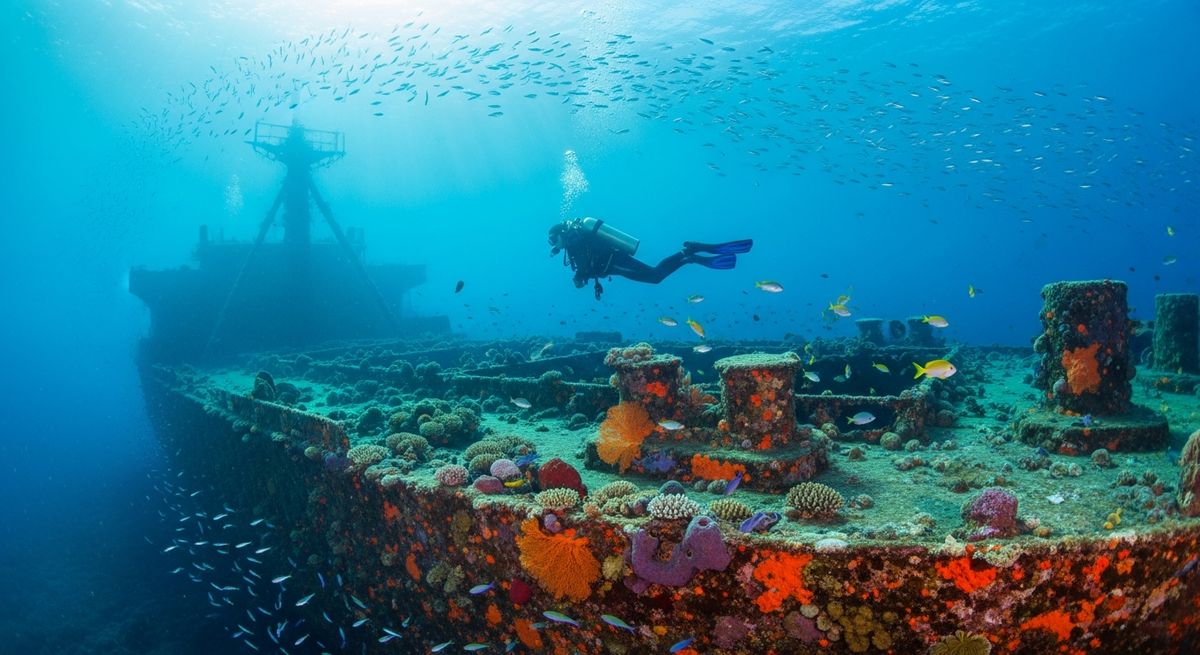
We love a good historical wreck, and the Annie Jane on the Scottish West Coast delivers. She’s a sailing vessel, sunk way back in 1853, a proper classic. At 29 metres, it’s a dive for those comfortable with a bit of depth and cooler water, but what you find down there is truly special. The Annie Jane lies broken, but her sheer size, at 73.2 metres, is still evident. We always find ourselves tracing the collapsed poop deck, imagining the force of that wave that sent her down. There are scattered timbers and metal fittings, giving it that archaeological feel, like you're exploring a forgotten time capsule. Over the decades, the structure has become a home, with colourful anemones clinging to the wood and dead man's fingers adding vibrant splashes of orange. You'll often spot wrasse darting between the frames and, if you're patient, a sneaky conger eel peeking from a dark crevice. Our favourite part is navigating the skeletal remains, feeling the history around you, while the local critters go about their business. It’s a dive that speaks to both the wreck enthusiast and anyone who appreciates a vibrant, naturally colonised artificial reef.
Typical ANNIE JANE Dive Profile
Illustrative profile based on site depth and type. Actual dive profiles vary - always follow your dive computer and training.
Safety Notes
Depth of 29m - Advanced Open Water certification recommended.
Wreck site - avoid penetration without wreck diving certification. Watch for sharp metal and entanglement hazards.
Always perform a 3-minute safety stop at 5m before surfacing.
ANNIE JANE Wreck History
Year Sunk
1853
Vessel Type
passenger ship
Cause
storm
Tonnage
1,294 tons
The Annie Jane was a brand new, three-masted wooden emigrant ship, built in Quebec in 1853. On only her second voyage, she departed Liverpool for Montreal carrying around 450 passengers and crew, the vast majority of whom were emigrants seeking a new life in Canada. The hopes and dreams of all on board were packed into her hull as she set sail into the Atlantic.
Tragedy struck on the night of September 28th, 1853. Caught in a ferocious gale off the Outer Hebrides, the ship was dismasted and became unmanageable. Helpless against the storm, she was driven onto the rocks of West Beach on the island of Vatersay. The vessel broke apart almost immediately in the violent surf, resulting in the catastrophic loss of an estimated 350 lives. With only around 100 survivors, the sinking of the Annie Jane remains one of the worst peacetime maritime disasters in British history.
Today, the wreck of the Annie Jane lies at a depth of 29 meters. The site is a scattered and broken debris field, a testament to the violence of her end and the relentless power of the sea over 170 years. Divers exploring the area will find a poignant scene of ironwork and hull fragments partially buried in the sand. It is a somber dive, a visit to an underwater grave that serves as a powerful memorial to the hundreds who perished in search of a better future.
Reviews for ANNIE JANE
Conditions
Ocean conditions, forecast and tides for ANNIE JANE
Plan & book
Ways to dive Scottish West Coast, from day trips to liveaboards.
Day trips & courses
via GetYourGuideGuided dives, courses and snorkel trips with instant booking.
Find dive trips in Scottish West CoastPlaces to stay
via Booking.comHotels and dive resorts near Scottish West Coast.
Search stays in Scottish West CoastDive insurance
Most travel insurance excludes or limits scuba. Check what you need before you go.
Dive insurance explainedPartner links: we may earn a commission if you book, at no extra cost to you. How we make money
Where to Stay near ANNIE JANE
Prices from Booking.com. We may earn a commission at no extra cost to you.