GENERAL SANTOS CITY
Protected Area
Las Piñas-Parañaque Critical Habitat and Ecotourism Area (LPPCHEA)/Las Piñas-Parañaque
Why dive here
With 57+ marine species recorded in the area - including blacktip reef sharks - GENERAL SANTOS CITY offers some of Subic Bay's richest wreck diving. Water ranges 27-32°C, warmest May, June, July.
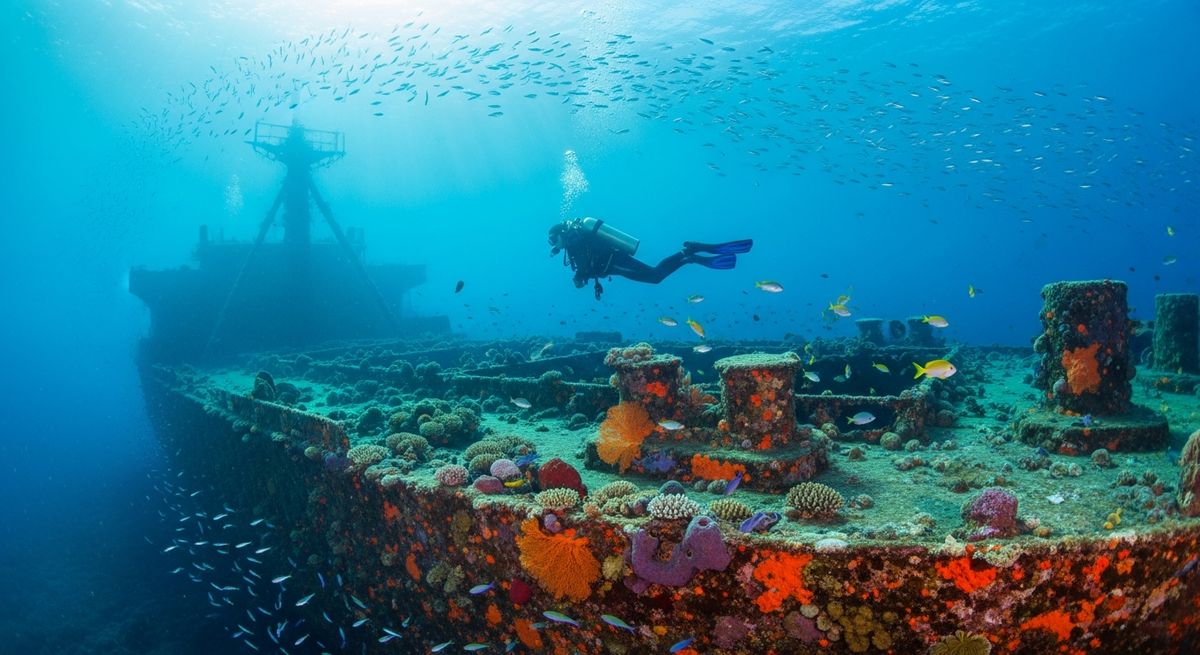
The General Santos City wreck in Subic Bay is a proper dive, one we keep coming back to. She’s a carrier vessel, went down in '76 after a fire, and now rests upright at 25 metres. The visibility here can vary, but on a good day, you'll see the full outline of her as you drop, a dark shape emerging from the blue. What we really like about this wreck is how explorable she is. Her cargo holds are open, inviting you in, and you can swim through large sections, peering into the gloom. The light filters down, playing across the bulkheads, and it’s always a little eerie, a little thrilling. We’ve found a fair few nudibranchs tucked into the crevices, and the resident batfish often hang out around the stern, quite curious as you approach. It’s a dive that rewards slow exploration, looking closely at the details, rather than just zooming past. This site suits divers comfortable with wreck penetration and who appreciate a good historical story with their dive.
Typical GENERAL SANTOS CITY Dive Profile
Illustrative profile based on site depth and type. Actual dive profiles vary - always follow your dive computer and training.
Safety Notes
Depth of 25m - Advanced Open Water certification recommended.
Wreck site - avoid penetration without wreck diving certification. Watch for sharp metal and entanglement hazards.
Always perform a 3-minute safety stop at 5m before surfacing.
Nearest Dive Centres to GENERAL SANTOS CITY
Dive shops near GENERAL SANTOS CITY
Blueworld Dive Center
Scuba Academy Manila
Dive Buddies Philippines
Divers Point
OceanZoneExplorers
Reviews for GENERAL SANTOS CITY
Conditions
Ocean conditions, forecast and tides for GENERAL SANTOS CITY
GENERAL SANTOS CITY Ocean Conditions
Monthly averages for GENERAL SANTOS CITY, sourced from Open-Meteo marine data + Copernicus Marine (EU) - nearest station: Open-Meteo marine grid (14.67, 120.67) (22km away)
October Averages
Sea Temperature
30°C
86°F · Range: 28.8–31.5°C
Current Speed
2.24 cm/s
Direction: NW (296.6°)
Chlorophyll-a
0.071 mg/m³
Very clear (oligotrophic)
Salinity
31.3 PSU
Based on 4 years of monitoring data · Data sources: Open-Meteo marine data + Copernicus Marine (EU)
Plan & book
Ways to dive Subic Bay, from day trips to liveaboards.
Day trips & courses
via GetYourGuideGuided dives, courses and snorkel trips with instant booking.
Find dive trips in Subic BayPlaces to stay
via Booking.comHotels and dive resorts near Subic Bay.
Search stays in Subic BayDive insurance
Most travel insurance excludes or limits scuba. Check what you need before you go.
Dive insurance explainedPartner links: we may earn a commission if you book, at no extra cost to you. How we make money
Where to Stay near GENERAL SANTOS CITY
Prices from Booking.com. We may earn a commission at no extra cost to you.