Diving in Kerama Islands
Why dive here
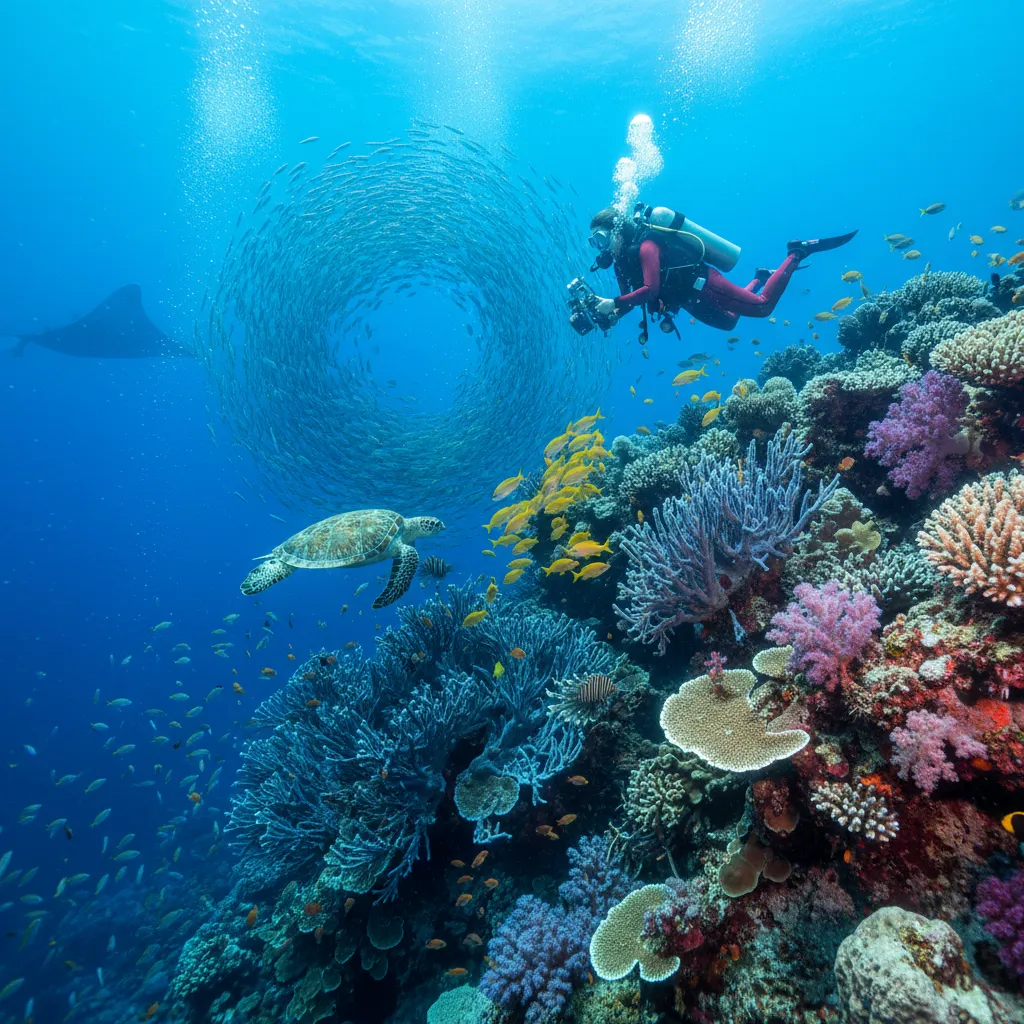
Kerama Islands offers some of Japan's richest diving, with 369+ marine species recorded in the area - including barracuda, bull sharks, humpback whales, seahorses and sea turtles. Water ranges 22-30°C, warmest July, August, September.
The Kerama Islands are a quick boat ride from Naha, but they feel a world away. We love the dramatic blue you get here, often 50 metres or more on a good day, earning it the nickname ‘Kerama Blue’. Our favourite sites are the pinnacles, where you’ll find schools of fusiliers so thick they sometimes block the light. Keep an eye out for green and hawksbill turtles gliding through the shallows. What makes Kerama special, beyond the visibility, is the sheer variety for an archipelago this size. You’ve got walls dropping into the abyss, intricate swim-throughs, and sandy patches perfect for macro hunting. We often spot barred blennies peeking from their holes and tiny orangefin ponyfish fluttering by. During winter months, between January and March, you might even hear the eerie song of humpback whales migrating through, a truly magical experience underwater. Dive early to avoid the crowds, especially at popular spots like Zambami, where the light plays beautifully through the overhangs.
Kerama Islands Dive Site Map
Dive sites and dive centres in Kerama Islands
Kerama Islands Dive Sites
71 dive sites in Kerama Islands
Adan Mae
Adan Mae is one of our favourite Kerama spots, hands down, and it's all about the coral. You drop down onto a gently sloping reef, maybe 12 to 15 metres, and it’s just wall-to-wall hard corals. We're talking serious Montipora plate corals, big old brain corals, and thickets of staghorn that stretch further than you can see. It feels ancient, like a city built by the reef itself. We love hitting Adan Mae in the late morning, when the sun is high. The light really picks out the colours in the coral, and you get these incredible contrasts as the smaller reef fish dart in and out of the shadows. Keep an eye out for the orange-lined triggerfish; they’re often patrolling the bigger coral bommies. It's not a site for big pelagics, but the sheer health and scale of the reef itself is the main attraction here. You want to bring your wide-angle lens for this one. It's a relaxed drift, generally, making it perfect for photographers or anyone who just wants to soak in a truly vibrant coral ecosystem without fighting a current.
Adan Mae
Adan Mae is one of our favourite Kerama spots, hands down, and it's all about the coral. You drop down onto a gently sloping reef, maybe 12 to 15 metres, and it’s just wall-to-wall hard corals. We're talking serious Montipora plate corals, big old brain corals, and thickets of staghorn that stretch further than you can see. It feels ancient, like a city built by the reef itself. We love hitting Adan Mae in the late morning, when the sun is high. The light really picks out the colours in the coral, and you get these incredible contrasts as the smaller reef fish dart in and out of the shadows. Keep an eye out for the orange-lined triggerfish; they’re often patrolling the bigger coral bommies. It's not a site for big pelagics, but the sheer health and scale of the reef itself is the main attraction here. You want to bring your wide-angle lens for this one. It's a relaxed drift, generally, making it perfect for photographers or anyone who just wants to soak in a truly vibrant coral ecosystem without fighting a current.
Agariushi
Agariushi usually gives us a relaxed dive, mostly around 17 meters deep. It’s a good spot to just cruise along, looking for smaller reef fish tucked into the crevices. We often find it's a solid choice when the wind picks up a bit elsewhere, making it suitable for newer divers or those who prefer a less strenuous day out.
Agenashikueda Sango
Agenashikueda Sango, or "Staghorn Coral" in the local dialect, is exactly that: a sprawling, undulating landscape of staghorn. It’s a site that really delivers on its name. We’re talking fields of it, stretching as far as you can see, in shades of brown, green, and pale lavender. When the light hits just right, often mid-morning, the entire reef seems to glow with an almost ethereal quality. We find it’s best approached slowly, letting your eyes adjust to the sheer scale of the coral garden, rather than rushing for big fish. What makes Agenashikueda Sango special, beyond the sheer density of coral, is the subtle life woven through it. Look closely for candy cane wrasse flitting between the branches or the unexpected flash of a bicolor nudibranch on a coral head. It’s a peaceful, somewhat shallow dive, perfect for photographers who appreciate intricate coralscapes and macro subjects. The currents here are generally mild, making it a relaxing drift over one of our favourite coral formations in the Keramas. This site suits divers who appreciate the quiet beauty of a healthy, extensive reef rather than chasing pelagics.
Agenashikueda Sango
Agenashikueda Sango, or "Staghorn Coral" in the local dialect, is exactly that: a sprawling, undulating landscape of staghorn. It’s a site that really delivers on its name. We’re talking fields of it, stretching as far as you can see, in shades of brown, green, and pale lavender. When the light hits just right, often mid-morning, the entire reef seems to glow with an almost ethereal quality. We find it’s best approached slowly, letting your eyes adjust to the sheer scale of the coral garden, rather than rushing for big fish. What makes Agenashikueda Sango special, beyond the sheer density of coral, is the subtle life woven through it. Look closely for candy cane wrasse flitting between the branches or the unexpected flash of a bicolor nudibranch on a coral head. It’s a peaceful, somewhat shallow dive, perfect for photographers who appreciate intricate coralscapes and macro subjects. The currents here are generally mild, making it a relaxing drift over one of our favourite coral formations in the Keramas. This site suits divers who appreciate the quiet beauty of a healthy, extensive reef rather than chasing pelagics.
Aguni Fudensaki
Aguni Fudensaki, off the Kerama Islands, offers a straightforward dive to 19 metres. It's a good spot for intermediate divers looking for a relaxed profile. You'll find a range of typical Kerama reef residents here, with schooling fish often present. It's a solid choice for a second or third dive of the day, unchallenging and generally calm.
Akasanbashi Mae
Akasanbashi Mae. It’s one of those Kerama sites we always try to squeeze in, especially when the light is just right. You drop onto a sprawling coral garden, mostly hard corals, dominated by huge stands of staghorn. We love drifting over it in the late morning, watching the sunlight dapple through the branches. It creates these shifting patterns of light and shadow, and that’s when the fish really come alive – clouds of fusiliers and damselfish moving as one. The corals themselves, particularly the honeycomb and brain corals, are surprisingly vibrant. We’ve spotted some pretty impressive parrotfish munching away on them, too. It’s a pretty gentle dive, perfect for just relaxing and taking it all in, which makes it a great spot for newer divers or anyone looking for a stress-free second dive. The currents are usually mild here, but keep an eye on the tide charts – a gentle drift can turn into a bit more of a push if you catch it wrong. We’d suggest going early, before the bigger boats arrive, for a quieter experience.
Ama Beach
Ama Beach is a straightforward shore dive, perfect for those new to diving or looking for an easy day. We often find juvenile reef fish sheltering amongst the scattered corals here. The maximum depth of 15 metres means long bottom times are possible, making it a good spot for buoyancy practice or leisurely exploration. Expect a relaxed dive with consistent conditions.
Ama Beach Mae
Ama Beach Mae, for us, is a gentle welcome to the Keramas. It’s perfect for easing into the local diving, maybe even for a longer shore dive if you're keen to explore at your own pace. The site drops gradually from the beach, a sandy slope giving way to these incredible fields of staghorn coral. Not just a few patches, but vast, sprawling gardens where clown anemonefish zip in and out of their homes. We often spot juvenile rock cod tucked amongst the coral branches, and if you look closely, you might even find a bicolor nudibranch inching along a leaf coral. The visibility here is usually excellent, often reaching 20-30 meters, so you get these expansive views of the whole coral landscape. We love it as a morning dive, when the sunbeams slice through the water, illuminating the corals in a way that just feels magical. It’s not a drift dive, so you can really take your time, get low, and observe the smaller critters.
Ama Beach Mae
Ama Beach Mae, for us, is a gentle welcome to the Keramas. It’s perfect for easing into the local diving, maybe even for a longer shore dive if you're keen to explore at your own pace. The site drops gradually from the beach, a sandy slope giving way to these incredible fields of staghorn coral. Not just a few patches, but vast, sprawling gardens where clown anemonefish zip in and out of their homes. We often spot juvenile rock cod tucked amongst the coral branches, and if you look closely, you might even find a bicolor nudibranch inching along a leaf coral. The visibility here is usually excellent, often reaching 20-30 meters, so you get these expansive views of the whole coral landscape. We love it as a morning dive, when the sunbeams slice through the water, illuminating the corals in a way that just feels magical. It’s not a drift dive, so you can really take your time, get low, and observe the smaller critters.
Ama Ushiji
Ama Ushiji isn’t just another Kerama site; it’s one of those places we return to repeatedly for a reason. Imagine the sunlight, bright and fractured, illuminating massive honeycomb and staghorn coral formations. We love drifting through the gaps, spotting leopard hinds peeking out, or just marveling at the sheer scale of the hard coral. The Chinese lettuce coral here grows in huge, undulating plates, creating these incredible, almost alien landscapes. Visibility here can be exceptional, often extending past 25 metres, especially around midday. It’s a site that rewards a slow pace. Don’t rush past the smaller stuff; the sebae anemones are always worth a closer look for their resident clownfish. For photographers, the interplay of light and shadow on the corals is a constant challenge and a huge draw. We’d suggest going on a sunny day to truly appreciate the colours.
Ariga Cable
Ariga Cable sits at a comfortable 17 meters, a gentle dive well-suited for beginners finding their fins. We’ve found it’s a good spot for spotting the smaller stuff, nudibranchs often make an appearance on the coral heads. There's a decent chance of seeing reef fish going about their day. It’s a relaxed entry, perfect for getting comfortable with the Kerama Islands' calm conditions.
Show all 71 dive sites in Kerama Islands
- Cape Kyan
- Cape No.6
- Cape No.7
- Chishi
- Crevasse
- Dragon Lady
- Gahi Mae
- Gahi Ura
- Gahi Ura
- Gina
- Gishippu Island
- Hanare Beach
- Hate No Hama
- Hidenchigama
- Ibo-ibo Sango
- Imazuni
- Jitsuru
- Kadena North Marker
- Kame Paradise
- Kamigu
- Kamiyama Labyrinth
- Kamiyama North
- KRM
- Kuefu Island North
- Kuroshima North Twin Rock
- Kuroshima South
- Nagannu North
- Nagannu South
- Nakachiburu
- Nakjnin Blue
- Nami no ue Seaside
- Nishi Hama
- Nita Cave
- Nita Doukutsu
- Nita Doukutsu
- Nozaki
- Oodo Beach
- Paraiso
- Sakubaru Gyosho
- Sanchin
- Sand Triangle
- Sea Wall Steps
- Shimozone
- Shiru Higashi
- Shiru Higashi
- Sunabe
- Tokashiki Lighthouse
- Tokashiki Three Rocks
- Tokashiku Beach Front
- Tokomasari Reef
- Toma No.1
- Tonbara
- Uchizan
- Ufutama
- Ugan
- Umagai
- Uminchu
- Uroro no Sachi
- Zamami Lighthouse
Kerama Islands Dive Centres
8 dive shops and operators in Kerama Islands
Ocean Wildlife in Kerama Islands
369 species recorded in Kerama Islands
Kerama Islands Daylight & Sunrise/Sunset
Sunrise and sunset times for Kerama Islands, calculated from coordinates
Today - Sunday 11 October
Sunrise
05:28
Sunset
17:08
Daylight
11h 40m
Golden Hour
16:38
First light (dawn) at 05:05 · Last light (dusk) at 17:32
Monthly Averages
| Month | Sunrise | Sunset | Daylight |
|---|---|---|---|
| Jan | 06:20 | 17:00 | 10h 40m |
| Feb | 06:08 | 17:24 | 11h 16m |
| Mar | 05:41 | 17:40 | 11h 58m |
| Apr | 05:08 | 17:54 | 12h 46m |
| May | 04:45 | 18:10 | 13h 25m |
| JunLongest | 04:39 | 18:25 | 13h 46m |
| Jul | 04:48 | 18:26 | 13h 38m |
| Aug | 05:04 | 18:09 | 13h 5m |
| Sep | 05:17 | 17:37 | 12h 20m |
| OctNow | 05:30 | 17:04 | 11h 34m |
| Nov | 05:50 | 16:42 | 10h 53m |
| DecShortest | 06:11 | 16:42 | 10h 31m |
Times are approximate local times based on longitude. Actual times may vary slightly depending on the exact timezone observed in Kerama Islands.
Where to Stay near Kerama Islands
Prices from Booking.com. We may earn a commission at no extra cost to you.
Marine Protected Areas near Kerama Islands
11 protected areas near Kerama Islands - please respect local regulations when diving
共同漁業権区域(沖縄県)
慶良間諸島
沖縄海岸
Keramashoto Coral Reef
久米島
やんばる
屋我地
沖縄戦跡
渡名喜
大保
チービシ
Getting to Kerama Islands
Naha
Okinawa
Kumejima
Plan & book
Ways to dive Kerama Islands, from day trips to liveaboards.
Day trips & courses
via GetYourGuideGuided dives, courses and snorkel trips with instant booking.
Find dive trips in Kerama IslandsPlaces to stay
via Booking.comHotels and dive resorts near Kerama Islands.
Search stays in Kerama IslandsDive insurance
Most travel insurance excludes or limits scuba. Check what you need before you go.
Dive insurance explainedPartner links: we may earn a commission if you book, at no extra cost to you. How we make money