ACHAIOS (POSSIBLY)
Protected Area
MPA Dasoudi
Why dive here
With 43+ marine species recorded in the area - including sea turtles - ACHAIOS (POSSIBLY) offers some of Paphos & Coral Bay's richest wreck diving. Water ranges 18-28°C, warmest July, August, September.
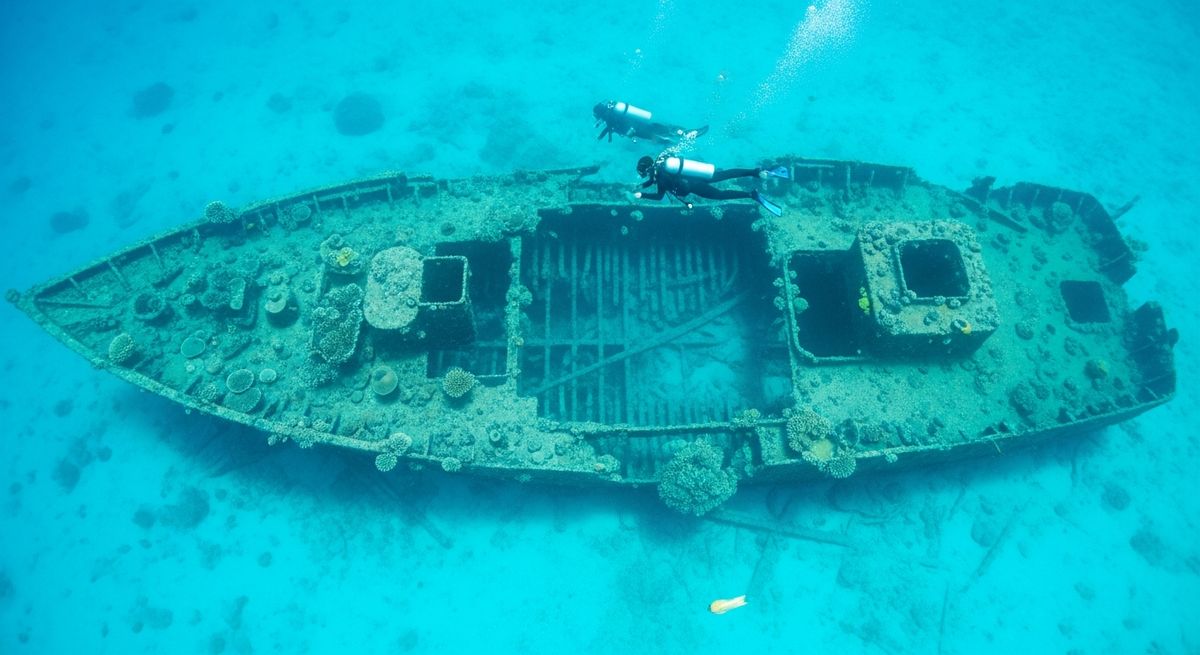
Okay, the Achaios. Or what we think is the Achaios, anyway. It’s tricky because the site we dive has a similar profile to the historical wreck data, but it’s a bit shallower than some records suggest. Regardless, we love this spot for a gentle, easy dive. The whole wreck lies in just 3m of water, which makes it absolutely perfect for snorkelers or anyone keen on a really long bottom time without pushing deco limits. What you get here is the skeletal remains of a decent-sized cargo ship, lying broken up on a sandy seabed. You can trace the ribs of the hull, and some of the thicker plates are still substantial enough to provide good shelter. We’ve found barracuda often hang out in the shadowy sections, just off the main structure. Look closely for nudibranchs, especially around any parts with algal growth. Visibility here can vary, but on a good day, with the sun high, the light filtering down into the wreck is quite beautiful, illuminating the rusted metal in shades of orange and brown. It’s a completely different vibe from a deep wreck dive, more like an archaeological exploration of a forgotten hulk. We’d suggest going early in the morning before any surface chop picks up; it really helps with the ambient light and makes spotting the smaller stuff easier.
Typical ACHAIOS (POSSIBLY) Dive Profile
Illustrative profile based on site depth and type. Actual dive profiles vary - always follow your dive computer and training.
Safety Notes
Wreck site - avoid penetration without wreck diving certification. Watch for sharp metal and entanglement hazards.
ACHAIOS (POSSIBLY) Wreck History
Year Sunk
1976
Vessel Type
cargo ship
Cause
grounding
The motor vessel Achaios was built in 1932 in Porsgrunn, Norway. At the time of her loss, she was a Greek-owned vessel operated by the Akarnania Maritime Co Ltd. The uncertainty in her identification, noted by the '(POSSIBLY)' in some records, adds a layer of mystery for divers exploring her remains.
On December 3, 1976, the Achaios was on a passage from Yugoslavia to Jeddah with a full cargo of timber. While navigating the waters off Paphos, she was caught in heavy weather and ran aground. The powerful waves and rocky shoreline sealed her fate, breaking the ship apart and scattering her cargo.
Resting in just 3 meters of water, the Achaios is an incredibly accessible dive site, perfect for beginners, snorkelers, and even freedivers. Decades of exposure to the surf have left the wreck heavily broken up, but divers can still identify large sections of the hull, machinery, and the ship's boilers. The shallow, sunlit waters have allowed a vibrant ecosystem to flourish on the wreckage, making it a lively and fascinating site for an easy coastal dive.
Nearest Dive Centres to ACHAIOS (POSSIBLY)
Dive shops near ACHAIOS (POSSIBLY)
Sea World Diving Adventures
Ninos Diving Centre
The Aquatic Centre
Pissouri Bay Divers
CREST DIVE LTD
Freedom Divers Cyprus
Reviews for ACHAIOS (POSSIBLY)
Conditions
Ocean conditions, forecast and tides for ACHAIOS (POSSIBLY)
ACHAIOS (POSSIBLY) Ocean Conditions
Monthly averages for ACHAIOS (POSSIBLY), sourced from Open-Meteo marine data - nearest station: Open-Meteo marine grid (34.73, 32.45) (18km away)
October Averages
Sea Temperature
26°C
78°F · Range: 24.4–27.2°C
Air Temperature
23°C
73°F
Wind Speed
4.1 m/s
8.0 knots
Atmospheric Pressure
1015 hPa
Based on 4 years of monitoring data · Data sources: Open-Meteo marine data
Plan & book
Ways to dive Paphos & Coral Bay, from day trips to liveaboards.
Day trips & courses
via GetYourGuideGuided dives, courses and snorkel trips with instant booking.
Find dive trips in Paphos & Coral BayPlaces to stay
via Booking.comHotels and dive resorts near Paphos & Coral Bay.
Search stays in Paphos & Coral BayDive insurance
Most travel insurance excludes or limits scuba. Check what you need before you go.
Dive insurance explainedPartner links: we may earn a commission if you book, at no extra cost to you. How we make money
Where to Stay near ACHAIOS (POSSIBLY)
Prices from Booking.com. We may earn a commission at no extra cost to you.