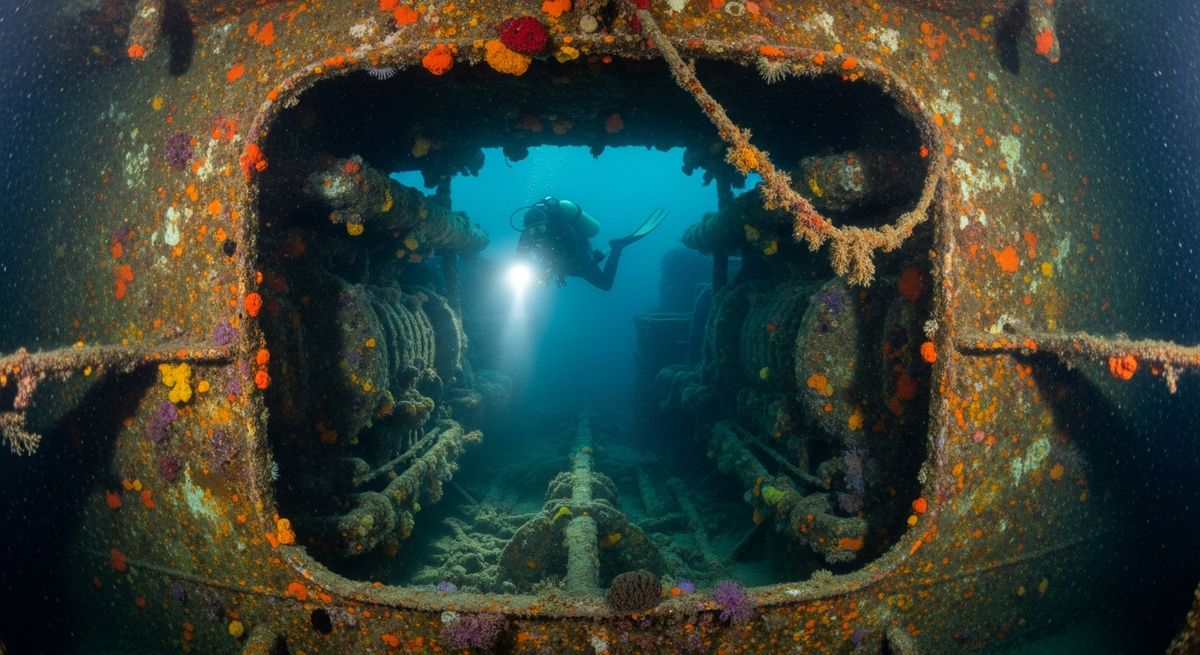
MOYALLA - West Coast

Moyalla isn't a deep dive, sitting in just 5 metres, but what it lacks in depth it more than makes up for in character. This old steamship, built in '27 and sunk in '46, feels like a proper piece of history down there. We love the way the light filters through the kelp, dappling the deck plates and giving everything a muted, emerald glow. You can really get a sense of its past life, tracing the line of the hull for the full 58 metres. For us, the real magic is in the details – the exposed ribs, the scattered plates, and how life has just taken over. You'll spot plenty of wrasse darting in and out of the nooks and crannies, and we've often seen spider crabs scuttling across the deck, completely camouflaged. It’s a site that rewards a slow pace, letting your eyes adjust to the low light. Our tip? Go on a calm day with good visibility. It just transforms the whole experience from a murky exploration into a truly evocative dive. It’s a site for those who appreciate maritime history and the quiet beauty of a wreck reclaimed by the sea.

Location
West Coast, Ireland, Mediterranean & Europe
Coordinates
53.235718, -9.108450
Type
wreck
Maximum Depth
5m

Marine Protected Area: Inner Galway Bay

Best Time to Dive in West Coast

The warmest water temperatures in West Coast occur in January, averaging 8.9°C. The coolest conditions are in December at 8.9°C.

Monthly Water Temperatures

  • January: 8.9°C (air: 7.2°C)
  • February: 8.9°C (air: 8.0°C)
  • March: 8.9°C (air: 8.0°C)
  • April: 8.9°C (air: 9.8°C)
  • May: 8.9°C (air: 12.0°C)
  • June: 8.9°C (air: 14.2°C)
  • July: 8.9°C (air: 15.2°C)
  • August: 8.9°C (air: 15.9°C)
  • September: 8.9°C (air: 14.8°C)
  • October: 8.9°C (air: 12.4°C)
  • November: 8.9°C (air: 10.3°C)
  • December: 8.9°C (air: 8.1°C)

Nearby Dive Sites in West Coast

Nearest Dive Centres to MOYALLA

Marine Life in West Coast

Home to 183 recorded species including 86 reef fish, 20 sharks & rays, 15 whales & dolphins, 12 other, 10 seagrass & algae, 8 crabs & lobsters.

Notable Species

  • dogfish (Scyliorhinus canicula) - Sharks & Rays
  • Haddock (Melanogrammus aeglefinus) - Reef Fish
  • hake (Merluccius merluccius) - Reef Fish
  • grey gurnard (Eutrigla gurnardus) - Reef Fish
  • whiting (Merlangius merlangus) - Reef Fish
  • Split (Scomber scombrus) - Reef Fish
  • megrim (Lepidorhombus whiffiagonis) - Reef Fish
  • Pollock (Trachurus trachurus) - Reef Fish
  • Common dragonet (Callionymus lyra) - Reef Fish
  • poor cod (Trisopterus minutus) - Reef Fish
  • blue whiting (Micromesistius poutassou) - Reef Fish
  • Boarfish (Capros aper) - Reef Fish
  • Protestant (Clupea harengus) - Reef Fish
  • lesser argentine (Argentina sphyraena) - Reef Fish
  • Soldier (Chelidonichthys cuculus) - Reef Fish
  • Angler (Lophius piscatorius) - Reef Fish
  • dab (Limanda limanda) - Reef Fish
  • Cape Shark (Squalus acanthias) - Sharks & Rays
  • sprat (Sprattus sprattus) - Reef Fish
  • Bastard Sole (Microchirus variegatus) - Reef Fish

Recommended Packing List for MOYALLA

Based on average water temperature of 8.9°C.

  • Drysuit - water at 9°C demands a drysuit with thermal undergarments
  • Hood & Gloves (7mm+) - critical to prevent heat loss
  • Mask - essential for every dive
  • Fins
  • BCD - buoyancy compensator
  • Regulator - your most safety-critical piece of gear
  • Dive Computer - tracks depth, time, and NDL
  • Surface Marker Buoy (SMB) - essential for boat pickups
  • Dive Torch - useful for crevices and colour at depth
  • Underwater Camera - capture your diving memories

Frequently Asked Questions

What is the typical depth range for diving the S.S. Moyalla shipwreck?
The S.S. Moyalla shipwreck is found at a typical depth of 5 meters, making it a relatively shallow wreck dive. This accessible depth allows for extended bottom times to explore the vessel, which is located off the West Coast of Ireland.
What kind of marine life and historical artifacts can divers expect to see at the Moyalla dive site?
The primary historical artifact at the Moyalla dive site is the wreck of the S.S. Moyalla itself, a steam ship vessel built in 1927 and sunk in 1946. Divers can explore its hull and superstructure, measuring 58m x 9.3m, offering a tangible glimpse into maritime history. Specific details regarding marine life commonly found at this site are not available in the current data, but you can explore general marine life information on our wildlife database.
How challenging is diving the S.S. Moyalla wreck, and is it suitable for beginner divers?
Diving the S.S. Moyalla wreck is classified as an intermediate difficulty dive. While its shallow depth of 5 meters is appealing, the nature of wreck diving often requires specific skills and experience beyond basic open water certification. Therefore, it may not be suitable for absolute beginner divers without appropriate supervision or advanced training.
What are the best months or weather conditions for diving the Moyalla shipwreck in Galway Bay?
Specific information regarding the best months or optimal weather conditions for diving the S.S. Moyalla shipwreck is not provided in the current data. Divers planning a trip to Ireland's West Coast should generally consider local weather patterns and sea conditions, which can vary significantly. For more general guidance on when to dive, please visit our When to Dive section.
Are there any specific diving certifications required to explore the S.S. Moyalla wreck?
While the S.S. Moyalla wreck is at a shallow depth of 5 meters, its classification as an intermediate dive suggests that divers should possess experience beyond entry-level certifications. Exploring wrecks often benefits from specialized training in wreck diving or advanced open water skills to safely navigate the site. Always check with local dive operators for their specific requirements.
What are the typical current conditions and visibility like at the Moyalla dive site?
Details regarding the typical current conditions and visibility at the Moyalla dive site are not provided in the available data. Divers should always consult with local dive centers or guides immediately prior to their dive for the most up-to-date information on site conditions, as these can change frequently.