OKEANOS - West Coast

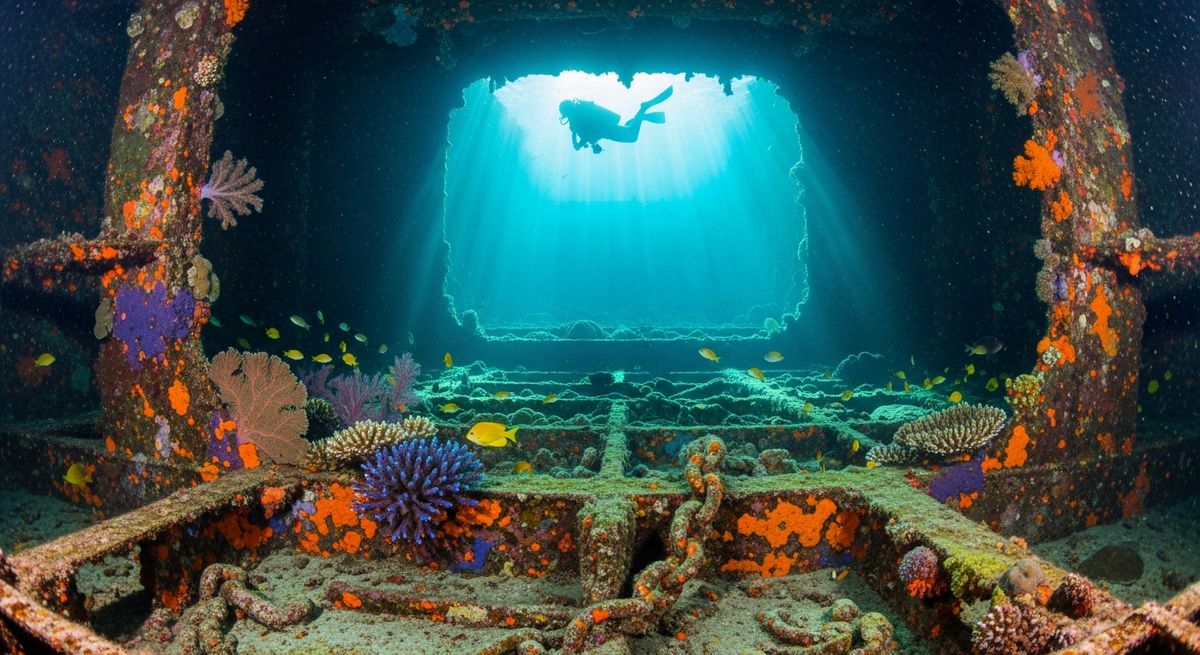
Okeanos isn't about depth, that's for sure. At a maximum of two metres, this is truly a snorkel or very shallow breath-hold dive, but don't let the shallowness fool you. We love it for the sheer history of it, right there off the West Coast of Ireland, almost within touching distance. The steamship ran aground in 1947, and she's still very much present, wedged between two rocky ledges. You'll see her plates, some twisted metal, and the ghostly outline of what was once a grand vessel. The triple-expansion engine is still there, too, a real marvel of engineering now slowly dissolving back into the sea. Our favourite part is the way the light plays through the kelp, illuminating patches of the wreck and the small crabs that scuttle over the barnacle-encrusted steel. It's a proper wreck, just scaled down for easy access, and perfect for photographers looking to capture that eerie, atmospheric shot without needing to get deep. This one suits anyone who appreciates a good story with their snorkel.

Location
West Coast, Ireland, Mediterranean & Europe
Coordinates
52.584366, -9.695500
Type
wreck
Maximum Depth
2m

Marine Protected Area: Illaunonearaun SPA

Best Time to Dive in West Coast

The warmest water temperatures in West Coast occur in January, averaging 8.9°C. The coolest conditions are in December at 8.9°C.

Monthly Water Temperatures

  • January: 8.9°C (air: 7.2°C)
  • February: 8.9°C (air: 8.0°C)
  • March: 8.9°C (air: 8.0°C)
  • April: 8.9°C (air: 9.8°C)
  • May: 8.9°C (air: 12.0°C)
  • June: 8.9°C (air: 14.2°C)
  • July: 8.9°C (air: 15.2°C)
  • August: 8.9°C (air: 15.9°C)
  • September: 8.9°C (air: 14.8°C)
  • October: 8.9°C (air: 12.4°C)
  • November: 8.9°C (air: 10.3°C)
  • December: 8.9°C (air: 8.1°C)

Nearby Dive Sites in West Coast

Nearest Dive Centres to OKEANOS

Marine Life in West Coast

Home to 183 recorded species including 86 reef fish, 20 sharks & rays, 15 whales & dolphins, 12 other, 10 seagrass & algae, 8 crabs & lobsters.

Notable Species

  • dogfish (Scyliorhinus canicula) - Sharks & Rays
  • Haddock (Melanogrammus aeglefinus) - Reef Fish
  • hake (Merluccius merluccius) - Reef Fish
  • grey gurnard (Eutrigla gurnardus) - Reef Fish
  • whiting (Merlangius merlangus) - Reef Fish
  • Split (Scomber scombrus) - Reef Fish
  • megrim (Lepidorhombus whiffiagonis) - Reef Fish
  • Pollock (Trachurus trachurus) - Reef Fish
  • Common dragonet (Callionymus lyra) - Reef Fish
  • poor cod (Trisopterus minutus) - Reef Fish
  • blue whiting (Micromesistius poutassou) - Reef Fish
  • Boarfish (Capros aper) - Reef Fish
  • Protestant (Clupea harengus) - Reef Fish
  • lesser argentine (Argentina sphyraena) - Reef Fish
  • Soldier (Chelidonichthys cuculus) - Reef Fish
  • Angler (Lophius piscatorius) - Reef Fish
  • dab (Limanda limanda) - Reef Fish
  • Cape Shark (Squalus acanthias) - Sharks & Rays
  • sprat (Sprattus sprattus) - Reef Fish
  • Bastard Sole (Microchirus variegatus) - Reef Fish

Recommended Packing List for OKEANOS

Based on average water temperature of 8.9°C.

  • Drysuit - water at 9°C demands a drysuit with thermal undergarments
  • Hood & Gloves (7mm+) - critical to prevent heat loss
  • Mask - essential for every dive
  • Fins
  • BCD - buoyancy compensator
  • Regulator - your most safety-critical piece of gear
  • Dive Computer - tracks depth, time, and NDL
  • Surface Marker Buoy (SMB) - essential for boat pickups
  • Dive Torch - useful for crevices and colour at depth
  • Underwater Camera - capture your diving memories

Frequently Asked Questions

What are the typical diving depths at OKEANOS dive sites?
The OKEANOS dive site is remarkably shallow, with a typical diving depth of just 2 meters. This makes it an accessible wreck dive, allowing for extended bottom times and excellent light penetration. You can explore this fascinating wreck in the waters of Ireland.
What kind of marine life and underwater features can divers expect to see at OKEANOS?
At the OKEANOS dive site, divers can expect to explore the remains of a steam ship vessel, built in 1918 and sunk in 1947. The wreck features a 3 cylinder triple expansion engine and 3 boilers, offering a glimpse into early 20th-century maritime engineering. While specific marine life details are not provided, wrecks like OKEANOS often become artificial reefs, attracting various local species.
How challenging are the dives at OKEANOS, and is it suitable for beginner divers?
Dives at the OKEANOS wreck are classified as intermediate difficulty. This suggests that while it is not suitable for absolute beginners, divers with some experience and appropriate training should find it manageable. The shallow depth of 2 meters contributes to its accessibility, but potential factors like currents or specific wreck penetration skills might elevate the difficulty.
What is the best time of year to dive OKEANOS for optimal conditions and marine encounters?
Information regarding the best time of year to dive OKEANOS for optimal conditions and marine encounters is not available in the provided data. For general guidance on diving seasons in Ireland, we recommend consulting our When to Dive resource.
What scuba diving certifications are required or recommended for diving with OKEANOS?
Given the intermediate difficulty rating for the OKEANOS wreck dive, an Open Water Diver certification is likely a minimum, but an Advanced Open Water certification or a Wreck Diver specialty course would be highly recommended. These certifications would equip divers with the skills and experience necessary to safely explore this historical steam ship.
What are the typical current conditions and visibility like at OKEANOS dive locations?
Details regarding the typical current conditions and visibility at the OKEANOS dive location are not specified in the provided data. Divers planning to visit this West Coast Ireland site should consult local dive operators for up-to-date information on conditions.