ST OLIVER - West Coast

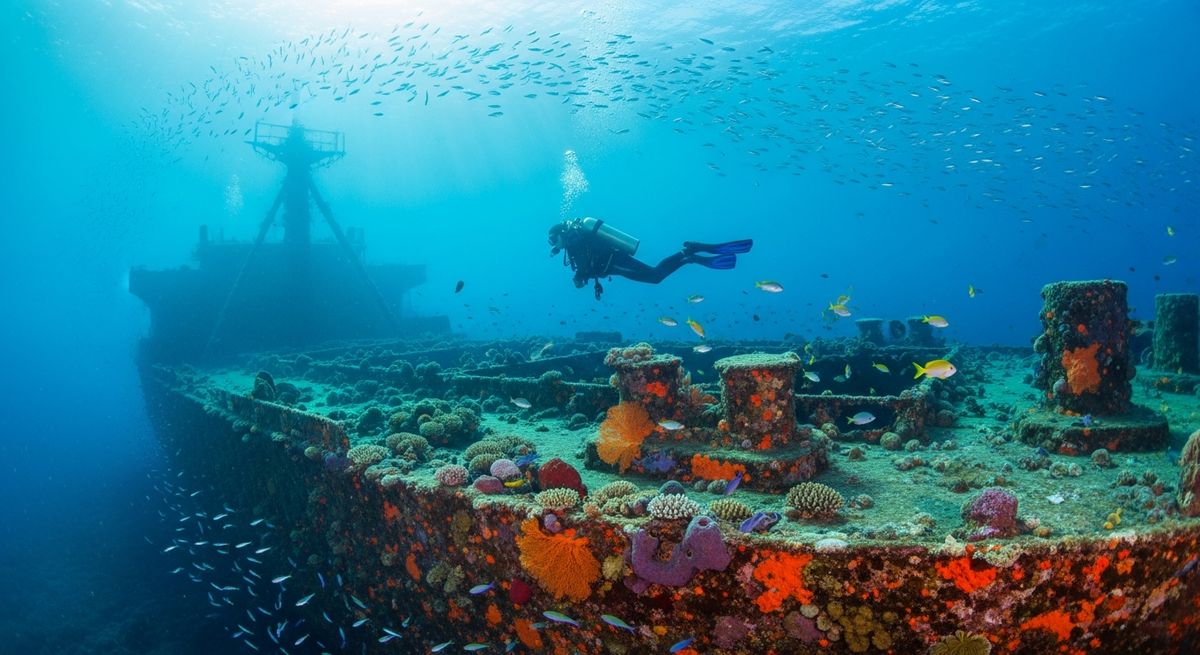
The St. Oliver, a fishing vessel built in Dingle in 1975, met its end on the rocks of the Aran Isles in 2004. We're looking at a wreck here, about 19.8 meters long, lying shallow enough that its hull or superstructure still breaks the surface. It’s a somber site, a reminder of the sea’s power, but beneath the waves, life finds a way. Expect to see the typical Irish cold-water residents - wrasse darting through the broken timbers, maybe a conger eel peeking from a dark crevice. This is a site for those interested in maritime history and how wrecks become artificial reefs; it’s not about vibrant corals, but the stark beauty of a man-made structure reclaimed by the ocean.

Location
West Coast, Ireland, Mediterranean & Europe
Coordinates
53.298500, -9.859167
Type
wreck
Maximum Depth
0m

Marine Protected Area: Slyne Head to Ardmore Point Islands SPA

Best Time to Dive in West Coast

The warmest water temperatures in West Coast occur in January, averaging 8.9°C. The coolest conditions are in December at 8.9°C.

Monthly Water Temperatures

  • January: 8.9°C (air: 7.2°C)
  • February: 8.9°C (air: 8.0°C)
  • March: 8.9°C (air: 8.0°C)
  • April: 8.9°C (air: 9.8°C)
  • May: 8.9°C (air: 12.0°C)
  • June: 8.9°C (air: 14.2°C)
  • July: 8.9°C (air: 15.2°C)
  • August: 8.9°C (air: 15.9°C)
  • September: 8.9°C (air: 14.8°C)
  • October: 8.9°C (air: 12.4°C)
  • November: 8.9°C (air: 10.3°C)
  • December: 8.9°C (air: 8.1°C)

Nearby Dive Sites in West Coast

Nearest Dive Centres to ST OLIVER

Marine Life in West Coast

Home to 183 recorded species including 86 reef fish, 20 sharks & rays, 15 whales & dolphins, 12 other, 10 seagrass & algae, 8 crabs & lobsters.

Notable Species

  • dogfish (Scyliorhinus canicula) - Sharks & Rays
  • Haddock (Melanogrammus aeglefinus) - Reef Fish
  • hake (Merluccius merluccius) - Reef Fish
  • grey gurnard (Eutrigla gurnardus) - Reef Fish
  • whiting (Merlangius merlangus) - Reef Fish
  • Split (Scomber scombrus) - Reef Fish
  • megrim (Lepidorhombus whiffiagonis) - Reef Fish
  • Pollock (Trachurus trachurus) - Reef Fish
  • Common dragonet (Callionymus lyra) - Reef Fish
  • poor cod (Trisopterus minutus) - Reef Fish
  • blue whiting (Micromesistius poutassou) - Reef Fish
  • Boarfish (Capros aper) - Reef Fish
  • Protestant (Clupea harengus) - Reef Fish
  • lesser argentine (Argentina sphyraena) - Reef Fish
  • Soldier (Chelidonichthys cuculus) - Reef Fish
  • Angler (Lophius piscatorius) - Reef Fish
  • dab (Limanda limanda) - Reef Fish
  • Cape Shark (Squalus acanthias) - Sharks & Rays
  • sprat (Sprattus sprattus) - Reef Fish
  • Bastard Sole (Microchirus variegatus) - Reef Fish

Recommended Packing List for ST OLIVER

Based on average water temperature of 8.9°C.

  • Drysuit - water at 9°C demands a drysuit with thermal undergarments
  • Hood & Gloves (7mm+) - critical to prevent heat loss
  • Mask - essential for every dive
  • Fins
  • BCD - buoyancy compensator
  • Regulator - your most safety-critical piece of gear
  • Dive Computer - tracks depth, time, and NDL
  • Surface Marker Buoy (SMB) - essential for boat pickups
  • Dive Torch - useful for crevices and colour at depth
  • Underwater Camera - capture your diving memories

Frequently Asked Questions

What is the typical depth range for diving at the ST OLIVER dive site?
The ST OLIVER dive site is listed with a depth of 0m. This indicates it is an extremely shallow site, likely at or just below the surface, or referring to the shallowest point of the wreck. Divers should be prepared for very shallow conditions when exploring the remains of this vessel.
What marine life and underwater topography can divers expect to encounter at ST OLIVER?
The ST OLIVER is a fishing vessel wreck, measuring 19.8m x 6.3m, which ran aground and broke up. Divers can expect to explore the remains of this wreck, classified as showing any portion of its hull or superstructure. While specific marine life isn't detailed in the provided data, wrecks often become artificial reefs, attracting various local species, which you can learn more about in our wildlife database.
Is the ST OLIVER dive site suitable for beginner divers, or is it considered advanced?
The ST OLIVER dive site is classified with an intermediate difficulty rating. This suggests it is not typically suitable for absolute beginner divers, but rather for those with some prior diving experience. Divers should possess the necessary skills and confidence for intermediate-level wreck dives.
What are the best months or seasons to dive at ST OLIVER for optimal conditions and visibility?
The provided data does not specify the best months or seasons for diving at the ST OLIVER site for optimal conditions and visibility. For general guidance on diving in Ireland, please consult our When to Dive section for broader seasonal recommendations.
Are there any specific scuba diving certifications required to dive at the ST OLIVER site?
While no specific certifications are explicitly listed for the ST OLIVER dive site, its intermediate difficulty rating implies that divers should have appropriate training and experience. Typically, an Advanced Open Water certification or equivalent is recommended for intermediate wreck dives to ensure diver safety and enjoyment. Always check with local dive operators for their specific requirements.
What are the usual current strengths and water conditions like at the ST OLIVER dive site?
The provided data does not include information on the usual current strengths or specific water conditions at the ST OLIVER dive site. Divers planning to visit this wreck should consult local dive centers or guides for the most up-to-date information on currents and conditions in the West Coast of Ireland.