CALA PINAR
Protected Area
Espacio marino del Baix Llobregat-Garraf
Why dive here
With 44+ marine species recorded in the area - including dolphins, ocean sunfish (mola mola) and sea turtles - CALA PINAR offers some of Costa Brava's richest wreck diving. Water ranges 13-25°C, warmest July, August, September.
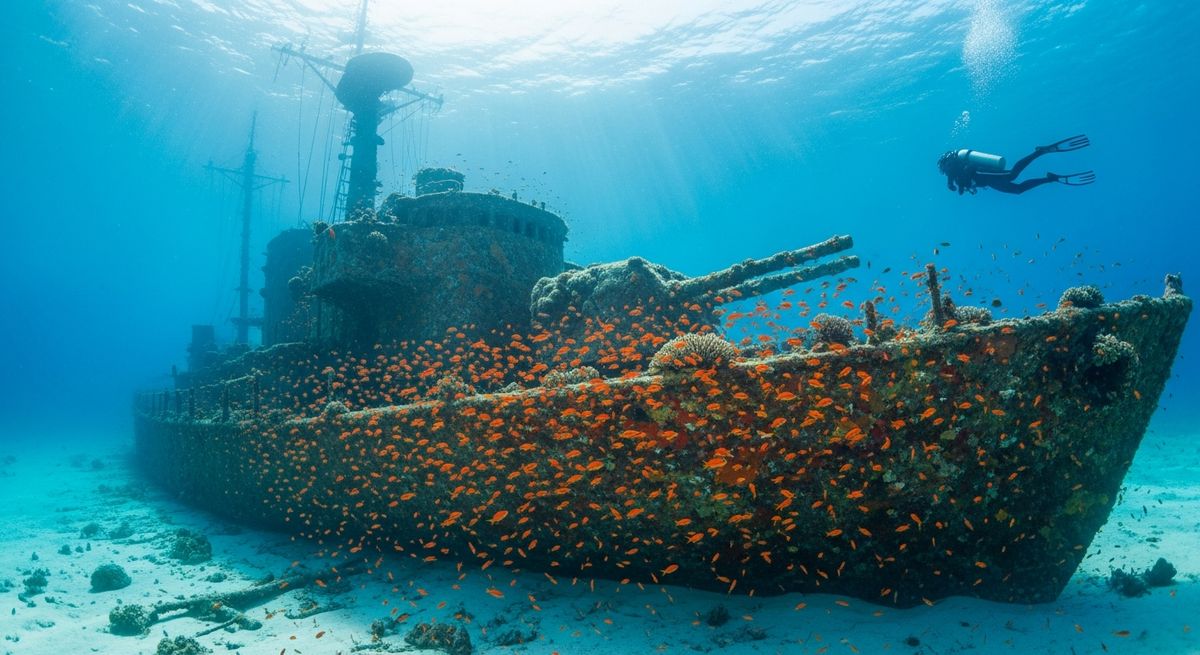
Cala Pinar has a bit of a story, one we really like. It’s not your typical wreck dive, given it actually sank twice. First in 1970, then salvaged, only to go down again permanently not long after. Today, it’s settled upright at a comfortable 13 metres, right by the shore. What you get is a shallow, approachable wreck, perfect for extending your bottom time. We love the way the light filters through the propellor and across the deck, illuminating the resident damselfish flitting around the superstructure. Look for moray eels tucked into crevices in the hull – we've spotted a few there over the years. This spot works really well for newer divers getting their first taste of wreck diving, but it’s just as good for experienced eyes wanting to slow down and really observe the small details and the marine life that now calls this vessel home. Our favourite time to dive it is late afternoon, when the sun starts to drop and the colours really pop.
Typical CALA PINAR Dive Profile
Illustrative profile based on site depth and type. Actual dive profiles vary - always follow your dive computer and training.
Safety Notes
Wreck site - avoid penetration without wreck diving certification. Watch for sharp metal and entanglement hazards.
Always perform a 3-minute safety stop at 5m before surfacing.
CALA PINAR Wreck History
Year Sunk
1970
Vessel Type
cargo ship
Cause
unknown
The Cala Pinar holds a particularly unusual place in maritime history, as it's the wreck of a ship that was ultimately saved. On June 4, 1970, the motor vessel developed a critical leak in its hull and sank to the seabed off the Costa Brava, coming to rest at a shallow depth of 13 meters. For most ships, this would be the final chapter, but not for the Cala Pinar.
In a remarkable salvage operation that unfolded over the next three months, a team of divers descended to the sunken vessel to painstakingly remove its cargo. Once the holds were empty, the ship itself was successfully refloated, patched up, and towed away for repairs, eventually expected to return to service. Because the vessel was recovered, divers visiting the location today will not find an intact shipwreck. Instead, the site is a debris field-a collection of items lost during the sinking and the subsequent recovery effort. It's a unique dive that tells a fascinating story of maritime resilience and recovery, rather than one of permanent loss.
Nearest Dive Centres to CALA PINAR
Dive shops near CALA PINAR
Medusadive
NEXTGEN DIVING TRAVEL S.L.
Underwater Barcelona
APNEA NATURA
MIGUEL LOZANO GRANDE
divertysub, escuela de buceo
Reviews for CALA PINAR
Conditions
Ocean conditions, forecast and tides for CALA PINAR
CALA PINAR Ocean Conditions
Monthly averages for CALA PINAR, sourced from Open-Meteo marine data + Copernicus Marine (EU) - nearest station: Open-Meteo marine grid (42.12, 3.15) (24km away)
October Averages
Sea Temperature
20°C
68°F · Range: 18.2–22.8°C
Current Speed
1 cm/s
Direction: E (90°)
Salinity
37.91 PSU
Based on 4 years of monitoring data · Data sources: Open-Meteo marine data + Copernicus Marine (EU)
Plan & book
Ways to dive Costa Brava, from day trips to liveaboards.
Day trips & courses
via GetYourGuideGuided dives, courses and snorkel trips with instant booking.
Find dive trips in Costa BravaPlaces to stay
via Booking.comHotels and dive resorts near Costa Brava.
Search stays in Costa BravaDive insurance
Most travel insurance excludes or limits scuba. Check what you need before you go.
Dive insurance explainedPartner links: we may earn a commission if you book, at no extra cost to you. How we make money
Where to Stay near CALA PINAR
Prices from Booking.com. We may earn a commission at no extra cost to you.