CAPITAINE LOUIS MALBERT
Protected Area
Lilla Middelgrund
Why dive here
With 121+ marine species recorded in the area - including dolphins, dwarf minke whales, humpback whales, orcas and seals & sea lions - CAPITAINE LOUIS MALBERT offers some of West Coast (Gothenburg)'s richest wreck diving. Water ranges 3-18°C, warmest July, August, September.
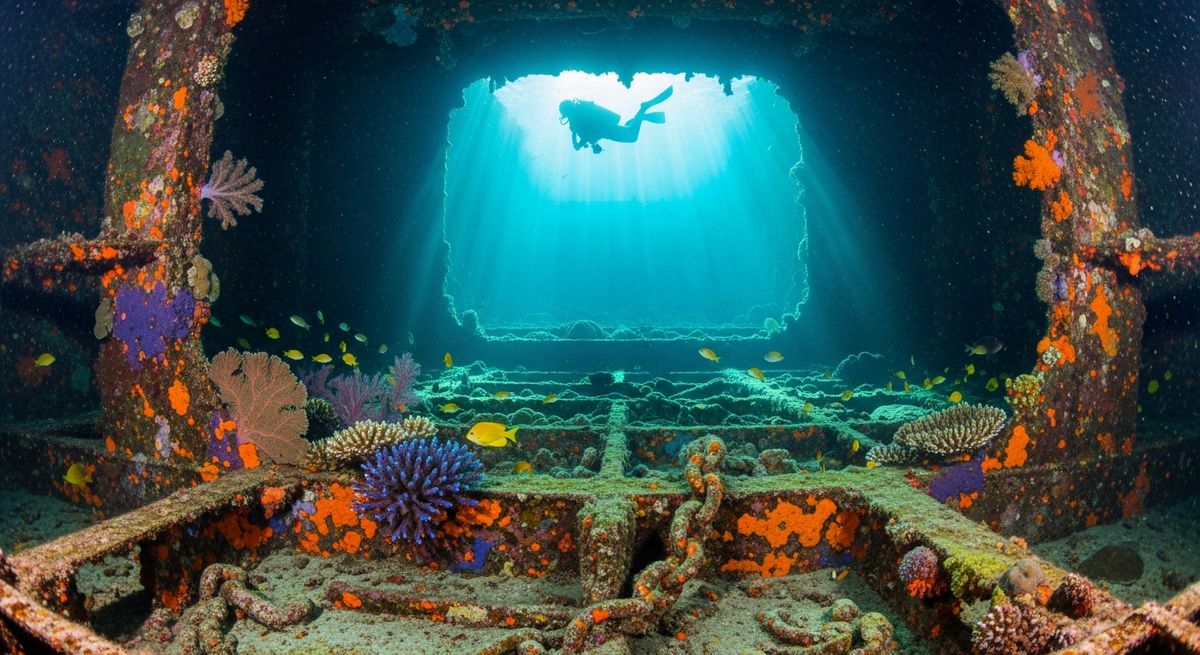
The Capitaine Louis Malbert, sunk in 1963 after a dense fog collision, is a proper ship. Not just a pile of plates. She sits upright in 52 metres, her stern broken, but otherwise remarkably intact for a vessel of her age and circumstances. We love descending onto that bow, seeing the anchor chains still running out, before pushing along the long main deck. The sheer scale of her, 115 metres from stem to stern, means you’ll need several dives to really take her in. Below 40 metres, the light really starts to fade, and the wreck’s imposing structure feels even more dramatic. Look for the massive propeller, it’s still there and quite a sight. Inside the holds, you'll often find ling and cod lurking in the shadows, and we’ve seen some decent-sized conger eels here too. Visibility can be a real lottery, from a murky few metres to a spectacular 20, so pick your weather window carefully. This is definitely one for experienced divers, comfortable with decompression and deep, cold water.
Typical CAPITAINE LOUIS MALBERT Dive Profile
Illustrative profile based on site depth and type. Actual dive profiles vary - always follow your dive computer and training.
Safety Notes
Maximum depth 52m exceeds recreational limits (40m). Technical diving certification and equipment required.
Wreck site - avoid penetration without wreck diving certification. Watch for sharp metal and entanglement hazards.
Cold water this month (avg 13°C). Drysuit or thick wetsuit (7mm+) recommended.
Always perform a 3-minute safety stop at 5m before surfacing.
CAPITAINE LOUIS MALBERT Wreck History
Year Sunk
1963
Vessel Type
cargo ship
Cause
collision
The steamship "Capitaine Louis Malbert" was a product of the British shipbuilding boom, constructed in 1930 by W. Pickersgill & Sons in Sunderland. For over three decades, she plied the seas, a workhorse of maritime commerce. Her career came to an abrupt end on December 30, 1963, while on passage from Hartlepool, UK, to Aarhus, Denmark. In the cold, dark waters off the coast of Sweden, she was involved in a fatal collision and sank beneath the waves.
Today, the Capitaine Louis Malbert is a premier technical diving site near Gothenburg, resting at a challenging depth of 52 meters. This depth has kept her remarkably well-preserved, sitting upright on the seabed as if still sailing. The dive is a serious undertaking, requiring trimix and decompression procedures, but the reward is immense. Technical divers can explore a largely intact steamship from a bygone era, with opportunities to see the bridge, cargo holds, and superstructure, all draped in the cold, dark, and silent majesty of the deep sea.
Reviews for CAPITAINE LOUIS MALBERT
Conditions
Ocean conditions, forecast and tides for CAPITAINE LOUIS MALBERT
CAPITAINE LOUIS MALBERT Ocean Conditions
Monthly averages for CAPITAINE LOUIS MALBERT, sourced from Open-Meteo marine data - nearest station: Open-Meteo marine grid (57.57, 11.03) (3km away)
October Averages
Sea Temperature
13°C
56°F · Range: 10.6–15.8°C
Air Temperature
10°C
50°F
Wind Speed
6.56 m/s
12.8 knots
Atmospheric Pressure
1010.2 hPa
Based on 4 years of monitoring data · Data sources: Open-Meteo marine data
Plan & book
Ways to dive West Coast (Gothenburg), from day trips to liveaboards.
Day trips & courses
via GetYourGuideGuided dives, courses and snorkel trips with instant booking.
Find dive trips in West Coast (Gothenburg)Places to stay
via Booking.comHotels and dive resorts near West Coast (Gothenburg).
Search stays in West Coast (Gothenburg)Dive insurance
Most travel insurance excludes or limits scuba. Check what you need before you go.
Dive insurance explainedPartner links: we may earn a commission if you book, at no extra cost to you. How we make money
Where to Stay near CAPITAINE LOUIS MALBERT
Prices from Booking.com. We may earn a commission at no extra cost to you.