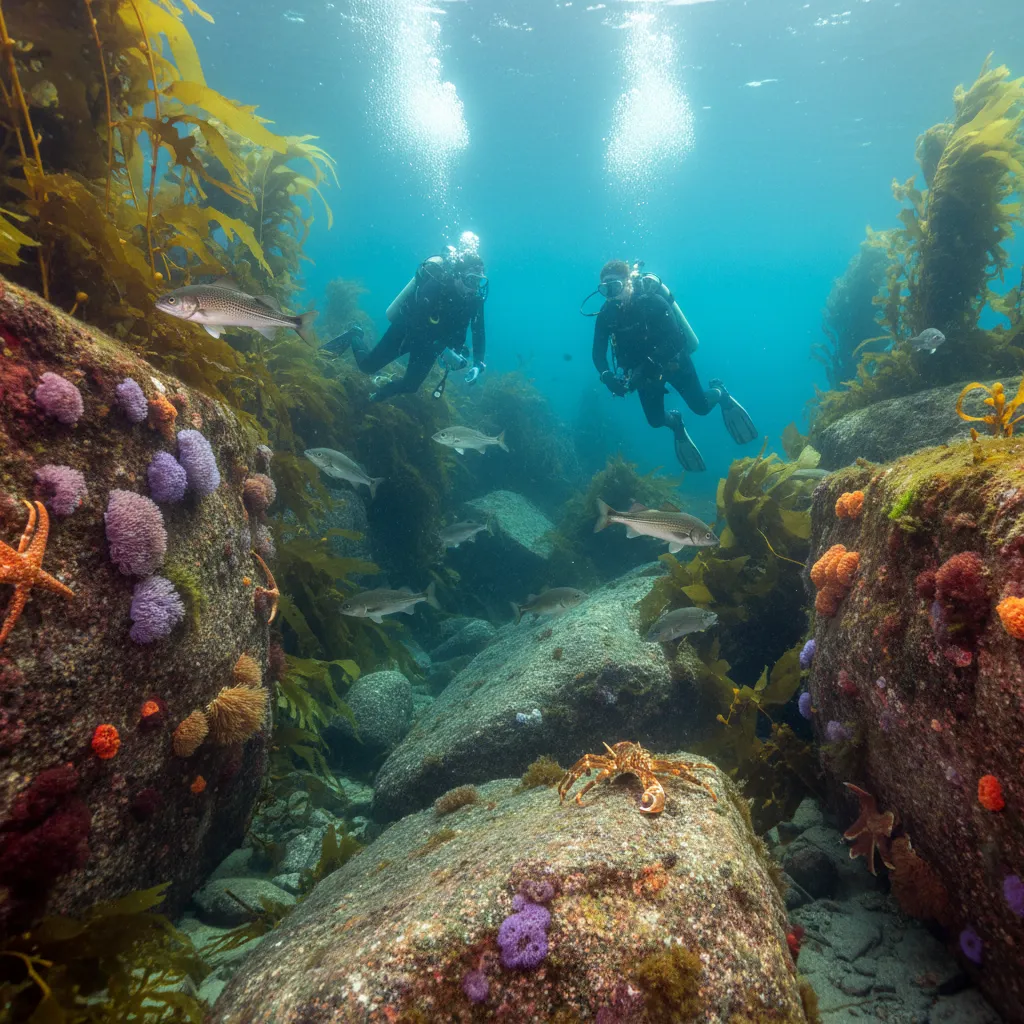
Diving in West Coast (Gothenburg)
Why dive here
West Coast (Gothenburg) offers some of Sweden's richest diving, with 121+ marine species recorded in the area - including dolphins, dwarf minke whales, humpback whales, orcas and seals & sea lions. Water sits around 2°C.
Diving on Sweden's West Coast, particularly around Gothenburg, is a unique, often bracing experience. Forget your typical tropical colours. Here, the North Sea influence brings a different kind of beauty: dense, swaying kelp forests and a rugged coastline that feels genuinely wild. We love the dramatic rock formations and the way sunlight filters through the green canopy, illuminating schools of saithe and wrasse. Our pick for a truly memorable dive is any of the numerous wrecks - they’re plentiful and often well-preserved in the colder water. You'll find yourself exploring old fishing boats and cargo ships, now home to harbour porpoises and thick colonies of hairy sea-mat. The visibility can vary, but on a good day, it's easily 15-20 metres, offering clear views of the structures and the fish that shelter within them. We’d suggest focusing on late summer or early autumn for the best conditions; the water’s at its warmest, around 15°C, and there’s less chance of strong winds. Just be ready for cooler water regardless - a drysuit is practically standard kit here. Keep an eye out for curious common gulls overhead and, if you're lucky, a fleeting glimpse of a sea trout. It’s not for everyone, but for those who appreciate temperate diving, this region offers an honest, raw beauty.
West Coast (Gothenburg) Dive Site Map
Dive sites and dive centres in West Coast (Gothenburg)
West Coast (Gothenburg) Dive Sites
171 dive sites in West Coast (Gothenburg)
ALFRED
The Alfred, off Sweden's West Coast, isn't your typical dramatic wreck dive, but we love it for its quiet charm and accessibility. She’s a decent-sized yacht, resting upright on a sandy bottom at 30 meters, with her mast still reaching skyward. It’s a gentle dive, really, often with clear, if dark, Baltic water, and feels more like exploring an abandoned boat than a tragic sunken vessel. You can easily swim the length of the deck, peer into the companionway, and often find inquisitive blennies peeking out from every nook and cranny. The intact structure offers plenty of shelter for schools of juvenile pollack and the occasional cod. Our favourite part? The way the light filters through the water on a sunny day, illuminating the mast and the hull in a surprisingly ethereal glow. It's an ideal spot for anyone keen on a relaxed wreck dive without the challenges of strong currents or extreme depths, perfect for honing those navigation skills around a real, albeit sunken, boat.
ALFRIDA
The **Alfrida** on Sweden's West Coast isn't your typical colourful tropical dive, and that's precisely why we love it. This isn't about vibrant corals or big pelagics; it's about history and the eerie beauty of a submerged fishing vessel, still upright and largely intact at 16 metres. The wreck itself has a quiet, dignified presence, sitting on the seabed like it's taking a rest. We particularly enjoy how the low light filters through the water, giving the whole scene a moody, atmospheric feel. You can poke your head into the wheelhouse, still eerily recognisable, or swim along the deck where fishing gear lies scattered, frozen in time. What really makes the Alfrida special, though, is the way nature has started to reclaim it. Large plumose anemones sprout from every surface, their feathery tentacles swaying gently in the subtle currents, creating a soft, living blanket over the steel. You'll spot inquisitive gobies darting between the crevices, and sometimes a scuttling crab or two making its way across the deck plates. It's a dive that rewards slow exploration and a keen eye for detail, making it a perfect spot for photographers or anyone who appreciates the quiet drama of a historical wreck. We'd suggest aiming for a calm day to fully appreciate the visibility and the ambient light. It’s also shallow enough for extended bottom times, letting you really soak in the atmosphere.
ALTRES
The Altres wreck, just off Gothenburg, might not have the colourful reefs of the tropics, but it’s got a real story to tell. We love this site for its character. She sits upright at 34 metres, a trawler that sank in 1968 after a collision. You descend onto the deck, usually met by a few curious cod darting from the wheelhouse. The stern is our favourite part, with the propeller still intact and often shrouded in the glassy bloom of compass jellyfish during the summer months. Visibility here can swing dramatically, from a glorious 15 metres to a murky 3, so picking your day is key. We’d suggest a calm morning, ideally after a few days without strong winds. You can penetrate the wheelhouse and engine room if you’re comfortable with overhead environments, but even just exploring the deck offers plenty of atmosphere. It’s a proper wreck dive for those who appreciate history and don't mind a bit of a chill.
ANDERS MARTIN
The *Anders Martin* is a proper piece of maritime history, not just another submerged boat. This dredger, resting in a shallow five metres, went down in '88 and has become a fascinating, slightly eerie dive. We love that it's so accessible, making it an excellent choice for divers looking for a substantial wreck without the depth. You'll quickly see why it’s classed as a dangerous wreck; those sharp edges and metal plates demand respect, especially with limited visibility. Inside, it's dark and silty, but the real show is the exterior. Barnacles and mussels coat almost every surface, and we've spotted plenty of crabs scuttling amongst the metalwork. Our favourite part has to be swimming along its 50-metre length, imagining the crew's last moments. It's not a dive for pristine corals, obviously, but it’s an immersive experience for those who appreciate the story behind the wreck. For the history buffs and those who enjoy a moody, atmospheric dive, the *Anders Martin* is a solid pick. Just remember to pack a good torch and take your time.
ANNA
Diving the Anna is a proper slice of Swedish maritime history. This old barge, sunk back in 1921, now rests in about 17 metres, making it a good depth for most divers. We find her fairly intact, offering clear lines to follow as you explore, with the wooden hull still holding its shape. Expect to see the usual suspects that make these wrecks home – crabs scuttling amongst the timbers and schools of small fish darting in and out of the deeper holds. It’s not a massive wreck, but it’s an interesting one, especially for those who enjoy poking around a well-preserved piece of the past.
ANNA PETERS
Okay, let's talk about the Anna Peters. When someone says "Swedish diving," your mind probably goes to cold, dark, deep wrecks. And yes, there are plenty. But the Anna Peters? This is something altogether different, and we absolutely love it for that. Picture this: a minelayer, sunk in 1944, lying in just two metres of water. We're talking wading depth here. What you get is an experience closer to snorkelling a wreck than a traditional dive, though a tank helps you properly explore. The light penetration is incredible, painting the wreck in shifting greens and blues, unlike the gloom of deeper sites. Visibility here is usually pretty good, making the details of the hull, the exposed ribs, and scattered debris really pop. Schools of small fish dart in and out of the metalwork, and we often spot crabs scuttling amongst the growth on the deck plates. It's a fantastic spot for photographers looking for something a bit unique, or for newer divers to get a feel for wreck exploration without the usual depth and current concerns. Our top tip? Go on a sunny day. The way the light plays on the wreck is genuinely mesmerising.
Aqualand Wreck
Diving the Aqualand Wreck off Gothenburg is a properly humbling experience. It’s a fishing trawler, sunk deliberately as an artificial reef, and while that might sound a bit manufactured, it’s really found its feet down there. We always tell people to look for the impressive growth of plumose anemones, especially on the deeper sections. Their feathery tentacles sway in the gentle surge, giving the whole wreck a soft, almost ethereal look. What we love most is exploring the wheelhouse. It's relatively intact, and you can still make out the outline of the controls. Keep an eye out for nudibranchs munching on the algae, and often you’ll spot a few inquisitive blennies peeking from crevices. Visibility can be a bit variable here, so we always suggest picking a calm day, ideally after a few days of settled weather. It’s a great dive for anyone comfortable with wreck penetration, even if it’s just peeking into an open hold. The Aqualand isn’t a deep dive, making it accessible for a wider range of experience levels, and it’s a fantastic example of how nature reclaims even the most deliberate of intrusions.
ARTHUR
The Arthur is one of those wrecks that just grabs you, even at 45 metres. We love dropping down and seeing her stern start to emerge from the gloom, often with huge schools of cod milling about the broken deck. She’s a steamship, sunk by a German U-boat in 1916, and you really feel that history as you fin over her. You can poke around the collapsed superstructure, imagining the cargo she was carrying from Leith to Gothenburg. The visibility here can vary, but on a good day, it's pretty clear, and the light filtering down gives her a ghostly, atmospheric feel. This site is definitely for experienced divers comfortable with deeper dives and the often chilly Swedish water. Keep an eye out for conger eels tucked into crevices; they’re regular residents, and we’ve spotted giant lumpsuckers here too, sometimes clinging to the bow. Our favourite part is exploring the propeller, often covered in colourful anemones. It’s a proper expedition dive, a real taste of West Coast wreck diving.
BATANIA III
Diving the Batiania III off Gothenburg’s coast is a proper history lesson, a stark reminder of the choppy seas and conflicts of the past. This isn't your vibrant coral reef dive; it’s a solemn descent into a moment frozen in time. The Batiania III, a steamship that met its end courtesy of a mine, sits shallow at 12 metres. That depth makes it accessible for most, but don’t let the shallowness fool you into thinking it's an easy-peasy dive. Weather in this part of the world can be… spirited. We'd definitely suggest picking your day carefully; a calm sea means a much better chance of good visibility. What we love about the Batiania III is the sheer intactness of it, considering its explosive demise. You can still make out the superstructure, the deck lines. It’s like a skeletal blueprint on the seabed, now home to a surprising amount of life. Crabs scuttle in the shadows, and we’ve seen some hefty cod patrolling the hull, using the wreck as their personal hunting ground. The atmosphere here is what really gets you; it’s quiet, a little eerie, and incredibly thought-provoking. For divers who appreciate maritime history and enjoy exploring a wreck that tells a story, rather than just being a pile of twisted metal, the Batiania III is a compelling dive.
BELLGROVE
The Bellgrove, a steamer that ran aground in 1917, is one of those wrecks we find ourselves returning to time and again. It’s not just the history, though imagining its final moments in a storm is part of the draw. It’s the way the stern sits upright, a proper ghost ship silhouette rising from the seabed at 20 metres. We love dropping down and seeing the twin boilers, still so prominent, and the steering gear, which often has a decent-sized cod lurking nearby. Exploring the cargo holds feels like stepping back in time; the sheer volume of crockery and bottles scattered within is genuinely surprising. It’s a great site for divers who appreciate the tangible connection to the past, and it’s shallow enough that you get good bottom time for a thorough look around. Look out for the nudibranchs on the encrusted metalwork, and we’ve often seen schools of pollack hanging out around the superstructure. Our favourite part? The bow section, broken away but still impressive, usually has some decent light penetrating, making for some dramatic photographs. Just remember, it can get a bit silty inside the holds, so good buoyancy is key.
BERNY
The Berny, a motor vessel that went down in 1961 after a collision, rests at 50 metres, a deep dive for sure but a rewarding one. We’ve found her to be quite intact, offering some interesting penetration opportunities if you’re experienced and properly equipped. The wreck itself has become home to a variety of creatures, with plenty of small fish darting in and out of the superstructure, and we’ve often spotted larger cod lurking in the deeper holds. It’s a challenging dive, best suited for advanced divers comfortable with depth and colder Scandinavian waters, but the historical feel of the Berny makes it worth the effort.
BICO
The BICO wreck, off Gothenburg’s coast, is a fishing vessel that now lies at 32 metres. It’s a good one for divers with some cold water experience looking for a proper wreck dive, not just a pile of rubble. We’ve found the stern section often holds the most interest, with crabs scuttling over the decaying nets and the odd cod eyeing you from a shadowed doorway. Visibility can vary quite a bit, so picking a calm day is key. It’s a dive that rewards slow exploration rather than a quick swim-through.
Show all 171 dive sites in West Coast (Gothenburg)
- BIRTHE
- BIRTHE
- BODIL & BJORN
- BRATTSKAER
- BRATTVIK
- CALLINE
- CAPITAINE LOUIS MALBERT
- CHRISTIAN RUMP
- CRACKERJACK
- DANBORG
- DELTA G
- DENDIT
- DIANA
- DORETHEA
- DORIT VEJEN
- DOROTHEA
- DORTHE
- EDITH
- EDO
- ELIN
- EMS
- ERNST
- ESCHERSHEIM
- ESPERANCE
- ESTER
- FALKEN
- Farners Wreck
- FAROS
- Flying Divers
- FRANK DALGAARD
- FREDEN
- FREJA
- FRIGGA
- GANLER
- GERDA
- GITANO
- GODALMING (POSSIBLY)
- GOMA
- GOTEBORG
- GOTFRIED BAUERNE
- GRATIA
- GRETHE
- GUNHILD
- HAMM
- HAMMERN
- HANSIA
- HELLE
- HERKULES
- HMS CRESCENT
- Hummerviken Oeckeroe
- Hven camping
- IDA
- INGE MARIE
- INGOMAR
- INSTO
- JANSON
- JOACHIM SCHULTE
- Jordfall Gullmarn
- JURI
- JYLLAND
- KAP FARVEL
- KARINA
- KARLSO
- KONGSHAVN
- KOSAK
- KOSMOS (POSSIBLY)
- Kosterhavet Marine Park
- Kullavik hamn
- Kullen
- LACHO
- LAKE PLACID
- LILA
- LILLY E
- LIS
- LISE KATRINE
- LN-PAA
- LOLLAND
- LONNY OGARD
- LYUDVIK SVOBODA (AFT PART)
- MARCONI
- MARIA BRES
- MARIE
- Marina af Hönö
- MARNE
- MARY
- MELISSA
- MERKURIUS
- METTE MEJ
- MIKKI
- MITZI
- MIZPAH
- MODENA
- Møkkalassa
- MONA METTE
- NAVIGATOR
- NEU HUSEN
- Nieman
- NIEMAN
- NORDJYDEN
- NORDLYSET
- NORDLYSET
- NORDPILEN
- NORDVEST
- OAKLAND
- OCEAN
- oen
- OLDENBURG
- OLGA
- ORANIENBORG
- ORMEN
- Ormestad
- Oslofjorden dykkesenter as
- PANDALUS NAVIGATOR
- POLANK
- RASK AF MOSS
- Reel Diving
- RIKKIE-LINE
- ROSE-MARIE
- RYGJA
- SABB
- SARAH CECILIE
- SEATTLE
- SENATOR
- SIGNE
- SIGRID
- SIVAL
- SKAGERAK
- SKAGERN
- Skar
- S/S Doris Wreck
- SS Westfalen
- STELLA
- STORNOWAY
- SUNIT
- SUSAN
- SVEA (POSSIBLY)
- SYDFJORD
- TANA
- Tangen Hoenoe
- TEX
- TOK
- TORDENSKJOLD
- Tristeingrunnen
- Trubaduren fyr
- U 534
- VAAURNUS
- Vannlmen
- Vattenholmen - West
- VELLAMO
- VENO
- VICTORIA
- VILDANDEN
- Vitbukt
- Waeteroe
- WALMA (POSSIBLY)
- WAR PATH (POSSIBLY)
- WINNIE RITA
- Wreck of Blücher
- Wreck of German torpedo boat Albatros
West Coast (Gothenburg) Dive Centres
16 dive shops and operators in West Coast (Gothenburg)
Atlantis Dive College
Carlsens Dykkercenter A/S
DIVERS.se
Dive Team
Dykcentrum Gullmarsfjorden
Dykning.net AB
Flying Divers
H2O Lund AB
Show all 16 dive centres in West Coast (Gothenburg)
Ocean Wildlife in West Coast (Gothenburg)
121 species recorded in West Coast (Gothenburg)
West Coast (Gothenburg) Daylight & Sunrise/Sunset
Sunrise and sunset times for West Coast (Gothenburg), calculated from coordinates
Today - Sunday 11 October
Sunrise
06:41
Sunset
17:26
Daylight
10h 44m
Golden Hour
16:32
First light (dawn) at 06:02 · Last light (dusk) at 18:04
Monthly Averages
| Month | Sunrise | Sunset | Daylight |
|---|---|---|---|
| Jan | 08:49 | 16:02 | 7h 13m |
| Feb | 07:50 | 17:12 | 9h 22m |
| Mar | 06:36 | 18:16 | 11h 40m |
| Apr | 05:10 | 19:24 | 14h 13m |
| May | 03:57 | 20:29 | 16h 31m |
| JunLongest | 03:17 | 21:17 | 17h 59m |
| Jul | 03:38 | 21:06 | 17h 28m |
| Aug | 04:39 | 20:04 | 15h 25m |
| Sep | 05:44 | 18:41 | 12h 57m |
| OctNow | 06:48 | 17:17 | 10h 30m |
| Nov | 07:58 | 16:04 | 8h 6m |
| DecShortest | 08:52 | 15:31 | 6h 38m |
Times are approximate local times based on longitude. Actual times may vary slightly depending on the exact timezone observed in West Coast (Gothenburg).
Where to Stay near West Coast (Gothenburg)
Prices from Booking.com. We may earn a commission at no extra cost to you.
Marine Protected Areas near West Coast (Gothenburg)
431 protected areas near West Coast (Gothenburg) - please respect local regulations when diving
Nordvästra Skånes havsområde
Nordvästra Skånes havsområde
Nordvästra Skånes havsområde
Nordvästra Skånes havsområde
Bratten
Bratten
Bratten
2051741 Skånska Kattegatt
Kosterfjorden-Väderöfjorden
Kosterfjorden-Väderöfjorden
Kosterfjorden-Väderöfjorden
2014914 Kosterhavets nationalpark
Showing 12 largest of 431
Getting to West Coast (Gothenburg)
Sindal
Göteborg
Aalborg
Plan & book
Ways to dive West Coast (Gothenburg), from day trips to liveaboards.
Day trips & courses
via GetYourGuideGuided dives, courses and snorkel trips with instant booking.
Find dive trips in West Coast (Gothenburg)Places to stay
via Booking.comHotels and dive resorts near West Coast (Gothenburg).
Search stays in West Coast (Gothenburg)Dive insurance
Most travel insurance excludes or limits scuba. Check what you need before you go.
Dive insurance explainedPartner links: we may earn a commission if you book, at no extra cost to you. How we make money