AENEAS (PROBABLY)
Protected Area
South Dorset
Why dive here
With 176+ marine species recorded in the area - including blue sharks, dolphins, dwarf minke whales, humpback whales and ocean sunfish (mola mola) - AENEAS (PROBABLY) offers some of Cornwall & Devon's richest wreck diving. Water ranges 10-18°C, warmest July, August, September.
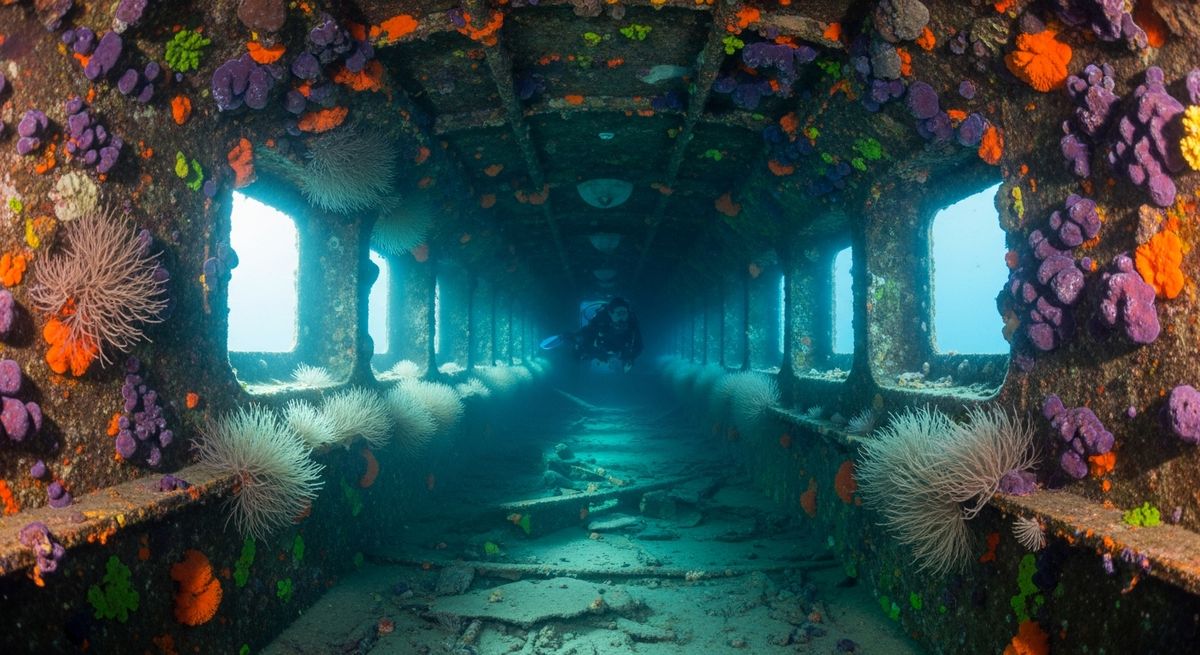
Alright, the Aeneas. Or probably the Aeneas, anyway. We’re still waiting for someone to put a definitive name to her, but we’re pretty sure this is the Blue Funnel Liner. And what a find she is. Dropping down to 53 metres, this isn't one for your open water cert, but for experienced tech divers, she’s a proper challenge. Built in Belfast in 1910, this 150-metre steamship met her end in 1940, torpedoed on a journey from Hong Kong to Glasgow. She lies on her starboard side, largely intact, which is what we love about her. The stern offers some incredible swim-throughs, the massive twin screws still prominent, often shrouded in schooling bib. Down in the engine room, if you’ve got the gas and the skills, the triple-expansion engines are a truly impressive sight. We’ve found conger eels tucked into every corner, and the sheer scale of the cargo holds, even empty, gives you a real sense of her former life. Visibility can be hit or miss, typical for the UK, but on a good day, the light filtering down through the superstructure is something else. Our top tip? Pick your slack tide perfectly; currents here can be fierce. She's a dark, deep dive, but for those who respect her depth, the Aeneas delivers a fantastic wreck experience.
Typical AENEAS (PROBABLY) Dive Profile
Illustrative profile based on site depth and type. Actual dive profiles vary - always follow your dive computer and training.
Safety Notes
Maximum depth 53m exceeds recreational limits (40m). Technical diving certification and equipment required.
Wreck site - avoid penetration without wreck diving certification. Watch for sharp metal and entanglement hazards.
Always perform a 3-minute safety stop at 5m before surfacing.
AENEAS (PROBABLY) Wreck History
Year Sunk
1940
Vessel Type
passenger ship
Cause
bombed
Tonnage
10,058 GRT
Built in 1910 by Workman, Clark & Co. in Belfast for Alfred Holt's prestigious Blue Funnel Line, the SS Aeneas was a 10,058-ton passenger-cargo liner. For three decades, she plied the trade routes between Great Britain and the Far East, a reliable and elegant vessel of her time. With the outbreak of World War II, she was called into service, continuing her vital transport duties under the constant threat of enemy action.
In early July 1940, while sailing in a convoy from Hong Kong to Glasgow, the Aeneas was spotted by German aircraft approximately 21 miles off Start Point. She was targeted and hit by bombs, sustaining critical damage. The ship fought to stay afloat but eventually broke in two and sank over a period of two days. The split created two separate wreck sites, with the main section settling on the seabed apart from the stern.
Today, this site is believed to be the main section of the Aeneas, resting in 53 meters of water. This is a serious undertaking, a deep dive for experienced technical and trimix divers only. The wreck is vast and, while it has collapsed considerably over eight decades, it remains an impressive sight. Divers can identify key features like her powerful triple-expansion engines and twin-screw propulsion system, a testament to the engineering of a bygone era.
Nearest Dive Centres to AENEAS (PROBABLY)
Dive shops near AENEAS (PROBABLY)
Dive Beyond Limited
Old Harbour Dive Centre
Divers Down
Mayim Mermaid Academy
Dorset Diving Services
Reviews for AENEAS (PROBABLY)
Conditions
Ocean conditions, forecast and tides for AENEAS (PROBABLY)
AENEAS (PROBABLY) Ocean Conditions
Monthly averages for AENEAS (PROBABLY), sourced from Open-Meteo marine data - nearest station: Open-Meteo marine grid (50.44, -2.73) (3km away)
October Averages
Sea Temperature
17°C
62°F · Range: 15.1–17.5°C
Air Temperature
13°C
56°F
Wind Speed
8.14 m/s
15.8 knots
Atmospheric Pressure
1011 hPa
Based on 4 years of monitoring data · Data sources: Open-Meteo marine data
Plan & book
Ways to dive Cornwall & Devon, from day trips to liveaboards.
Day trips & courses
via GetYourGuideGuided dives, courses and snorkel trips with instant booking.
Find dive trips in Cornwall & DevonPlaces to stay
via Booking.comHotels and dive resorts near Cornwall & Devon.
Search stays in Cornwall & DevonDive insurance
Most travel insurance excludes or limits scuba. Check what you need before you go.
Dive insurance explainedPartner links: we may earn a commission if you book, at no extra cost to you. How we make money
Where to Stay near AENEAS (PROBABLY)
Prices from Booking.com. We may earn a commission at no extra cost to you.