AENEAS (STERN SECTION)(POSSIBLY)
Protected Area
East of Start Point
Why dive here
With 176+ marine species recorded in the area - including blue sharks, dolphins, dwarf minke whales, humpback whales and ocean sunfish (mola mola) - AENEAS (STERN SECTION)(POSSIBLY) offers some of Cornwall & Devon's richest wreck diving. Water ranges 10-18°C, warmest July, August, September.
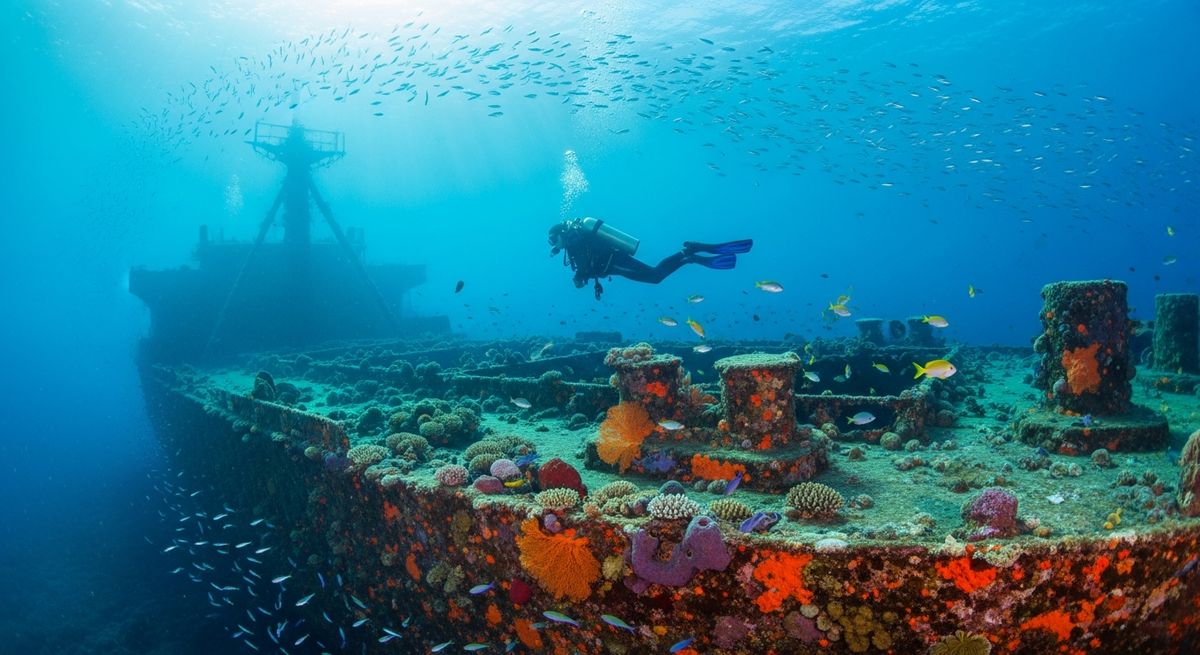
When we talk about deep wrecks off the UK coast, the Aeneas stern often comes up. It's a real challenging dive, heading down to 60m, so this is definitely one for the experienced trimix crowd. Dropping onto that massive stern section, you're immediately hit by the scale of it. The plating is still largely intact, and you can pick out the huge rudder and propellers, often wreathed in dead man's fingers and anemones. We love how the light fades as you descend, making the steel structure even more imposing. Exploring the Aeneas is all about appreciating the sheer bulk of a liner brought down. You can spend a good chunk of bottom time just circumnavigating the stern, imagining the power that once drove this ship. Keep an eye out for conger eels peering from dark holes and schools of pouting darting through the superstructure. The currents here can be a bit lively, so good dive planning and navigation are essential. It's a proper British wreck dive, cold, deep, and utterly rewarding for those who make the effort.
Typical AENEAS (STERN SECTION)(POSSIBLY) Dive Profile
Illustrative profile based on site depth and type. Actual dive profiles vary - always follow your dive computer and training.
Safety Notes
Maximum depth 60m exceeds recreational limits (40m). Technical diving certification and equipment required.
Wreck site - avoid penetration without wreck diving certification. Watch for sharp metal and entanglement hazards.
Always perform a 3-minute safety stop at 5m before surfacing.
AENEAS (STERN SECTION)(POSSIBLY) Wreck History
Year Sunk
1940
Vessel Type
passenger ship
Cause
bombed
Tonnage
10,058 GRT
The SS Aeneas was a substantial passenger liner built for the Blue Funnel Line in 1910. Her career came to a violent end on July 2nd, 1940, when she was attacked by German bombers while sailing in convoy off the Devon coast. The damage was catastrophic, and though she remained afloat for two more days, the ship broke apart and finally sank on July 4th, her hull splitting into at least two major sections.
This wreck site is believed to be the stern section of the once-majestic liner. Lying in 60 meters of seawater, it is an even more challenging dive than the main hull, demanding trimix certification, meticulous planning, and experience with deep decompression diving. The reward is a view of an imposing structure, sitting upright on the seabed. Divers can clearly identify the ship's distinctive counter stern, rudder, and propellers, offering a powerful and poignant glimpse into the liner's final moments before she disappeared beneath the waves.
Reviews for AENEAS (STERN SECTION)(POSSIBLY)
Conditions
Ocean conditions, forecast and tides for AENEAS (STERN SECTION)(POSSIBLY)
AENEAS (STERN SECTION)(POSSIBLY) Ocean Conditions
Monthly averages for AENEAS (STERN SECTION)(POSSIBLY), sourced from Open-Meteo marine data - nearest station: Open-Meteo marine grid (50.44, -2.73) (3km away)
October Averages
Sea Temperature
17°C
62°F · Range: 15.1–17.5°C
Air Temperature
13°C
56°F
Wind Speed
8.14 m/s
15.8 knots
Atmospheric Pressure
1011 hPa
Based on 4 years of monitoring data · Data sources: Open-Meteo marine data
Plan & book
Ways to dive Cornwall & Devon, from day trips to liveaboards.
Day trips & courses
via GetYourGuideGuided dives, courses and snorkel trips with instant booking.
Find dive trips in Cornwall & DevonPlaces to stay
via Booking.comHotels and dive resorts near Cornwall & Devon.
Search stays in Cornwall & DevonDive insurance
Most travel insurance excludes or limits scuba. Check what you need before you go.
Dive insurance explainedPartner links: we may earn a commission if you book, at no extra cost to you. How we make money
Where to Stay near AENEAS (STERN SECTION)(POSSIBLY)
Prices from Booking.com. We may earn a commission at no extra cost to you.