AEOLUS (PROBABLY)
Protected Area
Flat Holm
Why dive here
With 176+ marine species recorded in the area - including blue sharks, dolphins, dwarf minke whales, humpback whales and ocean sunfish (mola mola) - AEOLUS (PROBABLY) offers some of Cornwall & Devon's richest wreck diving. Water ranges 10-18°C, warmest July, August, September.
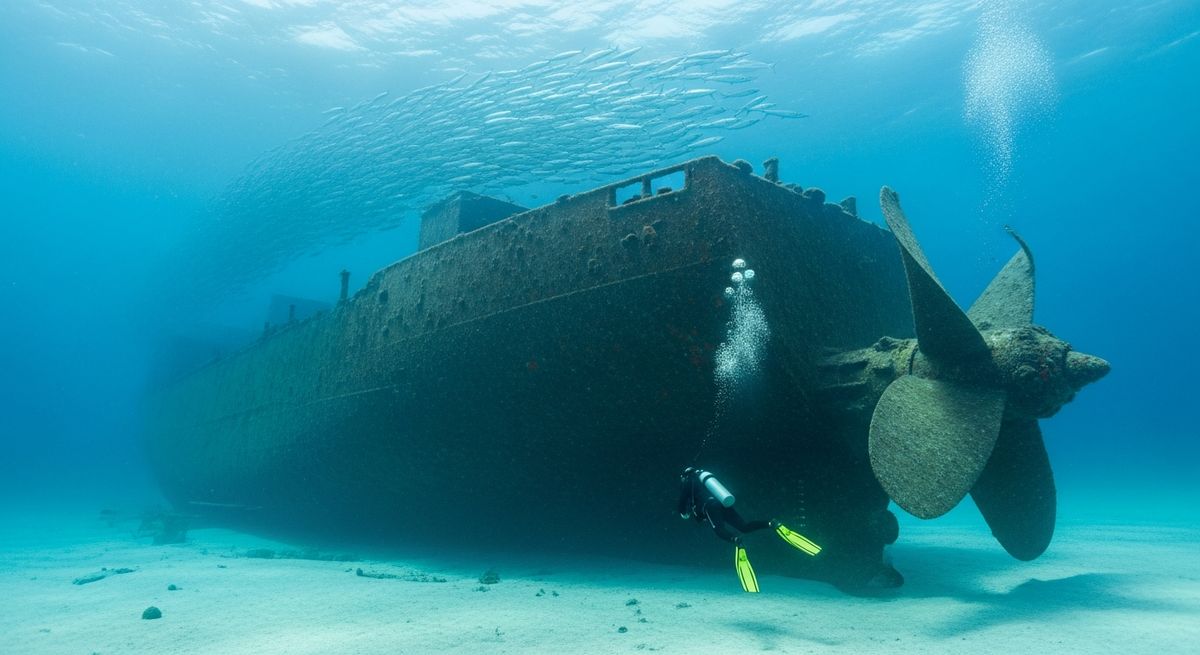
The Aeolus, or what we’re fairly sure is the Aeolus, is a proper slice of Cornish wreck diving. We love a good identification mystery, and while its true identity has been debated, what’s undeniable is the character of the site. Sitting at a shallow 11 meters, it’s a brilliant dive for those newer to wreck exploration or anyone wanting a relaxed second dive. You’ll find the wreck well broken up, but the triple expansion engines and three massive boilers are still very much intact and make for fantastic swim-throughs and photographic opportunities. Sunlight dapples through the shallower parts, illuminating clouds of tommy ruffs and pouting that dart between the metalwork. Look carefully among the plates and you’ll often spot dogfish eggs, like little mermaid’s purses, swaying in the gentle surge. Our favourite tip for this site is to hit it on a slack tide, an hour or so after high water, for the best visibility and easiest navigation around the substantial wreckage. It’s a proper engine room exploration, made even better by the inquisitive pollack that seem to follow you from one section to the next.
Typical AEOLUS (PROBABLY) Dive Profile
Illustrative profile based on site depth and type. Actual dive profiles vary - always follow your dive computer and training.
Safety Notes
Wreck site - avoid penetration without wreck diving certification. Watch for sharp metal and entanglement hazards.
Always perform a 3-minute safety stop at 5m before surfacing.
AEOLUS (PROBABLY) Wreck History
Year Sunk
1913
Vessel Type
cargo ship
Cause
grounding
Tonnage
2,830 GRT
The SS Aeolus was a 2,830-ton Greek steamship built in 1902. In January 1913, she was on a voyage from Newport, Wales, bound for Piraeus, Greece, with a cargo of Welsh coal. While navigating the notoriously treacherous waters off the coast of Cornwall, she ran afoul of one of the area's most dangerous hazards.
The Aeolus struck the infamous Wolves Rock, a submerged reef that has claimed countless vessels over the centuries. The impact was catastrophic, ripping open the ship's hull. She foundered and sank quickly, her wreckage scattering on the seabed at the base of the rock. Her loss was another grim entry in the long maritime history of the Cornish coast.
Resting in a shallow 11 meters, the remains of the Aeolus are an accessible dive, though the site's exposed location demands calm sea conditions. The wreck is heavily broken and salvaged after more than a century underwater, but divers can still easily identify her three large boilers and parts of the triple-expansion steam engine. The wreckage is now part of the reef, covered in kelp and teeming with the vibrant marine life typical of the area, making for a scenic dive that blends history with nature.
Nearest Dive Centres to AEOLUS (PROBABLY)
Dive shops near AEOLUS (PROBABLY)
Welsh Diving
Extreme Marine
Divexplore
Scuba Scene Taunton
Scuba Blue Ltd
Reviews for AEOLUS (PROBABLY)
Conditions
Ocean conditions, forecast and tides for AEOLUS (PROBABLY)
AEOLUS (PROBABLY) Ocean Conditions
Monthly averages for AEOLUS (PROBABLY), sourced from Open-Meteo marine data - nearest station: Open-Meteo marine grid (50.44, -2.73) (3km away)
October Averages
Sea Temperature
17°C
62°F · Range: 15.1–17.5°C
Air Temperature
13°C
56°F
Wind Speed
8.14 m/s
15.8 knots
Atmospheric Pressure
1011 hPa
Based on 4 years of monitoring data · Data sources: Open-Meteo marine data
Plan & book
Ways to dive Cornwall & Devon, from day trips to liveaboards.
Day trips & courses
via GetYourGuideGuided dives, courses and snorkel trips with instant booking.
Find dive trips in Cornwall & DevonPlaces to stay
via Booking.comHotels and dive resorts near Cornwall & Devon.
Search stays in Cornwall & DevonDive insurance
Most travel insurance excludes or limits scuba. Check what you need before you go.
Dive insurance explainedPartner links: we may earn a commission if you book, at no extra cost to you. How we make money
Where to Stay near AEOLUS (PROBABLY)
Prices from Booking.com. We may earn a commission at no extra cost to you.