AFON DULAIS
Protected Area
Offshore Overfalls
Why dive here
With 176+ marine species recorded in the area - including blue sharks, dolphins, dwarf minke whales, humpback whales and ocean sunfish (mola mola) - AFON DULAIS offers some of Cornwall & Devon's richest wreck diving. Water ranges 10-18°C, warmest July, August, September.
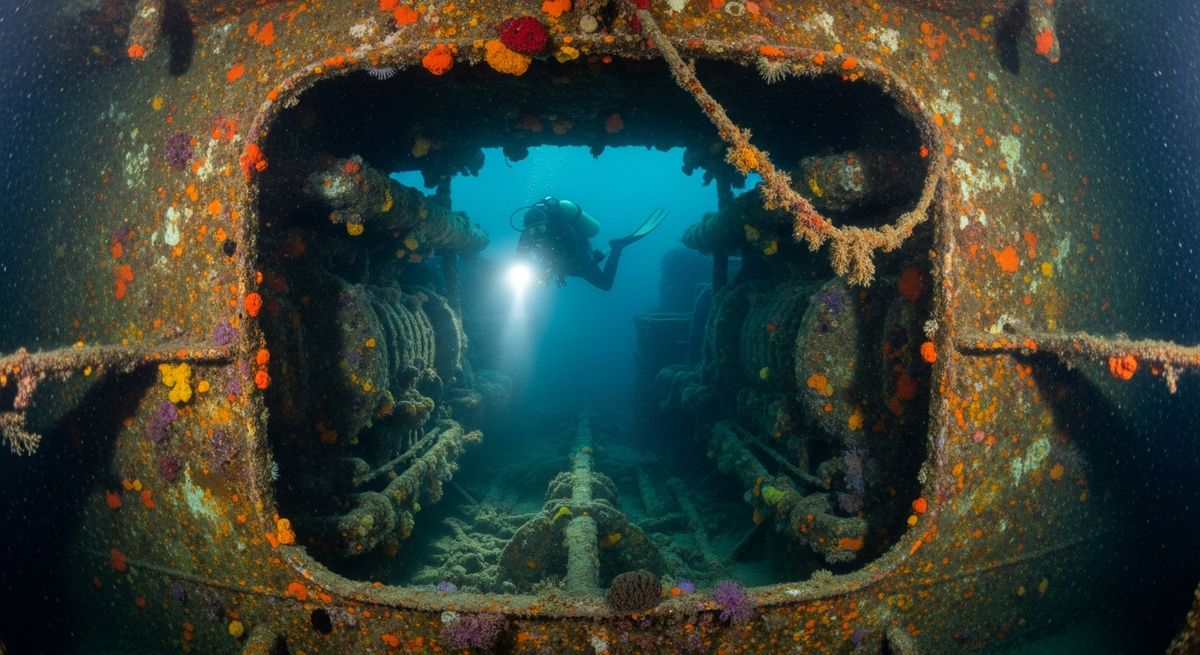
The Afon Dulais, a 63-metre steamship, isn’t your typical upright wreck. She lies on her starboard side at 26 metres, broken midships, a testament to that June 1942 mine. We love how her orientation offers a different perspective; you’re not just swimming over decks but along bulkheads, feeling the roll of her original journey. Entry can be tricky here, so picking a calm day is essential. Visibility, when it’s good, lets you appreciate the sheer scale of the coal carrier. Our favourite part is navigating the twisted metal, imagining the cargo spilling out. Conger eels are regulars, tucked into crevices, and we’ve spotted impressive anglerfish camouflaged on the hull plates. It’s a dive for those who enjoy exploring the history etched into the steel, not just ticking off species. You’ll leave feeling the grit of wartime shipping, not just the usual chill of a UK dive.
Typical AFON DULAIS Dive Profile
Illustrative profile based on site depth and type. Actual dive profiles vary - always follow your dive computer and training.
Safety Notes
Depth of 26m - Advanced Open Water certification recommended.
Wreck site - avoid penetration without wreck diving certification. Watch for sharp metal and entanglement hazards.
Always perform a 3-minute safety stop at 5m before surfacing.
AFON DULAIS Wreck History
Year Sunk
1942
Vessel Type
cargo ship
Cause
torpedo
The SS 'Afon Dulais' was a British steamship built in 1919, just after the end of the First World War. For over two decades, she faithfully plied the coastal trade routes, but the outbreak of World War II placed her in constant danger. On June 20, 1942, while on passage from Seaham, she became another victim of the war at sea. She was attacked and sunk by a German E-boat, fast and deadly torpedo boats that terrorized Allied shipping in the English Channel. The attack was swift and devastating, sending the 'Afon Dulais' and her cargo to the seabed.
Today, the wreck of the 'Afon Dulais' rests at a depth of 26 meters off the coast of Cornwall. This makes it an ideal dive for advanced recreational divers. The wreck is largely intact, though her superstructure shows the damage from her violent end. Divers can explore the deck, peer into the cargo holds, and examine the boiler and triple-expansion engine that once powered her. The wreck has become a thriving artificial reef, attracting dense schools of bib, pollack, and colorful cuckoo wrasse, offering a poignant mix of military history and vibrant marine life.
Nearest Dive Centres to AFON DULAIS
Dive shops near AFON DULAIS
Sussex Diving & Leisure
Mulberry Marine Experiences CIC
Abyss Scuba School
Ocean View
In2 Diving
Reviews for AFON DULAIS
Conditions
Ocean conditions, forecast and tides for AFON DULAIS
AFON DULAIS Ocean Conditions
Monthly averages for AFON DULAIS, sourced from Open-Meteo marine data - nearest station: Open-Meteo marine grid (50.44, -2.73) (3km away)
October Averages
Sea Temperature
17°C
62°F · Range: 15.1–17.5°C
Air Temperature
13°C
56°F
Wind Speed
8.14 m/s
15.8 knots
Atmospheric Pressure
1011 hPa
Based on 4 years of monitoring data · Data sources: Open-Meteo marine data
Plan & book
Ways to dive Cornwall & Devon, from day trips to liveaboards.
Day trips & courses
via GetYourGuideGuided dives, courses and snorkel trips with instant booking.
Find dive trips in Cornwall & DevonPlaces to stay
via Booking.comHotels and dive resorts near Cornwall & Devon.
Search stays in Cornwall & DevonDive insurance
Most travel insurance excludes or limits scuba. Check what you need before you go.
Dive insurance explainedPartner links: we may earn a commission if you book, at no extra cost to you. How we make money
Where to Stay near AFON DULAIS
Prices from Booking.com. We may earn a commission at no extra cost to you.