ALBERT C FIELD (PROBABLY)
Protected Area
Albert Field
Why dive here
With 176+ marine species recorded in the area - including blue sharks, dolphins, dwarf minke whales, humpback whales and ocean sunfish (mola mola) - ALBERT C FIELD (PROBABLY) offers some of Cornwall & Devon's richest wreck diving. Water ranges 10-18°C, warmest July, August, September.
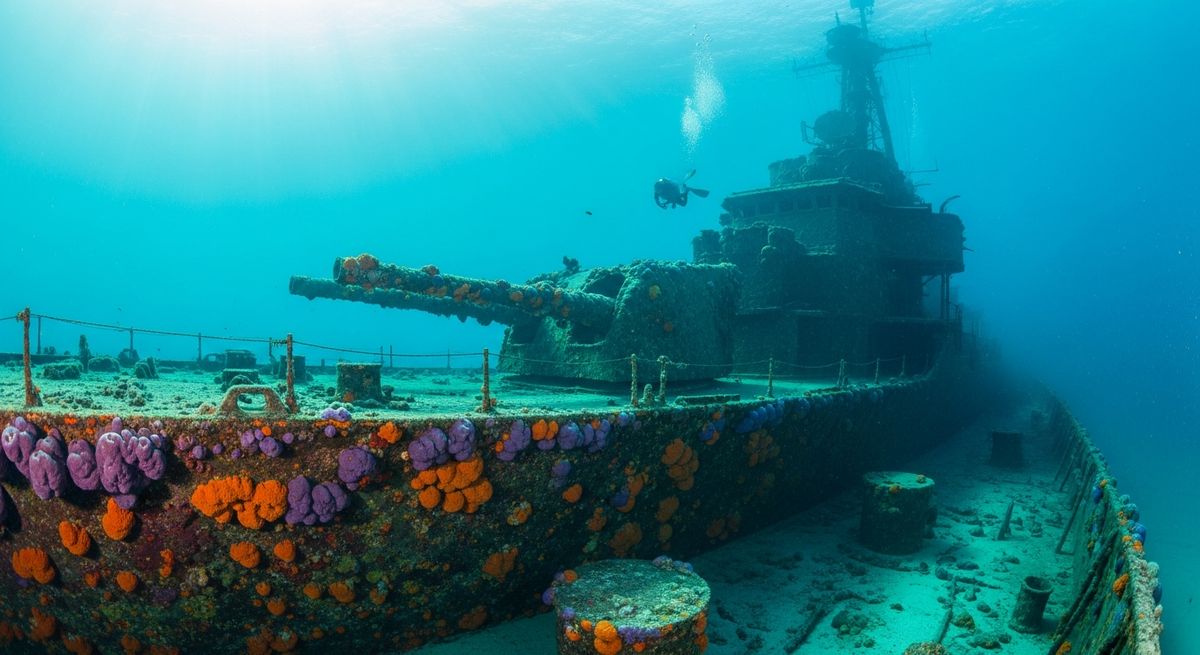
The Albert C. Field, or what we strongly suspect is her, sits upright at 36 metres, a proper, solid wreck dive off the Cornish coast. Dropping down, the first thing you notice is the sheer scale. She’s a big steamship, about 77 metres long, and the visibility here, when it’s good, lets you appreciate that. We love drifting along the deck line, imagining her in her working life before she went down in 1944. The stern is our favourite spot; the propeller is often still visible, and there’s usually some playful conger eel poking out from the collapsed sections. Look closely for the smaller stuff too: nudibranchs are common on the superstructure, and crabs scuttle across the plating. This is a wreck for those who appreciate history and don't mind a bit of a current. It’s not a dive for beginners, but for experienced wreckies, she offers a substantial exploration. Best dived on a slack tide, obviously, to really take in the atmosphere.
Typical ALBERT C FIELD (PROBABLY) Dive Profile
Illustrative profile based on site depth and type. Actual dive profiles vary - always follow your dive computer and training.
Safety Notes
Deep dive (36m) - monitor air consumption closely. Advanced certification recommended.
Wreck site - avoid penetration without wreck diving certification. Watch for sharp metal and entanglement hazards.
Always perform a 3-minute safety stop at 5m before surfacing.
ALBERT C FIELD (PROBABLY) Wreck History
Year Sunk
1944
Vessel Type
cargo ship
Cause
torpedo
The SS Albert C. Field was a Canadian cargo ship built in 1923. Originally plying the Great Lakes, she was requisitioned by the British government during World War II to support the war effort. Her final, critical mission began in June 1944, just days after the D-Day landings. Loaded with 2,500 tons of vital munitions and 1,300 bags of mail for the troops, she joined Convoy EBC-14, bound for the Normandy beachhead.
On June 18, 1944, as the convoy steamed south of The Needles off the Isle of Wight, it was attacked by German aircraft. The Albert C. Field was struck by an aerial torpedo, and with her volatile cargo, the ship was doomed. She sank in a mere three minutes, a catastrophic explosion taking four of her crew down with her. The swift and violent end scattered the ship across the seabed.
Today, the wreck lies on a gravel bottom at a depth of 36 metres. The explosion and subsequent salvage efforts have left the hull badly damaged and collapsed. The highest point of the wreck is her prominent boiler, which rises to about 30 metres. Exploring the debris field reveals the twisted metal and machinery of a ship that played a small but vital part in the liberation of Europe, making it a poignant and historic dive for experienced wreck enthusiasts.
Nearest Dive Centres to ALBERT C FIELD (PROBABLY)
Dive shops near ALBERT C FIELD (PROBABLY)
Divers Down
Mayim Mermaid Academy
TAL Scuba Ltd.
Dorset Diving Services
Dive Beyond Limited
Reviews for ALBERT C FIELD (PROBABLY)
Conditions
Ocean conditions, forecast and tides for ALBERT C FIELD (PROBABLY)
ALBERT C FIELD (PROBABLY) Ocean Conditions
Monthly averages for ALBERT C FIELD (PROBABLY), sourced from Open-Meteo marine data - nearest station: Open-Meteo marine grid (50.44, -2.73) (3km away)
October Averages
Sea Temperature
17°C
62°F · Range: 15.1–17.5°C
Air Temperature
13°C
56°F
Wind Speed
8.14 m/s
15.8 knots
Atmospheric Pressure
1011 hPa
Based on 4 years of monitoring data · Data sources: Open-Meteo marine data
Plan & book
Ways to dive Cornwall & Devon, from day trips to liveaboards.
Day trips & courses
via GetYourGuideGuided dives, courses and snorkel trips with instant booking.
Find dive trips in Cornwall & DevonPlaces to stay
via Booking.comHotels and dive resorts near Cornwall & Devon.
Search stays in Cornwall & DevonDive insurance
Most travel insurance excludes or limits scuba. Check what you need before you go.
Dive insurance explainedPartner links: we may earn a commission if you book, at no extra cost to you. How we make money
Where to Stay near ALBERT C FIELD (PROBABLY)
Prices from Booking.com. We may earn a commission at no extra cost to you.