ALEX VAN OPSTAL
Protected Area
Studland to Portland
Why dive here
With 176+ marine species recorded in the area - including blue sharks, dolphins, dwarf minke whales, humpback whales and ocean sunfish (mola mola) - ALEX VAN OPSTAL offers some of Cornwall & Devon's richest wreck diving. Water ranges 10-18°C, warmest July, August, September.
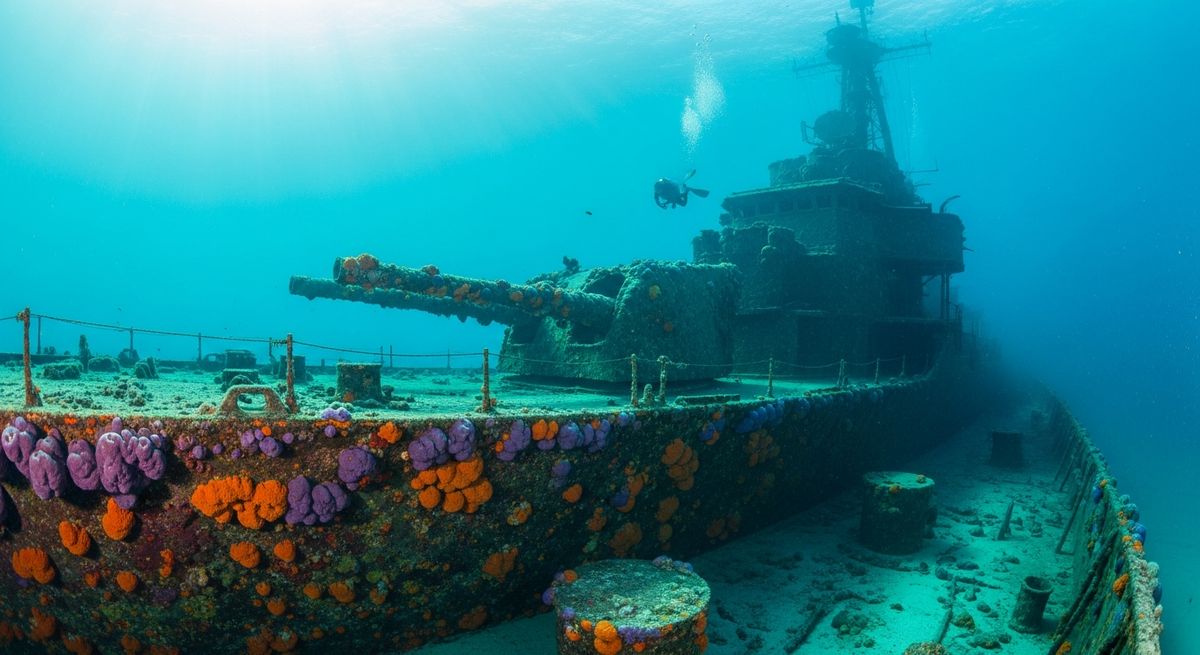
We think the *Alex van Opstal* is one of the better dives off the Lizard, a true standout among the Cornish wrecks. She was a big girl, 128 metres of cargo ship, and when she hit a mine in 1939, she went down quickly, breaking into three main sections. You’ll find her sitting upright at 28 metres, which means you get to really appreciate her scale. We love swimming the length of her, feeling that cold metal rise out of the gloom. The stern section, with its enormous propeller, is our favourite part. Look closely around the prop blades for conger eels, some of them are huge here. Heading forward, you can often duck into the cargo holds if you're comfortable with overhead environments and good on your buoyancy. Just remember to bring a decent torch – it gets dark in there. The bow lies a little further off, often a bit more broken up, but still home to clouds of jewel anemones, all those vibrant oranges and pinks against the steel. The visibility here can be a bit hit or miss, typical for the UK, but when it's good, say 10 metres, it's a magnificent dive. It's a dive for experienced wreck lovers, no doubt. The current can pick up, so time your dive for slack water.
Typical ALEX VAN OPSTAL Dive Profile
Illustrative profile based on site depth and type. Actual dive profiles vary - always follow your dive computer and training.
Safety Notes
Depth of 28m - Advanced Open Water certification recommended.
Wreck site - avoid penetration without wreck diving certification. Watch for sharp metal and entanglement hazards.
Always perform a 3-minute safety stop at 5m before surfacing.
ALEX VAN OPSTAL Wreck History
Year Sunk
1939
Vessel Type
cargo ship
Cause
mine
The Belgian merchant ship *Alex Van Opstal* was a modern vessel, built in 1937 and owned by the prestigious Cie Maritime Belge. Her story is a poignant reminder of the sudden and far-reaching impact of World War II. In September 1939, with the war less than two weeks old, the neutral vessel was on a transatlantic passage from New York to her home port of Antwerp, carrying general cargo.
On September 15, 1939, while navigating the English Channel, the *Alex Van Opstal* struck a German-laid mine off the coast of Weymouth. The explosion was catastrophic, and the ship sank, becoming one of the very first neutral vessels lost in the conflict. Today, she lies at a depth of 28 meters, a popular and fascinating site for advanced recreational divers. Exploring her remains offers a direct connection to the opening days of the war and serves as an underwater memorial to a conflict that would soon engulf the world.
Nearest Dive Centres to ALEX VAN OPSTAL
Dive shops near ALEX VAN OPSTAL
Dive Beyond Limited
Old Harbour Dive Centre
Divers Down
Mayim Mermaid Academy
Dorset Diving Services
TAL Scuba Ltd.
Reviews for ALEX VAN OPSTAL
Conditions
Ocean conditions, forecast and tides for ALEX VAN OPSTAL
ALEX VAN OPSTAL Ocean Conditions
Monthly averages for ALEX VAN OPSTAL, sourced from Open-Meteo marine data - nearest station: Open-Meteo marine grid (50.44, -2.73) (3km away)
October Averages
Sea Temperature
17°C
62°F · Range: 15.1–17.5°C
Air Temperature
13°C
56°F
Wind Speed
8.14 m/s
15.8 knots
Atmospheric Pressure
1011 hPa
Based on 4 years of monitoring data · Data sources: Open-Meteo marine data
Plan & book
Ways to dive Cornwall & Devon, from day trips to liveaboards.
Day trips & courses
via GetYourGuideGuided dives, courses and snorkel trips with instant booking.
Find dive trips in Cornwall & DevonPlaces to stay
via Booking.comHotels and dive resorts near Cornwall & Devon.
Search stays in Cornwall & DevonDive insurance
Most travel insurance excludes or limits scuba. Check what you need before you go.
Dive insurance explainedPartner links: we may earn a commission if you book, at no extra cost to you. How we make money
Where to Stay near ALEX VAN OPSTAL
Prices from Booking.com. We may earn a commission at no extra cost to you.