ALGIERS
Protected Area
Offshore Overfalls
Why dive here
With 176+ marine species recorded in the area - including blue sharks, dolphins, dwarf minke whales, humpback whales and ocean sunfish (mola mola) - ALGIERS offers some of Cornwall & Devon's richest wreck diving. Water ranges 10-18°C, warmest July, August, September.
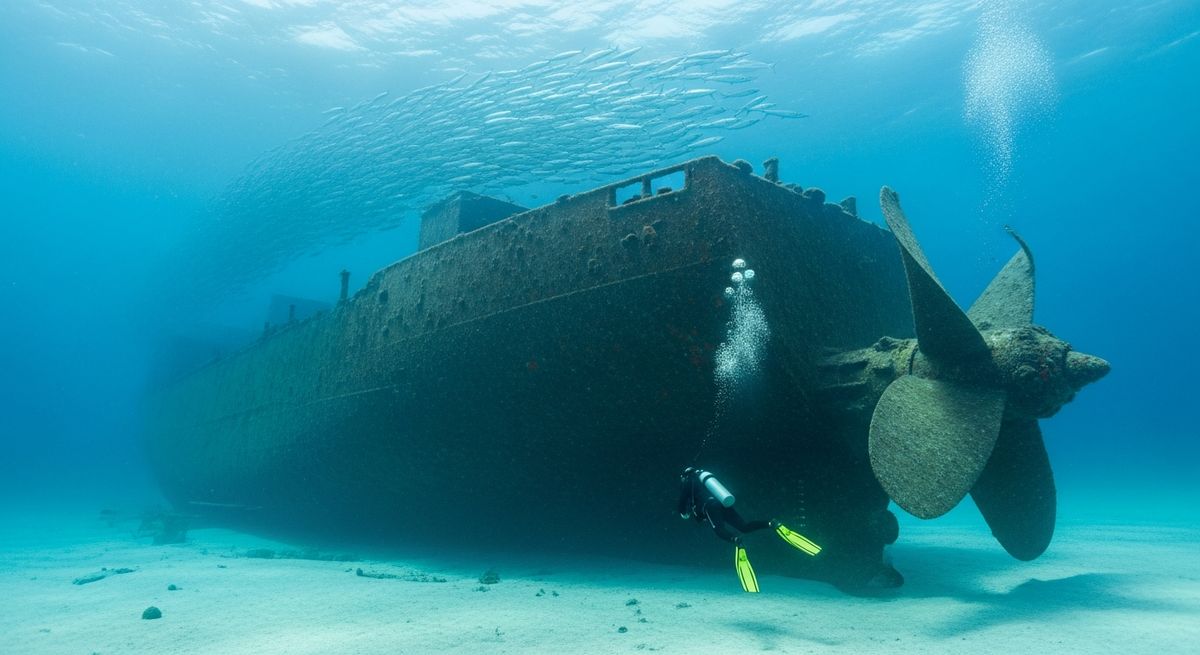
The **Algiers** is our kind of wreck. Not just some scattered debris, but a proper ship, laid out on the seabed like she’s still sailing, albeit downwards. We love how her two huge boilers are still standing proud, a real focal point around 30 metres, often shrouded in a hazy cloud of small fish that pulse and shift with the current. This 91-metre steamship, sunk in 1917, is a grand dame of the Cornish deep, perfect for experienced wreck divers comfortable at depth. Dropping down, the first thing you notice is the sheer scale. Her bow points east, the stern to the west, and you can spend a whole dive just traversing her length. Inside, the triple-expansion engine is still identifiable, a skeletal reminder of the power that once drove her. It's a dark, silty dive, so good buoyancy and a strong torch are essential. Keep an eye out for conger eels tucked into the darker recesses, and plenty of pollack circling the higher points. The occasional jewel anemone adds a splash of unexpected colour to the otherwise muted palette of rust and green. It's a challenging dive, but the sense of history here is palpable, a truly rewarding experience for those who make the journey.
Typical ALGIERS Dive Profile
Illustrative profile based on site depth and type. Actual dive profiles vary - always follow your dive computer and training.
Safety Notes
Deep dive (37m) - monitor air consumption closely. Advanced certification recommended.
Wreck site - avoid penetration without wreck diving certification. Watch for sharp metal and entanglement hazards.
Always perform a 3-minute safety stop at 5m before surfacing.
ALGIERS Wreck History
Year Sunk
1917
Vessel Type
cargo ship
Cause
torpedo
Tonnage
2,630 GRT
Launched in 1882 from the Wigham Richardson & Co. shipyard in Newcastle-upon-Tyne, the vessel we know as the Algiers lived a varied life under several names, including the Castle Eden and the Lys. By 1917, she was sailing under the ownership of the Franco-British SS Co Ltd, a testament to her 35 years of durable service as a cargo-carrying steamship.
Like so many of her contemporaries, her career was ended by the First World War. On February 26th, 1917, while in the waters off the Cornish coast, she was attacked and torpedoed by the German submarine UC-65. The explosion crippled the ship, and she sank, joining the growing underwater graveyard of merchant vessels in the English Channel.
The wreck of the Algiers now lies at a depth of 37 metres, making it an excellent site for advanced recreational divers. The vessel is well broken up but key features, such as her two large boilers and the remains of her engine, are still clearly identifiable. The wreckage provides a complex and interesting habitat for marine life, with schools of pollack and wrasse often seen patrolling the structure, while conger eels and crabs hide amongst the fallen plates.
Nearest Dive Centres to ALGIERS
Dive shops near ALGIERS
Sussex Diving & Leisure
Mulberry Marine Experiences CIC
Abyss Scuba School
Ocean View
In2 Diving
Reviews for ALGIERS
Conditions
Ocean conditions, forecast and tides for ALGIERS
ALGIERS Ocean Conditions
Monthly averages for ALGIERS, sourced from Open-Meteo marine data - nearest station: Open-Meteo marine grid (50.44, -2.73) (3km away)
October Averages
Sea Temperature
17°C
62°F · Range: 15.1–17.5°C
Air Temperature
13°C
56°F
Wind Speed
8.14 m/s
15.8 knots
Atmospheric Pressure
1011 hPa
Based on 4 years of monitoring data · Data sources: Open-Meteo marine data
Plan & book
Ways to dive Cornwall & Devon, from day trips to liveaboards.
Day trips & courses
via GetYourGuideGuided dives, courses and snorkel trips with instant booking.
Find dive trips in Cornwall & DevonPlaces to stay
via Booking.comHotels and dive resorts near Cornwall & Devon.
Search stays in Cornwall & DevonDive insurance
Most travel insurance excludes or limits scuba. Check what you need before you go.
Dive insurance explainedPartner links: we may earn a commission if you book, at no extra cost to you. How we make money
Where to Stay near ALGIERS
Prices from Booking.com. We may earn a commission at no extra cost to you.