AMELIE (PROBABLY)
Protected Area
Start Point to Plymouth Sound & Eddystone
Why dive here
With 176+ marine species recorded in the area - including blue sharks, dolphins, dwarf minke whales, humpback whales and ocean sunfish (mola mola) - AMELIE (PROBABLY) offers some of Cornwall & Devon's richest wreck diving. Water ranges 10-18°C, warmest July, August, September.
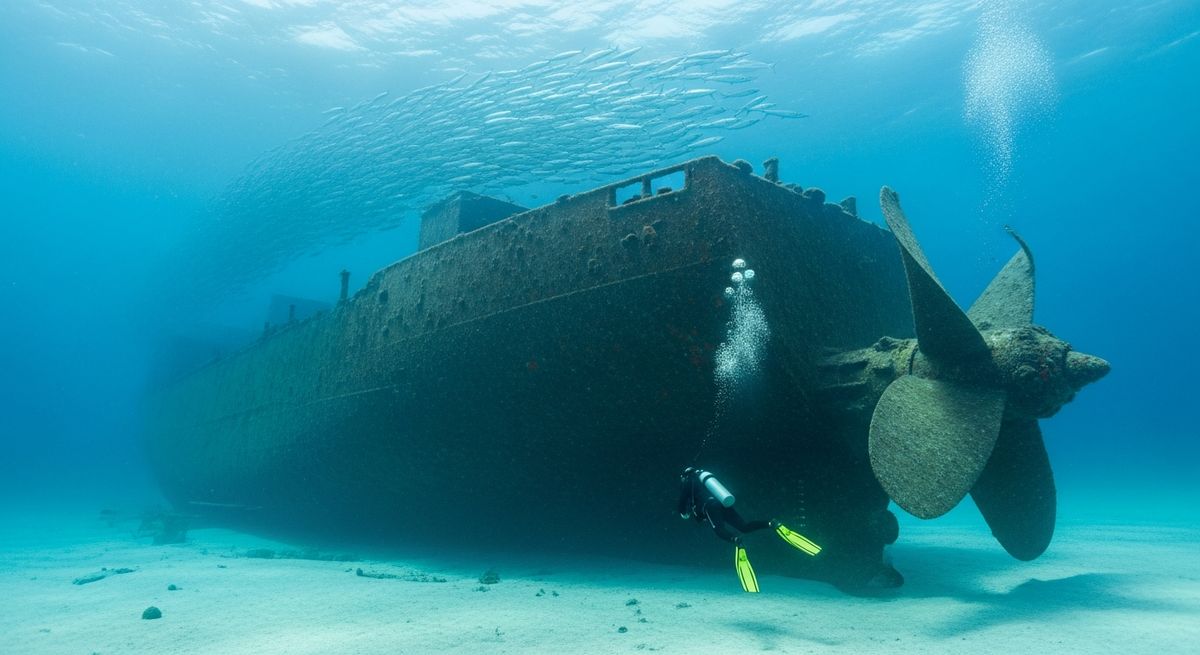
The Amelie, or what we’re pretty sure is the Amelie, is one of those wrecks that just *feels* old. You drop down, and at 59 metres, the light really starts to fade, giving the whole site a wonderfully atmospheric gloom. Built in 1883, she’s a steamship torpedoed in 1917, and her age shows in the way the wreck has settled, almost melting into the seabed. We love picking our way through the collapsed sections, trying to piece together her original form. The stern is often a good spot to start, looking for the rudder post, then working forward. Visibility here can be hit or miss, typical for the Channel, but when it's good, you can make out the lines of the hull stretching into the murk. Dogfish often rest in the sand nearby, and conger eels peek out from every dark crevice, their eyes catching the beam of your torch. It's a deep dive, definitely one for experienced tech divers comfortable with decompression, but the sense of history down there is palpable. Our best tip? Go on a slack tide, obviously, but also look for a day with minimal surface chop – it makes the long deco stops much more pleasant.
Typical AMELIE (PROBABLY) Dive Profile
Illustrative profile based on site depth and type. Actual dive profiles vary - always follow your dive computer and training.
Safety Notes
Maximum depth 59m exceeds recreational limits (40m). Technical diving certification and equipment required.
Wreck site - avoid penetration without wreck diving certification. Watch for sharp metal and entanglement hazards.
Always perform a 3-minute safety stop at 5m before surfacing.
AMELIE (PROBABLY) Wreck History
Year Sunk
1917
Vessel Type
cargo ship
Cause
torpedo
The SS Amelie was a steamship built in 1883, a workhorse of the sea that found itself caught in the crosshairs of the First World War. By 1917, under the ownership of Armement Adolf Deppe, she was braving the U-boat-infested waters of the English Channel. On November 13, 1917, while on a passage from Le Havre, France, to Cardiff, Wales, her luck ran out. A German submarine spotted the merchant vessel, and a single torpedo sealed her fate. The Amelie sank quickly, becoming another silent victim of the unrestricted submarine warfare that defined the era.
Lying at a depth of 59 meters off the coast of Cornwall and Devon, the wreck of the Amelie is a dive reserved for experienced technical divers. The depth and strong currents of the channel demand careful planning and execution. Those who make the descent are rewarded with a view of a historic vessel, a tangible connection to the events of WWI. The wreck is a somber memorial, its decaying form slowly being reclaimed by the sea, offering a challenging and poignant dive into history.
Nearest Dive Centres to AMELIE (PROBABLY)
Dive shops near AMELIE (PROBABLY)
Sound Diving Limited
Plymouth Diving Centre
Dive Looe
Teign Diving Centre
Reviews for AMELIE (PROBABLY)
Conditions
Ocean conditions, forecast and tides for AMELIE (PROBABLY)
AMELIE (PROBABLY) Ocean Conditions
Monthly averages for AMELIE (PROBABLY), sourced from Open-Meteo marine data - nearest station: Open-Meteo marine grid (50.44, -2.73) (3km away)
October Averages
Sea Temperature
17°C
62°F · Range: 15.1–17.5°C
Air Temperature
13°C
56°F
Wind Speed
8.14 m/s
15.8 knots
Atmospheric Pressure
1011 hPa
Based on 4 years of monitoring data · Data sources: Open-Meteo marine data
Plan & book
Ways to dive Cornwall & Devon, from day trips to liveaboards.
Day trips & courses
via GetYourGuideGuided dives, courses and snorkel trips with instant booking.
Find dive trips in Cornwall & DevonPlaces to stay
via Booking.comHotels and dive resorts near Cornwall & Devon.
Search stays in Cornwall & DevonDive insurance
Most travel insurance excludes or limits scuba. Check what you need before you go.
Dive insurance explainedPartner links: we may earn a commission if you book, at no extra cost to you. How we make money
Where to Stay near AMELIE (PROBABLY)
Prices from Booking.com. We may earn a commission at no extra cost to you.