ANDOLA
Protected Area
The Manacles
Why dive here
With 176+ marine species recorded in the area - including blue sharks, dolphins, dwarf minke whales, humpback whales and ocean sunfish (mola mola) - ANDOLA offers some of Cornwall & Devon's richest wreck diving. Water ranges 10-18°C, warmest July, August, September.
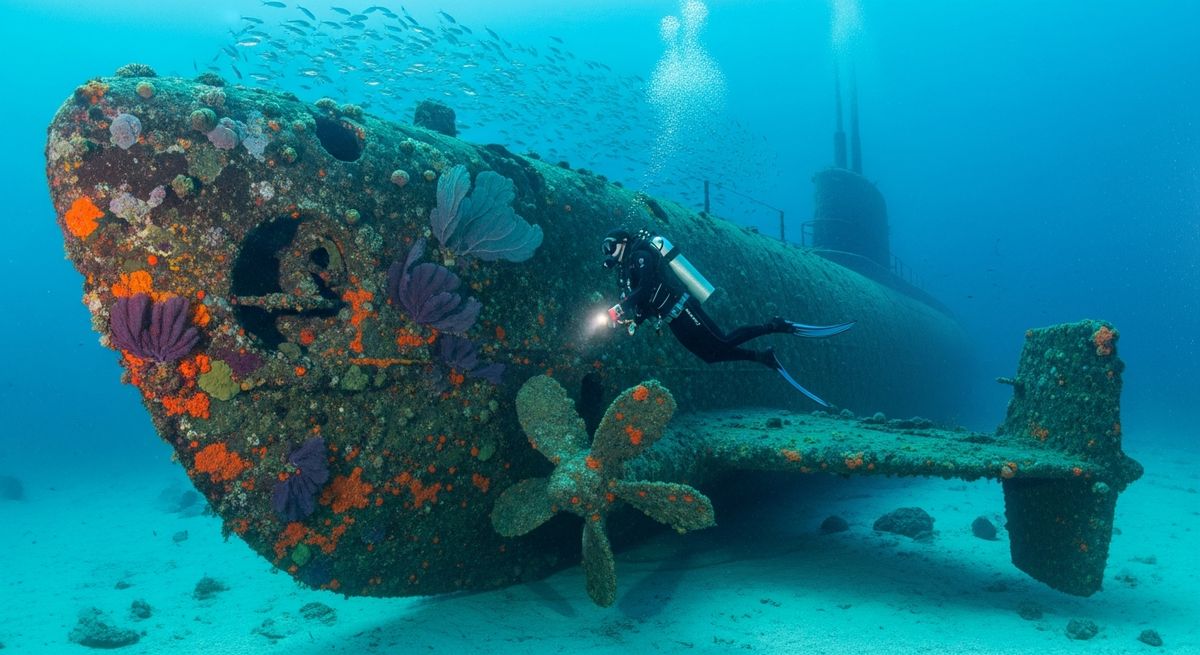
The Andola is a favourite of ours for a reason. It’s not about huge depths or shocking pelagics here; it’s about history you can touch. This barque, sunk in 1895 after a rough journey, now lies broken across the northern side of Shark’s Fin Rock. At just six metres, it’s a brilliant rummage for divers who appreciate the subtler side of wreck diving. We’ve spent many an hour tracing the outline of her collapsed hull, the timbers long gone but the general shape still there in the scattered metal plates and ribbing. What we love most is the way the local life has reclaimed it. You’ll find iridescent snakelocks anemones clinging to every surface, their tentacles waving in the gentle swell. Look closer into the crevices and under the plates for blennies peering out, or the occasional velvet swimming crab scuttling past. It’s an easy dive, perfect for a relaxed afternoon, and we’d suggest going at slack water for the best visibility to really appreciate the details.
Typical ANDOLA Dive Profile
Illustrative profile based on site depth and type. Actual dive profiles vary - always follow your dive computer and training.
Safety Notes
Wreck site - avoid penetration without wreck diving certification. Watch for sharp metal and entanglement hazards.
ANDOLA Wreck History
Year Sunk
1895
Vessel Type
cargo ship
Cause
grounding
Tonnage
659 GRT
The Andola was a hardy Norwegian barque built in 1869, accustomed to the rigors of 19th-century global trade. Her final, fateful voyage was an epic and arduous journey from Tacoma, on the west coast of North America, bound for Europe. The trip around Cape Horn was exceptionally difficult, and the ship arrived in Falmouth, Cornwall, a full two months overdue, undoubtedly bearing the scars of the sea.
After a brief stop, the Andola was ordered to proceed to her final destination of Hull. On January 29, 1895, as she attempted to navigate out of the Cornish coast, she fell victim to the infamous Manacles reef. The sailing ship tacked too late and was driven hard aground on the northern side of Shark's Fin Rock, a notorious ship-killer. Battered by the waves, the Andola quickly broke apart and was lost.
Resting in just 6 meters of water, the remains of the Andola are now scattered across the rocky seabed of the Manacles. Over a century of storm and surge has ensured that no large sections of the hull remain intact. For divers, this is a historical scavenger hunt. The site consists of flattened iron plates, frames, and other metal fixtures mingled with the kelp and rocks. It’s a dive that connects you directly to the perilous reality of Cornwall's maritime past, offering a poignant glimpse into a shipwreck from the great age of sail.
Nearest Dive Centres to ANDOLA
Dive shops near ANDOLA
Porthkerris Divers
DiveUK
Seaways Diving
Karleyth Diving Ltd.
Viewpoint Diving Centre
Wavecrest Scuba
Reviews for ANDOLA
Conditions
Ocean conditions, forecast and tides for ANDOLA
ANDOLA Ocean Conditions
Monthly averages for ANDOLA, sourced from Open-Meteo marine data - nearest station: Open-Meteo marine grid (50.44, -2.73) (3km away)
October Averages
Sea Temperature
17°C
62°F · Range: 15.1–17.5°C
Air Temperature
13°C
56°F
Wind Speed
8.14 m/s
15.8 knots
Atmospheric Pressure
1011 hPa
Based on 4 years of monitoring data · Data sources: Open-Meteo marine data
Plan & book
Ways to dive Cornwall & Devon, from day trips to liveaboards.
Day trips & courses
via GetYourGuideGuided dives, courses and snorkel trips with instant booking.
Find dive trips in Cornwall & DevonPlaces to stay
via Booking.comHotels and dive resorts near Cornwall & Devon.
Search stays in Cornwall & DevonDive insurance
Most travel insurance excludes or limits scuba. Check what you need before you go.
Dive insurance explainedPartner links: we may earn a commission if you book, at no extra cost to you. How we make money
Where to Stay near ANDOLA
Prices from Booking.com. We may earn a commission at no extra cost to you.