ANNA SOFIE
Protected Area
Trevose Head
Why dive here
With 176+ marine species recorded in the area - including blue sharks, dolphins, dwarf minke whales, humpback whales and ocean sunfish (mola mola) - ANNA SOFIE offers some of Cornwall & Devon's richest wreck diving. Water ranges 10-18°C, warmest July, August, September.
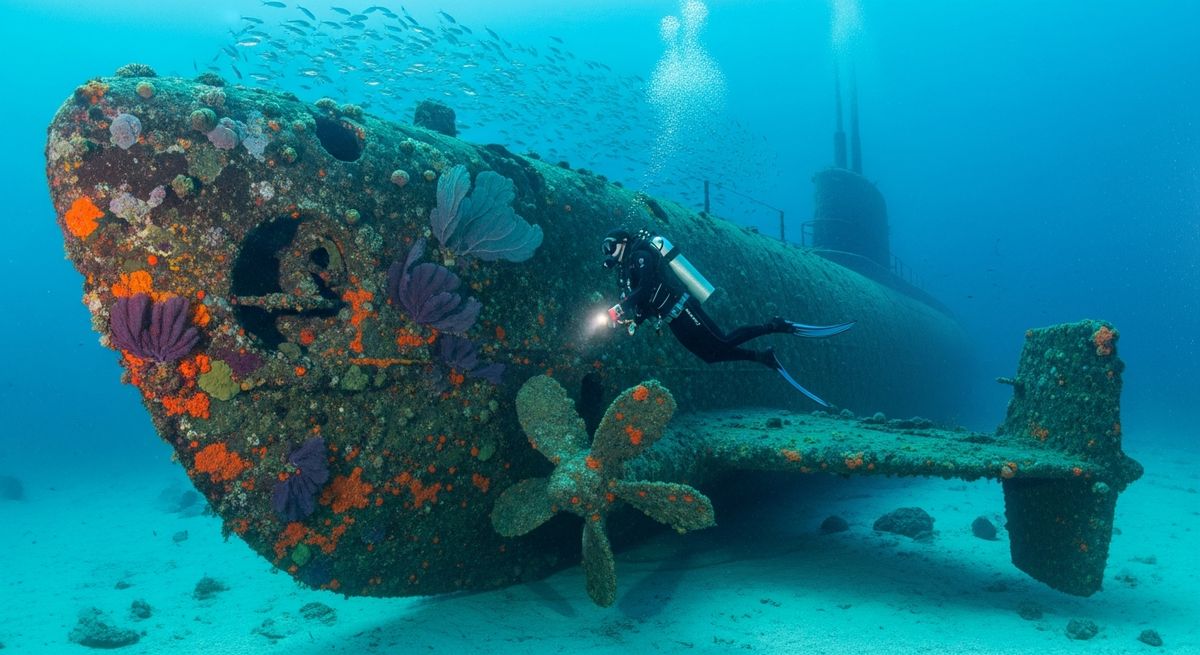
Dive the Anna Sofie off the Lizard and you’re dropping onto a piece of maritime history. This 97-metre steamship, sunk in 1918, lies upright and mostly intact at 38 metres. We love how the visibility, often a good 15 to 20 metres on a calm day, lets you appreciate her scale as you descend through the green-blue. You’ll hit the main deck first, then the bridge, before gliding over the cargo holds which are now home to conger eels and squat lobsters tucked into every nook. Our favourite part is the engine room, surprisingly accessible if you’re comfortable with overhead environments. Peer inside and you can still make out the triple expansion engine, now draped in dead man's fingers and jewelled anemones. The twin boilers are massive, a real sense of industrial power frozen in time. This site suits experienced divers comfortable with deeper wrecks and potential currents; pick a slack water dive for the best experience and take your time exploring.
Typical ANNA SOFIE Dive Profile
Illustrative profile based on site depth and type. Actual dive profiles vary - always follow your dive computer and training.
Safety Notes
Deep dive (38m) - monitor air consumption closely. Advanced certification recommended.
Wreck site - avoid penetration without wreck diving certification. Watch for sharp metal and entanglement hazards.
Always perform a 3-minute safety stop at 5m before surfacing.
ANNA SOFIE Wreck History
Year Sunk
1918
Vessel Type
cargo ship
Cause
torpedo
Tonnage
2,557 GRT
Built in 1896 by the renowned Ropner & Sons shipyard in Stockton-on-Tees, the vessel began its life as the *Vera*. Over the next two decades, it changed hands and names several times, becoming the *S. Anargyros* and then the *Theologos* before finally being named *Anna Sofie* under the ownership of W. M. France, Fenwick & Co. Ltd. This 2,557-ton steamship was a typical workhorse of its era, plying the vital trade routes of Europe with various bulk cargoes.
During the height of World War I, the *Anna Sofie* was on a crucial voyage, transporting a full load of iron ore from Bilbao, Spain, to Middlesbrough. On July 23, 1918, as it steamed through the English Channel, it was spotted by the German submarine UB-112. A single torpedo struck the vessel five miles east of Start Point, sealing its fate. The ship sank quickly, tragically taking six of her crew with her to the seabed.
Today, the wreck of the *Anna Sofie* lies upright on a sandy bottom at a depth of around 38 meters. The bow remains relatively intact, but the midships section, where the torpedo hit, is heavily damaged and has collapsed. The two large boilers stand proud of the wreckage, providing a key landmark for divers exploring the site. The wreck is a haven for marine life, with schools of bib, pollack, and large conger eels often found sheltering within the decaying hull. It's a poignant dive that serves as a tangible link to the perils of WWI maritime trade.
Nearest Dive Centres to ANNA SOFIE
Dive shops near ANNA SOFIE
Dive Newquay
Wavecrest Scuba
Harlyn Dive School
Scuba 2000
Karleyth Diving Ltd.
Viewpoint Diving Centre
Reviews for ANNA SOFIE
Conditions
Ocean conditions, forecast and tides for ANNA SOFIE
ANNA SOFIE Ocean Conditions
Monthly averages for ANNA SOFIE, sourced from Open-Meteo marine data - nearest station: Open-Meteo marine grid (50.44, -2.73) (3km away)
October Averages
Sea Temperature
17°C
62°F · Range: 15.1–17.5°C
Air Temperature
13°C
56°F
Wind Speed
8.14 m/s
15.8 knots
Atmospheric Pressure
1011 hPa
Based on 4 years of monitoring data · Data sources: Open-Meteo marine data
Plan & book
Ways to dive Cornwall & Devon, from day trips to liveaboards.
Day trips & courses
via GetYourGuideGuided dives, courses and snorkel trips with instant booking.
Find dive trips in Cornwall & DevonPlaces to stay
via Booking.comHotels and dive resorts near Cornwall & Devon.
Search stays in Cornwall & DevonDive insurance
Most travel insurance excludes or limits scuba. Check what you need before you go.
Dive insurance explainedPartner links: we may earn a commission if you book, at no extra cost to you. How we make money
Where to Stay near ANNA SOFIE
Prices from Booking.com. We may earn a commission at no extra cost to you.