ANNIE YVONNE
Protected Area
Lizard Point
Why dive here
With 176+ marine species recorded in the area - including blue sharks, dolphins, dwarf minke whales, humpback whales and ocean sunfish (mola mola) - ANNIE YVONNE offers some of Cornwall & Devon's richest wreck diving. Water ranges 10-18°C, warmest July, August, September.
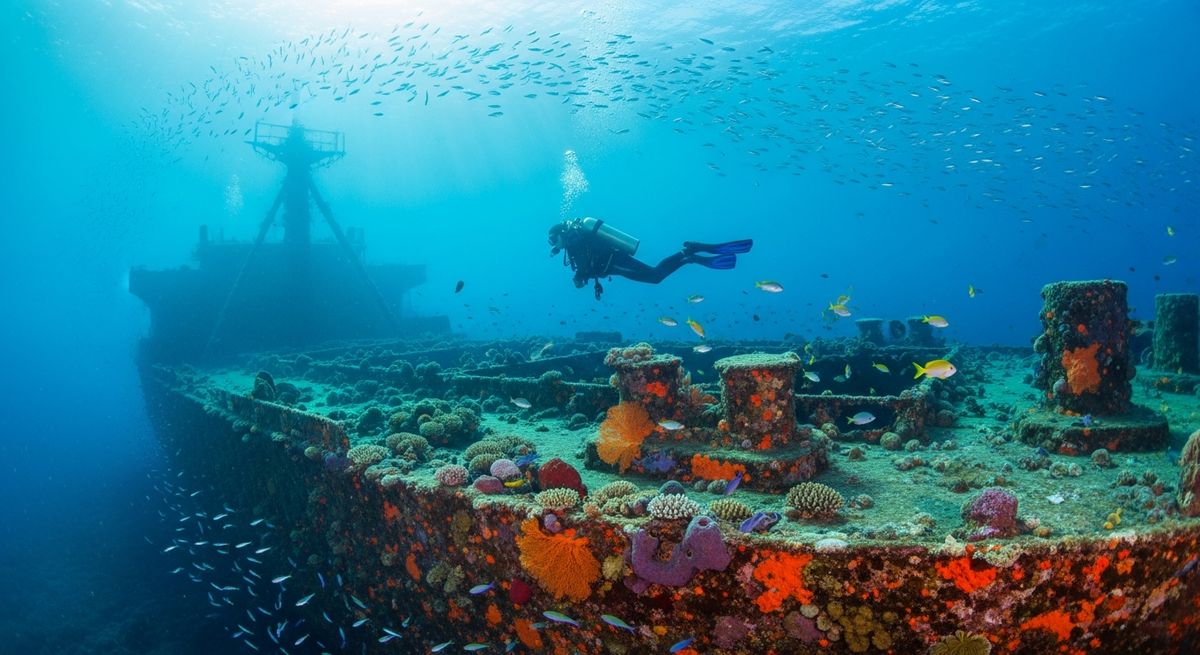
Diving the *Annie Yvonne* is like stepping back into a moment of maritime history, the wreck itself a stark reminder of wartime perils. This 25-meter sailing vessel, torpedoed by a German U-boat in 1918, lies upright and remarkably intact at 21 meters, a real bonus for a wreck of this age. We love how her wooden hull has largely survived, especially the stern, which still holds much of its original shape. Swimming along the deck, you can almost trace the crew’s final moments. The bow is broken but the midships section is pretty complete, offering swim-throughs into what would have been the cargo hold. Sunlight, even on a cloudy day, filters down, illuminating the vibrant jewel anemones that have colonised every available surface. Look closely among the planks and you’ll spot gobies darting into crevices, while velvet crabs scuttle across the timbers. For us, the highlight is exploring the rigging, now a jumble of beams and spars, where conger eels often lurk, peeking out from beneath the structure. It’s a site that really suits divers who appreciate historical wrecks and aren’t put off by the cooler Atlantic waters. We’d suggest a slack tide dive for the best experience, as currents can pick up here.
Typical ANNIE YVONNE Dive Profile
Illustrative profile based on site depth and type. Actual dive profiles vary - always follow your dive computer and training.
Safety Notes
Depth of 21m - Advanced Open Water certification recommended.
Wreck site - avoid penetration without wreck diving certification. Watch for sharp metal and entanglement hazards.
Always perform a 3-minute safety stop at 5m before surfacing.
ANNIE YVONNE Wreck History
Year Sunk
1918
Vessel Type
cargo ship
Cause
scuttled
Tonnage
109 GRT
The Annie Yvonne was a small French wooden schooner, a sailing vessel that was still a common sight carrying cargo along coastal routes even in the age of steam. In March 1918, during the final, intense year of World War I, she was on a voyage from Swansea, Wales, to Granville, France, navigating the treacherous waters of the English Channel, which had become a prime hunting ground for German U-boats.
On March 17th, her luck ran out. She was intercepted by the German submarine UB-57, a successful and feared predator of Allied shipping. As the Annie Yvonne was an unarmed sailing vessel, the U-boat simply surfaced. Rather than waste a valuable torpedo, the German crew scuttled the schooner, likely by placing explosive charges against the hull and allowing her crew to abandon ship in their boats before sending the vessel to the bottom.
Today, the remains of the Annie Yvonne lie in 21 meters of water off Cadgwith, Cornwall, making for a fascinating dive for recreational divers. As a wooden ship, her hull has largely disintegrated over the last century, leaving behind a scattered but intriguing debris field. Divers can explore the site searching for the non-wooden parts of the ship that have survived, such as iron ballast, metal fittings, anchors, and other hardware. It's an archaeological dive that offers a direct connection to a dramatic WWI encounter.
Nearest Dive Centres to ANNIE YVONNE
Dive shops near ANNIE YVONNE
Porthkerris Divers
DiveUK
Seaways Diving
Karleyth Diving Ltd.
Wavecrest Scuba
Viewpoint Diving Centre
Reviews for ANNIE YVONNE
Conditions
Ocean conditions, forecast and tides for ANNIE YVONNE
ANNIE YVONNE Ocean Conditions
Monthly averages for ANNIE YVONNE, sourced from Open-Meteo marine data - nearest station: Open-Meteo marine grid (50.44, -2.73) (3km away)
October Averages
Sea Temperature
17°C
62°F · Range: 15.1–17.5°C
Air Temperature
13°C
56°F
Wind Speed
8.14 m/s
15.8 knots
Atmospheric Pressure
1011 hPa
Based on 4 years of monitoring data · Data sources: Open-Meteo marine data
Plan & book
Ways to dive Cornwall & Devon, from day trips to liveaboards.
Day trips & courses
via GetYourGuideGuided dives, courses and snorkel trips with instant booking.
Find dive trips in Cornwall & DevonPlaces to stay
via Booking.comHotels and dive resorts near Cornwall & Devon.
Search stays in Cornwall & DevonDive insurance
Most travel insurance excludes or limits scuba. Check what you need before you go.
Dive insurance explainedPartner links: we may earn a commission if you book, at no extra cost to you. How we make money
Where to Stay near ANNIE YVONNE
Prices from Booking.com. We may earn a commission at no extra cost to you.