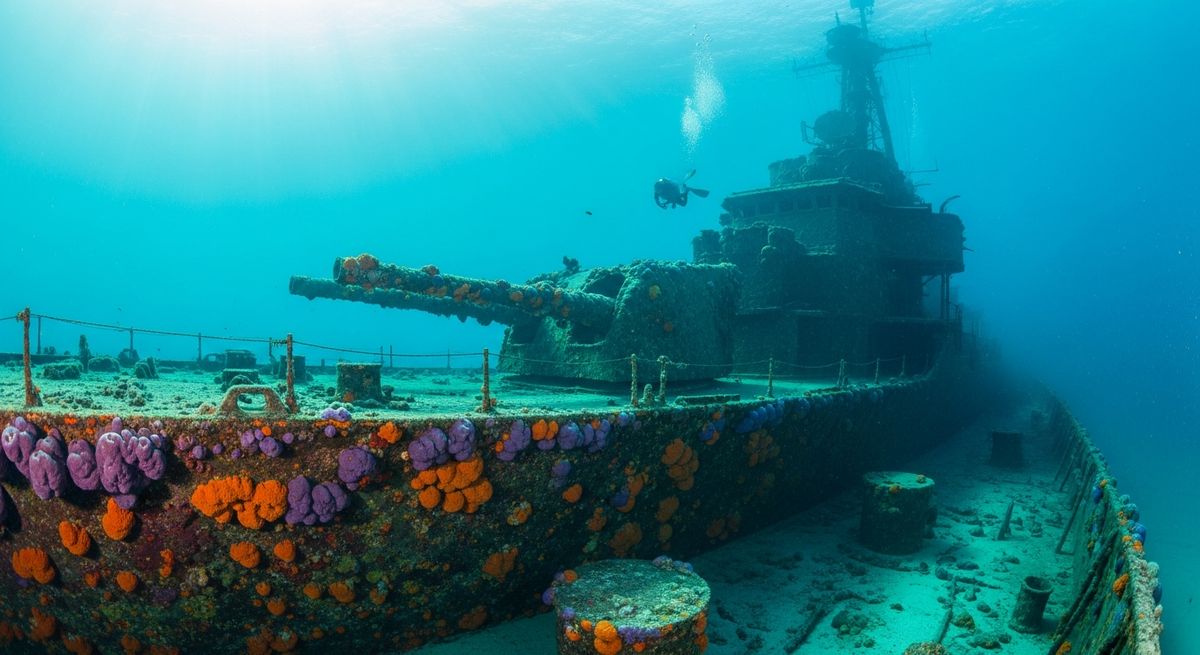
ANTOINETTE
Protected Area
Gouliot Caves and Headland, Sark
Why dive here
With 176+ marine species recorded in the area - including blue sharks, dolphins, dwarf minke whales, humpback whales and ocean sunfish (mola mola) - ANTOINETTE offers some of Cornwall & Devon's richest wreck diving. Water ranges 10-18°C, warmest July, August, September.
The Antoinette, she’s a proper dive, one for those who appreciate the chill of a deep wreck. Dropping down to 52 metres, you’re looking at a serious commitment, so check your gas and your bottom time. She’s a sailing vessel, gone down in 1900, and resting two miles south of St. Martins Point. We love how intact she feels for her age and depth. You can make out the lines of the hull, the spars, and some of the decking. It’s a proper history lesson, feeling the cold water swirl around the ghost of her rigging. Visibility down here can be decent on a good day, but it’s the sheer atmosphere that grabs you. Look for the conger eels nestled into the darker recesses, and the odd intrepid lobster making its home in the twisted metal. We’d suggest going on a slack tide, if you can time it right. It makes a huge difference when you’re trying to absorb the scale of her. This isn’t a quick splash, it’s a dive where you take your time, respect the depth, and soak in the silence of a century-old sinking.
Typical ANTOINETTE Dive Profile
Illustrative profile based on site depth and type. Actual dive profiles vary - always follow your dive computer and training.
Safety Notes
Maximum depth 52m exceeds recreational limits (40m). Technical diving certification and equipment required.
Wreck site - avoid penetration without wreck diving certification. Watch for sharp metal and entanglement hazards.
Always perform a 3-minute safety stop at 5m before surfacing.
ANTOINETTE Wreck History
Year Sunk
1900
Vessel Type
sailing vessel
Cause
unknown
The story of the Antoinette is shrouded in the mists of time. A sailing vessel lost at the turn of the 20th century, her final moments are not clearly recorded, leaving only the wreck itself to tell her tale. She sank in August 1900, two miles south of St Martin's Point in the Channel Islands, an area known for its strong currents and challenging maritime conditions. Without a definitive cause of loss, we are left to imagine a sudden Channel storm or a navigational error that sealed her fate, sending her to the seabed in the final years of the age of sail.
Resting at a depth of 52 meters, the Antoinette is a challenging and rewarding dive reserved for experienced technical divers. In the deep, cool waters, the wreck is a haunting silhouette from a bygone era. Subject to over a century of tides, she is likely well broken, but divers can still identify features of her wooden construction. Exploring the scattered timbers, ribs, and any remaining artifacts offers a profound connection to the maritime past. The visibility can be excellent, but the depth and potential for strong currents demand careful planning and respect for this historic site.
Nearest Dive Centres to ANTOINETTE
Dive shops near ANTOINETTE
View all dive centres in Cornwall & DevonReviews for ANTOINETTE
Conditions
Ocean conditions, forecast and tides for ANTOINETTE
ANTOINETTE Ocean Conditions
Monthly averages for ANTOINETTE, sourced from Open-Meteo marine data - nearest station: Open-Meteo marine grid (50.44, -2.73) (3km away)
October Averages
Sea Temperature
17°C
62°F · Range: 15.1–17.5°C
Air Temperature
13°C
56°F
Wind Speed
8.14 m/s
15.8 knots
Atmospheric Pressure
1011 hPa
Based on 4 years of monitoring data · Data sources: Open-Meteo marine data
Plan & book
Ways to dive Cornwall & Devon, from day trips to liveaboards.
Day trips & courses
via GetYourGuideGuided dives, courses and snorkel trips with instant booking.
Find dive trips in Cornwall & DevonPlaces to stay
via Booking.comHotels and dive resorts near Cornwall & Devon.
Search stays in Cornwall & DevonDive insurance
Most travel insurance excludes or limits scuba. Check what you need before you go.
Dive insurance explainedPartner links: we may earn a commission if you book, at no extra cost to you. How we make money
Where to Stay near ANTOINETTE
Prices from Booking.com. We may earn a commission at no extra cost to you.