ANTONIO (PROBABLY)
Protected Area
Skerries Bank and Surrounds
Why dive here
With 176+ marine species recorded in the area - including blue sharks, dolphins, dwarf minke whales, humpback whales and ocean sunfish (mola mola) - ANTONIO (PROBABLY) offers some of Cornwall & Devon's richest wreck diving. Water ranges 10-18°C, warmest July, August, September.
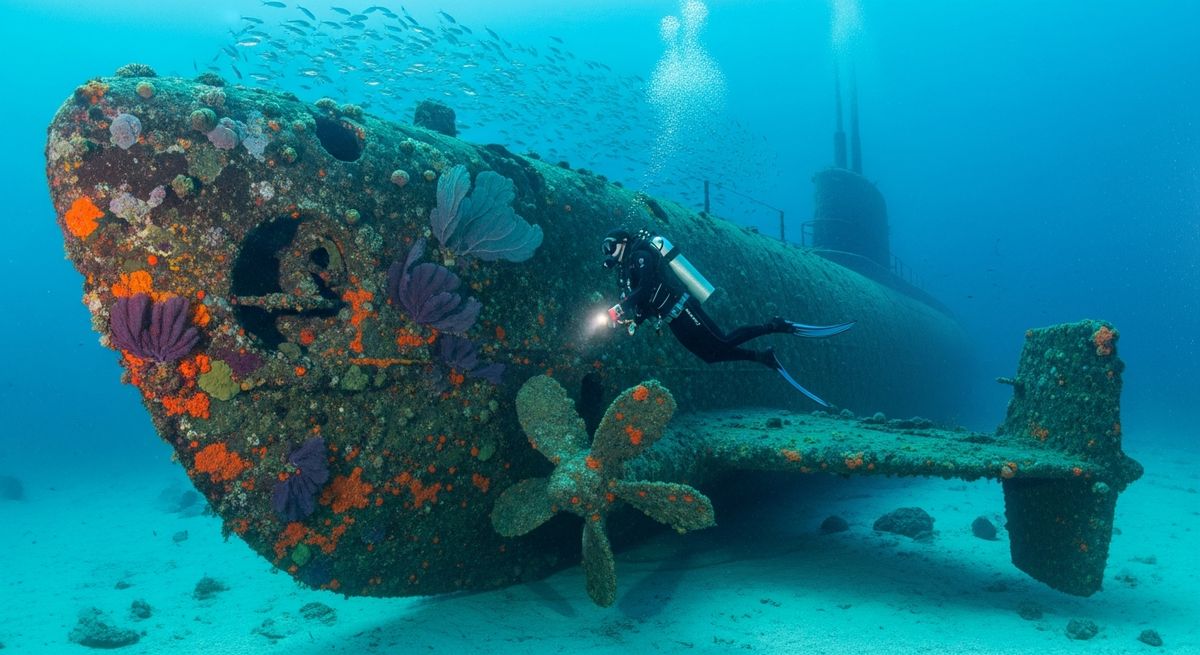
Let's be clear, it's called ANTONIO (PROBABLY) for a reason. Pinpointing exact wreck identities in these waters is often a best guess, but that’s part of the adventure, isn't it? We love this wreck for its sheer scale and the journey it offers into early 20th-century maritime history. Dropping onto the deck at 53 metres, you're immediately struck by the robust engineering of a 1905 steamship. The twin boilers are a particular highlight, still impressively intact, hinting at the immense power that once drove this 95-metre vessel. The real beauty here lies in the exploration. We’ve spent many dives tracing the outline of her massive hull, imagining the cargo holds filled with goods. The triple-expansion engine is still discernable, a ghostly monument to its working days. Visibility, as always in the UK, can be variable, but when it’s good, the light penetrating from above creates dramatic shafts through the superstructure. Conger eels are often found tucked into nooks and crannies, and dead man’s fingers coral grows in thick, creamy blankets across the metalwork. This site is a serious technical dive, demanding experience and good gas planning. Go with a local guide; their knowledge of the tides and potential currents is invaluable. It’s a dive that rewards patience and a keen eye for detail.
Typical ANTONIO (PROBABLY) Dive Profile
Illustrative profile based on site depth and type. Actual dive profiles vary - always follow your dive computer and training.
Safety Notes
Maximum depth 53m exceeds recreational limits (40m). Technical diving certification and equipment required.
Wreck site - avoid penetration without wreck diving certification. Watch for sharp metal and entanglement hazards.
Always perform a 3-minute safety stop at 5m before surfacing.
ANTONIO (PROBABLY) Wreck History
Year Sunk
1917
Vessel Type
cargo ship
Cause
torpedo
Tonnage
3,101 GRT
The SS Antonio was a British steamship built in 1905 by J. Blumer & Co. in Sunderland for the Egypt & Levant Steamship Co. For over a decade, she served as a typical merchant vessel of her era, transporting goods across the globe. Her fate was sealed during the height of World War I, when Germany's unrestricted submarine warfare campaign turned the seas into a battlefield for civilian and military ships alike.
On March 7, 1917, the Antonio was on a voyage from Alexandria, Egypt, to Hull, carrying a cargo of cotton seed. While navigating the English Channel about 10 miles east of Start Point, she was spotted and torpedoed by the German submarine UC-48. The attack was swift and devastating, sinking the ship and tragically claiming the lives of 14 of her crew members.
Today, the wreck identified as the Antonio rests at a challenging depth of 53 meters, making it a dive reserved for experienced technical and trimix divers. The vessel is broken but substantial sections remain, including her two large boilers and the triple-expansion engine, which stand proud of the seabed. The strong currents of the channel demand respect and careful planning, but for those qualified to make the descent, the Antonio offers a poignant and fascinating glimpse into the maritime toll of the Great War.
Nearest Dive Centres to ANTONIO (PROBABLY)
Dive shops near ANTONIO (PROBABLY)
Teign Diving Centre
Edge Watersports
Sound Diving Limited
Plymouth Diving Centre
Reviews for ANTONIO (PROBABLY)
Conditions
Ocean conditions, forecast and tides for ANTONIO (PROBABLY)
ANTONIO (PROBABLY) Ocean Conditions
Monthly averages for ANTONIO (PROBABLY), sourced from Open-Meteo marine data - nearest station: Open-Meteo marine grid (50.44, -2.73) (3km away)
October Averages
Sea Temperature
17°C
62°F · Range: 15.1–17.5°C
Air Temperature
13°C
56°F
Wind Speed
8.14 m/s
15.8 knots
Atmospheric Pressure
1011 hPa
Based on 4 years of monitoring data · Data sources: Open-Meteo marine data
Plan & book
Ways to dive Cornwall & Devon, from day trips to liveaboards.
Day trips & courses
via GetYourGuideGuided dives, courses and snorkel trips with instant booking.
Find dive trips in Cornwall & DevonPlaces to stay
via Booking.comHotels and dive resorts near Cornwall & Devon.
Search stays in Cornwall & DevonDive insurance
Most travel insurance excludes or limits scuba. Check what you need before you go.
Dive insurance explainedPartner links: we may earn a commission if you book, at no extra cost to you. How we make money
Where to Stay near ANTONIO (PROBABLY)
Prices from Booking.com. We may earn a commission at no extra cost to you.