APARIMA
Protected Area
Albert Field
Why dive here
With 176+ marine species recorded in the area - including blue sharks, dolphins, dwarf minke whales, humpback whales and ocean sunfish (mola mola) - APARIMA offers some of Cornwall & Devon's richest wreck diving. Water ranges 10-18°C, warmest July, August, September.
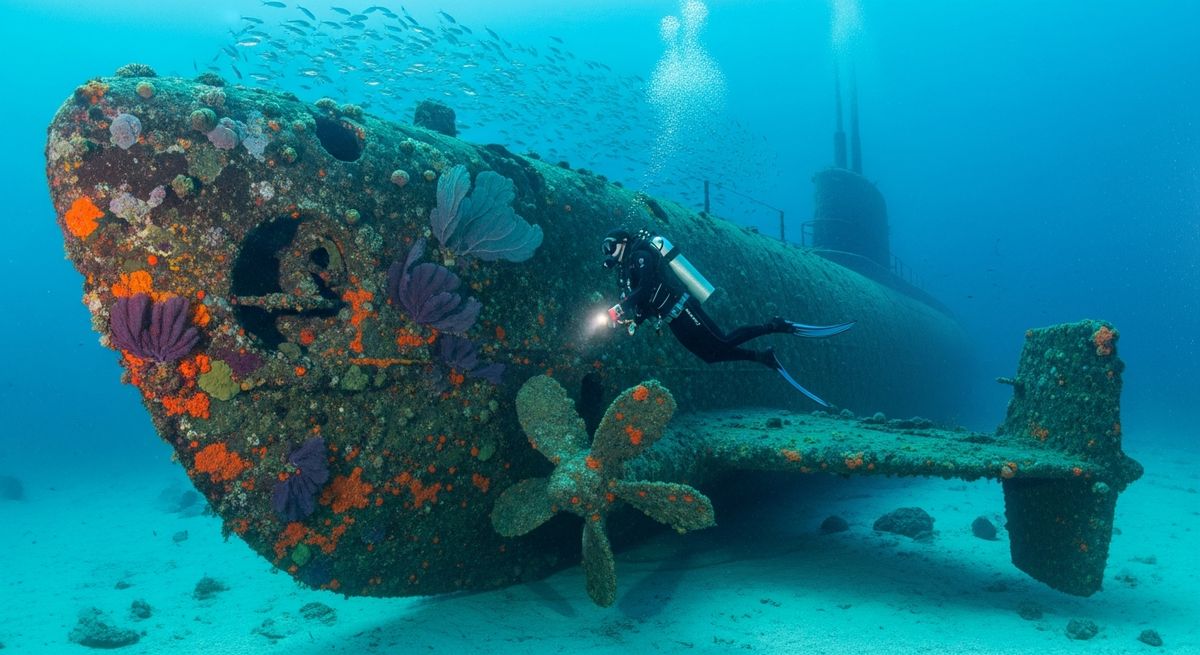
The Aparima is one of those wrecks that really sticks with you. She’s a big liner, over 130 metres, sitting upright in about 38 metres. We love that you can really get a sense of her scale as you descend, the deck structures looming out of the murk. It’s a proper expedition, certainly not one for a quick splash. The stern is our favourite part; the huge propellers are still there, often swarming with pollack. You’ll find plenty of conger eels tucked into every nook and cranny, and the deeper sections are usually home to big ling. Visibility here can be a bit of a lottery, as it often is off the Cornish coast. We’d suggest aiming for slack water on a neap tide for the best chance of a clear run, allowing you to properly explore the promenade decks and cargo holds. It’s a challenging dive, best suited to experienced wreck divers comfortable with depth and navigating larger structures, but the reward is a truly magnificent piece of history.
Typical APARIMA Dive Profile
Illustrative profile based on site depth and type. Actual dive profiles vary - always follow your dive computer and training.
Safety Notes
Deep dive (38m) - monitor air consumption closely. Advanced certification recommended.
Wreck site - avoid penetration without wreck diving certification. Watch for sharp metal and entanglement hazards.
Always perform a 3-minute safety stop at 5m before surfacing.
APARIMA Wreck History
Year Sunk
1917
Vessel Type
passenger ship
Cause
torpedo
Tonnage
5,704 GRT
Built in 1902, the SS Aparima served the Union Steamship Company of New Zealand as a passenger and cargo liner on the route between Calcutta and Australasia. A modern vessel for her time, she was powered by twin triple-expansion steam engines and could carry passengers, general cargo, and even prized racehorses in comfort and style. With the outbreak of the First World War, the Aparima was requisitioned for the war effort and converted into a troopship, tasked with transporting soldiers far from her usual commercial routes.
Her wartime service came to a tragic end on November 19, 1917. While sailing in the English Channel, she was spotted by the German U-boat UB-40. A single torpedo struck the Aparima in the engine room, causing catastrophic damage. The ship sank in less than ten minutes, taking 54 of her crew members with her. It was a sudden and violent end for the elegant liner, becoming another casualty of the intense submarine warfare in the waters around the United Kingdom.
Today, the wreck of the Aparima rests upright on a sandy seabed at 38 meters. It is a popular but challenging dive, often subject to strong currents and limited visibility. Divers who make the descent are rewarded with the sight of a largely intact early 20th-century steamship. The bow and stern remain impressive, and amidships, the massive boilers and engines stand as a testament to her power. The wreck is a poignant memorial, offering a direct connection to the maritime history of WWI.
Nearest Dive Centres to APARIMA
Dive shops near APARIMA
Divers Down
Mayim Mermaid Academy
Dorset Diving Services
TAL Scuba Ltd.
Dive Beyond Limited
Old Harbour Dive Centre
Reviews for APARIMA
Conditions
Ocean conditions, forecast and tides for APARIMA
APARIMA Ocean Conditions
Monthly averages for APARIMA, sourced from Open-Meteo marine data - nearest station: Open-Meteo marine grid (50.44, -2.73) (3km away)
October Averages
Sea Temperature
17°C
62°F · Range: 15.1–17.5°C
Air Temperature
13°C
56°F
Wind Speed
8.14 m/s
15.8 knots
Atmospheric Pressure
1011 hPa
Based on 4 years of monitoring data · Data sources: Open-Meteo marine data
Plan & book
Ways to dive Cornwall & Devon, from day trips to liveaboards.
Day trips & courses
via GetYourGuideGuided dives, courses and snorkel trips with instant booking.
Find dive trips in Cornwall & DevonPlaces to stay
via Booking.comHotels and dive resorts near Cornwall & Devon.
Search stays in Cornwall & DevonDive insurance
Most travel insurance excludes or limits scuba. Check what you need before you go.
Dive insurance explainedPartner links: we may earn a commission if you book, at no extra cost to you. How we make money
Where to Stay near APARIMA
Prices from Booking.com. We may earn a commission at no extra cost to you.