ARCTIC DAWN
Protected Area
Purbeck Coast
Why dive here
With 176+ marine species recorded in the area - including blue sharks, dolphins, dwarf minke whales, humpback whales and ocean sunfish (mola mola) - ARCTIC DAWN offers some of Cornwall & Devon's richest wreck diving. Water ranges 10-18°C, warmest July, August, September.
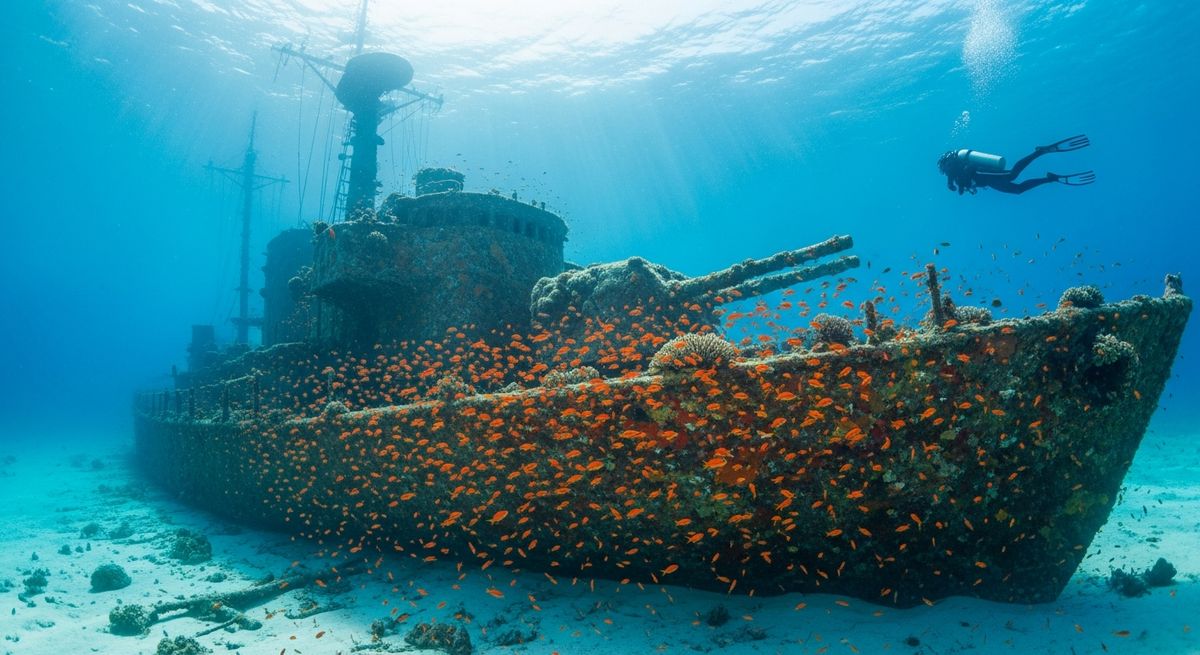
The Arctic Dawn is a curious one, a wreck that wasn't meant to be. She was derelict, being towed to her end, when the sea decided otherwise in 1957. What’s left is scattered, a collection of intriguing debris at a shallow six metres, making it a perfect spot for those wanting a relaxed dive with a touch of history. We love how accessible it is, a gentle introduction to wreck diving without any of the usual depth or current worries. You’ll find plates and beams spread across the seabed, each piece now a miniature reef. Look closely and you’ll spot tiny crabs scuttling for cover and blennies peering out from crevices. It’s less about a grand structure and more about the details; the way the light plays on the corroded metal, the surprising flashes of colour from anemones clinging on. Our favourite part is the feeling of discovery, sifting through the remains, imagining the vessel’s final moments. It’s a quiet, reflective dive, ideal for photographers or anyone who appreciates the subtle beauty of a wreck reclaimed by the ocean.
Typical ARCTIC DAWN Dive Profile
Illustrative profile based on site depth and type. Actual dive profiles vary - always follow your dive computer and training.
Safety Notes
Wreck site - avoid penetration without wreck diving certification. Watch for sharp metal and entanglement hazards.
ARCTIC DAWN Wreck History
Year Sunk
1957
Vessel Type
cargo ship
Cause
unknown
Tonnage
169 GRT
The Arctic Dawn had a long and fascinating history that stretched back to the golden age of sail. Built in 1891 in Denmark as the three-masted schooner 'Jason', she spent decades plying the trade routes of Northern Europe, carrying cargo under wind power. By the mid-20th century, however, such vessels were obsolete. The ship, renamed Arctic Dawn, eventually fell into a state of disrepair.
Her final voyage occurred on July 3rd, 1957. The aging, derelict schooner was being towed, likely to a scrapyard, when she could no longer withstand the strain. She began taking on water and foundered, sinking beneath the waves off Wyke Regis on the Dorset coast.
Lying in just 6 meters of water, the Arctic Dawn is a dive into history. The classification 'Distributed remains' is accurate; the wreck is a scattered collection of timbers, frames, and iron fittings partially buried in the sand. There is no intact structure to penetrate, but for divers with a passion for maritime archaeology, it's a rewarding experience. Exploring the debris field allows one to trace the faint outline of this 19th-century sailing ship and imagine its final moments. Its shallow depth makes it a very accessible dive, though it is best explored on a calm day with good visibility.
Nearest Dive Centres to ARCTIC DAWN
Dive shops near ARCTIC DAWN
Divers Down
Mayim Mermaid Academy
Dorset Diving Services
TAL Scuba Ltd.
Dive Beyond Limited
Old Harbour Dive Centre
Reviews for ARCTIC DAWN
Conditions
Ocean conditions, forecast and tides for ARCTIC DAWN
ARCTIC DAWN Ocean Conditions
Monthly averages for ARCTIC DAWN, sourced from Open-Meteo marine data - nearest station: Open-Meteo marine grid (50.44, -2.73) (3km away)
October Averages
Sea Temperature
17°C
62°F · Range: 15.1–17.5°C
Air Temperature
13°C
56°F
Wind Speed
8.14 m/s
15.8 knots
Atmospheric Pressure
1011 hPa
Based on 4 years of monitoring data · Data sources: Open-Meteo marine data
Plan & book
Ways to dive Cornwall & Devon, from day trips to liveaboards.
Day trips & courses
via GetYourGuideGuided dives, courses and snorkel trips with instant booking.
Find dive trips in Cornwall & DevonPlaces to stay
via Booking.comHotels and dive resorts near Cornwall & Devon.
Search stays in Cornwall & DevonDive insurance
Most travel insurance excludes or limits scuba. Check what you need before you go.
Dive insurance explainedPartner links: we may earn a commission if you book, at no extra cost to you. How we make money
Where to Stay near ARCTIC DAWN
Prices from Booking.com. We may earn a commission at no extra cost to you.