ARCTIC PIONEER
Protected Area
Whitecliff Bay and Bembridge Ledges
Why dive here
With 176+ marine species recorded in the area - including blue sharks, dolphins, dwarf minke whales, humpback whales and ocean sunfish (mola mola) - ARCTIC PIONEER offers some of Cornwall & Devon's richest wreck diving. Water ranges 10-18°C, warmest July, August, September.
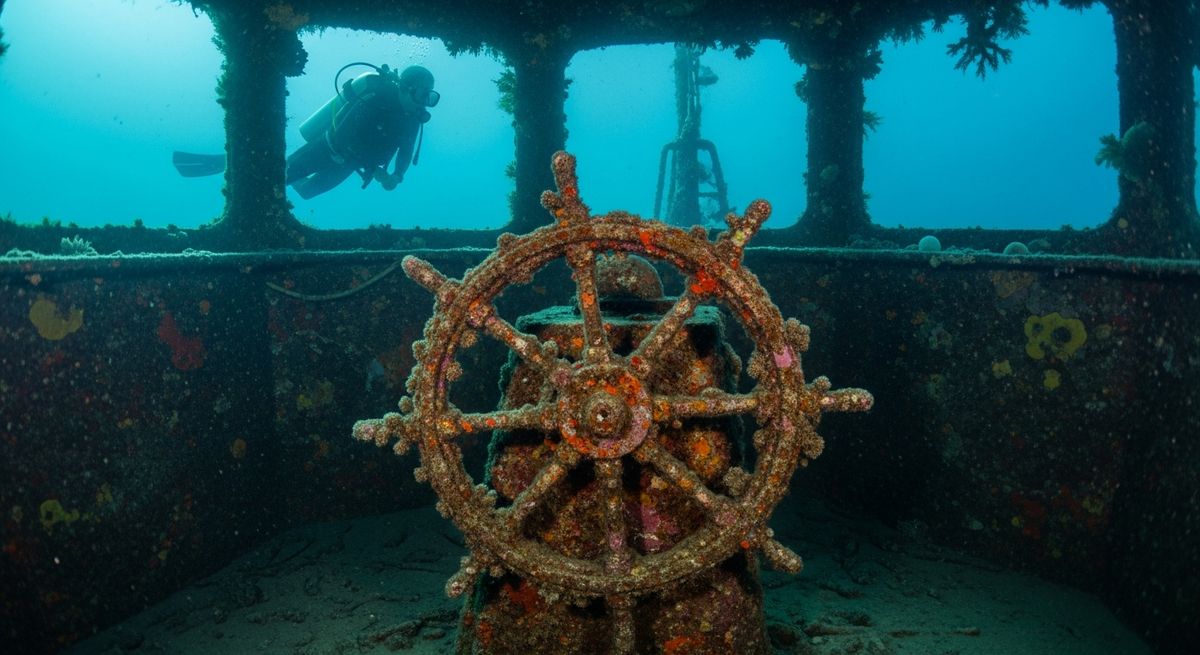
The Arctic Pioneer, a trawler sunk by a mine in 1942, sits upright at a modest 10 metres. We love that you can see almost the entire wreck in one dive, with plenty of time to poke around. Her superstructure is broken, but the bow and stern are still distinct, creating lots of nooks for conger eels and squat lobsters. We'd suggest aiming for a slack tide; the currents here can whip up and turn the visibility milky, but on a good day, you're rewarded with light shafts filtering through the collapsed deck plates onto colourful jewel anemones. It's an ideal spot for newer wreck divers or those wanting a relaxed potter, and our favourite feature has to be the huge propeller, often covered in dead man's fingers.
Typical ARCTIC PIONEER Dive Profile
Illustrative profile based on site depth and type. Actual dive profiles vary - always follow your dive computer and training.
Safety Notes
Wreck site - avoid penetration without wreck diving certification. Watch for sharp metal and entanglement hazards.
ARCTIC PIONEER Wreck History
Year Sunk
1942
Vessel Type
fishing vessel
Cause
torpedo
Tonnage
551 GRT
The Arctic Pioneer was a large, powerful steam trawler built in 1936, designed to withstand the harsh conditions of fishing in the North Atlantic. With the outbreak of World War II, her robust build made her a prime candidate for military service. She was requisitioned by the British Admiralty, armed, and designated His Majesty's Trawler (HMT) Arctic Pioneer. Her new mission was to patrol the English Channel, hunting for enemy submarines and protecting vital Allied shipping lanes.
On May 27th, 1942, her wartime service came to a violent end. While on patrol off the Cornish coast, HMT Arctic Pioneer struck a German-laid mine. The resulting explosion was devastating, and the ship sank almost immediately with the loss of most of her crew. Her sinking was a tragic but common story during the Battle of the Atlantic, where the waters around the UK were a constant, invisible battlefield.
Today, the wreck of the Arctic Pioneer lies in 10 meters of water, serving as a poignant memorial to her crew. The mine explosion and subsequent salvage work have left the wreck heavily broken and scattered, with the ship's massive boilers being the most prominent and recognizable feature. Classified as a 'Dangerous Wreck' due to its shallow depth, it presents a hazard to shipping but an interesting site for divers. Exploring the debris field offers a direct connection to the naval history of the Second World War, a shallow dive that is rich in historical significance.
Nearest Dive Centres to ARCTIC PIONEER
Dive shops near ARCTIC PIONEER
In2 Diving
Sussex Diving & Leisure
Mulberry Marine Experiences CIC
Andark Diving
Abyss Scuba School
Sunken Dreams Scuba Diving Academy
Reviews for ARCTIC PIONEER
Conditions
Ocean conditions, forecast and tides for ARCTIC PIONEER
ARCTIC PIONEER Ocean Conditions
Monthly averages for ARCTIC PIONEER, sourced from Open-Meteo marine data - nearest station: Open-Meteo marine grid (50.44, -2.73) (3km away)
October Averages
Sea Temperature
17°C
62°F · Range: 15.1–17.5°C
Air Temperature
13°C
56°F
Wind Speed
8.14 m/s
15.8 knots
Atmospheric Pressure
1011 hPa
Based on 4 years of monitoring data · Data sources: Open-Meteo marine data
Plan & book
Ways to dive Cornwall & Devon, from day trips to liveaboards.
Day trips & courses
via GetYourGuideGuided dives, courses and snorkel trips with instant booking.
Find dive trips in Cornwall & DevonPlaces to stay
via Booking.comHotels and dive resorts near Cornwall & Devon.
Search stays in Cornwall & DevonDive insurance
Most travel insurance excludes or limits scuba. Check what you need before you go.
Dive insurance explainedPartner links: we may earn a commission if you book, at no extra cost to you. How we make money
Where to Stay near ARCTIC PIONEER
Prices from Booking.com. We may earn a commission at no extra cost to you.