ARDANGORM
Protected Area
Cuckoo Rock to Turbot Point
Why dive here
With 176+ marine species recorded in the area - including blue sharks, dolphins, dwarf minke whales, humpback whales and ocean sunfish (mola mola) - ARDANGORM offers some of Cornwall & Devon's richest wreck diving. Water ranges 10-18°C, warmest July, August, September.
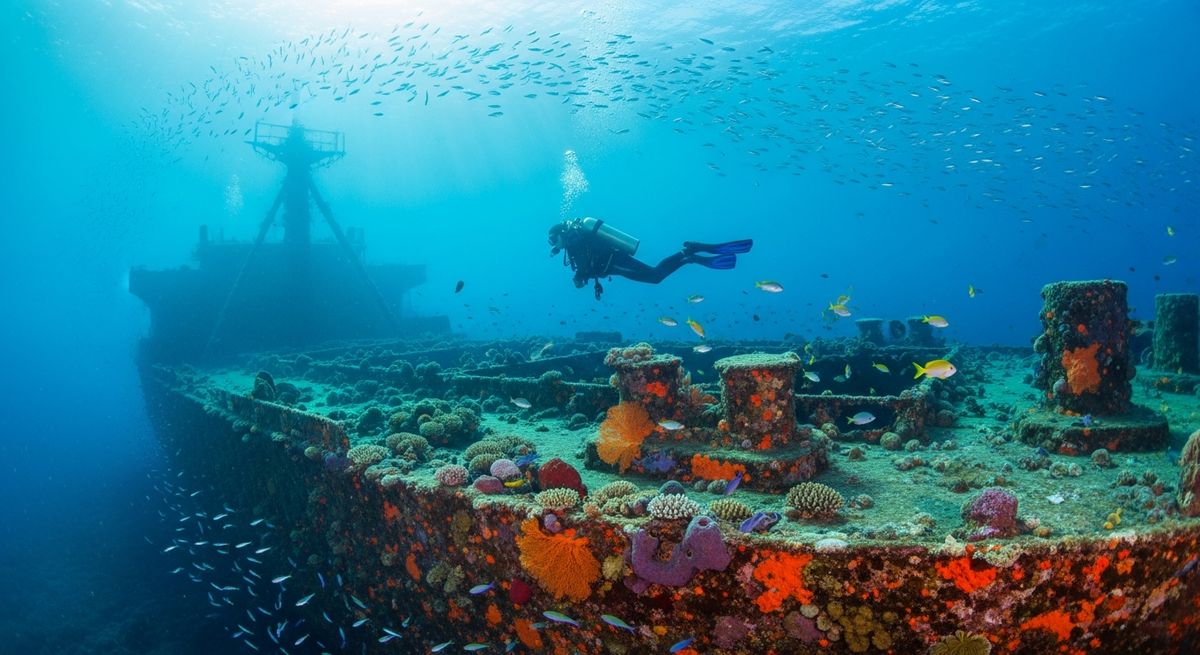
The Ardjangorm, just off the Cornish coast, is one of our favourite shallow wrecks. We love its accessibility, sitting at a comfortable 10 metres. It’s perfect for divers who want to spend time truly exploring a wreck rather than just flying over it. The ship was a steam merchant that went down in 1940 after hitting the Gwineas Rocks in thick fog. You can still see significant sections of her hull and machinery spread across the seabed, giving a real sense of the force involved in the wrecking. Entry can be a little choppy on windy days, so pick your weather. Once you're down, though, the current usually isn't a problem. What truly makes the Ardjangorm special is the sheer density of life that has colonised the twisted metal. We often find conger eels tucked into the darker crevices, their heads poking out to eye you up. Look out for dogfish resting on the sand nearby, and the whole wreck shimmers with pollack and wrasse darting in and out of the structure. It’s a photographer’s dream, especially on a sunny day when the light penetrates right to the bottom, illuminating the kelp-covered steel. We’d suggest taking your time, really nosing into the nooks and crannies – that’s where the best stuff hides.
Typical ARDANGORM Dive Profile
Illustrative profile based on site depth and type. Actual dive profiles vary - always follow your dive computer and training.
Safety Notes
Wreck site - avoid penetration without wreck diving certification. Watch for sharp metal and entanglement hazards.
ARDANGORM Wreck History
Year Sunk
1940
Vessel Type
cargo ship
Cause
grounding
Tonnage
1,489 GRT
The SS Ardangorm was a British steamship built in 1919, a product of the post-WWI era of maritime trade. For two decades, it reliably plied the coastal routes of Europe, transporting essential goods like coal. Its service came to an end during the early months of the Second World War, not from enemy action, but from the timeless peril of the sea: fog.
On January 4, 1940, the Ardangorm was on a voyage from Swansea to Rouen, France, with a full cargo of coal. As it navigated the Cornish coast, a dense fog descended, completely obscuring visibility. The vessel lost its bearings and ran hard aground on the notorious Gwineas Rocks, a treacherous reef south of Gorran Haven. The impact sealed the ship's fate, but fortunately, the Fowey lifeboat was able to rescue all 21 crew members before the Ardangorm broke apart under the relentless force of the sea.
Lying in just 10 meters of water, the Ardangorm is now a scattered but fascinating dive site. Decades of storms have flattened the wreck, but its key features, including the large boilers and sections of steel plating, are still easily identifiable. The wreckage is carpeted in marine life, with kelp forests growing over the steel and an abundance of wrasse, pollack, and crabs making their homes in the debris. Its shallow depth makes it an excellent and accessible dive for novices and a perfect second dive of the day for more experienced divers exploring the Cornish coast.
Nearest Dive Centres to ARDANGORM
Dive shops near ARDANGORM
Viewpoint Diving Centre
Karleyth Diving Ltd.
Scuba 2000
DiveUK
Dive Looe
Seaways Diving
Reviews for ARDANGORM
Conditions
Ocean conditions, forecast and tides for ARDANGORM
ARDANGORM Ocean Conditions
Monthly averages for ARDANGORM, sourced from Open-Meteo marine data - nearest station: Open-Meteo marine grid (50.44, -2.73) (3km away)
October Averages
Sea Temperature
17°C
62°F · Range: 15.1–17.5°C
Air Temperature
13°C
56°F
Wind Speed
8.14 m/s
15.8 knots
Atmospheric Pressure
1011 hPa
Based on 4 years of monitoring data · Data sources: Open-Meteo marine data
Plan & book
Ways to dive Cornwall & Devon, from day trips to liveaboards.
Day trips & courses
via GetYourGuideGuided dives, courses and snorkel trips with instant booking.
Find dive trips in Cornwall & DevonPlaces to stay
via Booking.comHotels and dive resorts near Cornwall & Devon.
Search stays in Cornwall & DevonDive insurance
Most travel insurance excludes or limits scuba. Check what you need before you go.
Dive insurance explainedPartner links: we may earn a commission if you book, at no extra cost to you. How we make money
Where to Stay near ARDANGORM
Prices from Booking.com. We may earn a commission at no extra cost to you.