ARISTOS
Protected Area
Beachy Head West
Why dive here
With 176+ marine species recorded in the area - including blue sharks, dolphins, dwarf minke whales, humpback whales and ocean sunfish (mola mola) - ARISTOS offers some of Cornwall & Devon's richest wreck diving. Water ranges 10-18°C, warmest July, August, September.
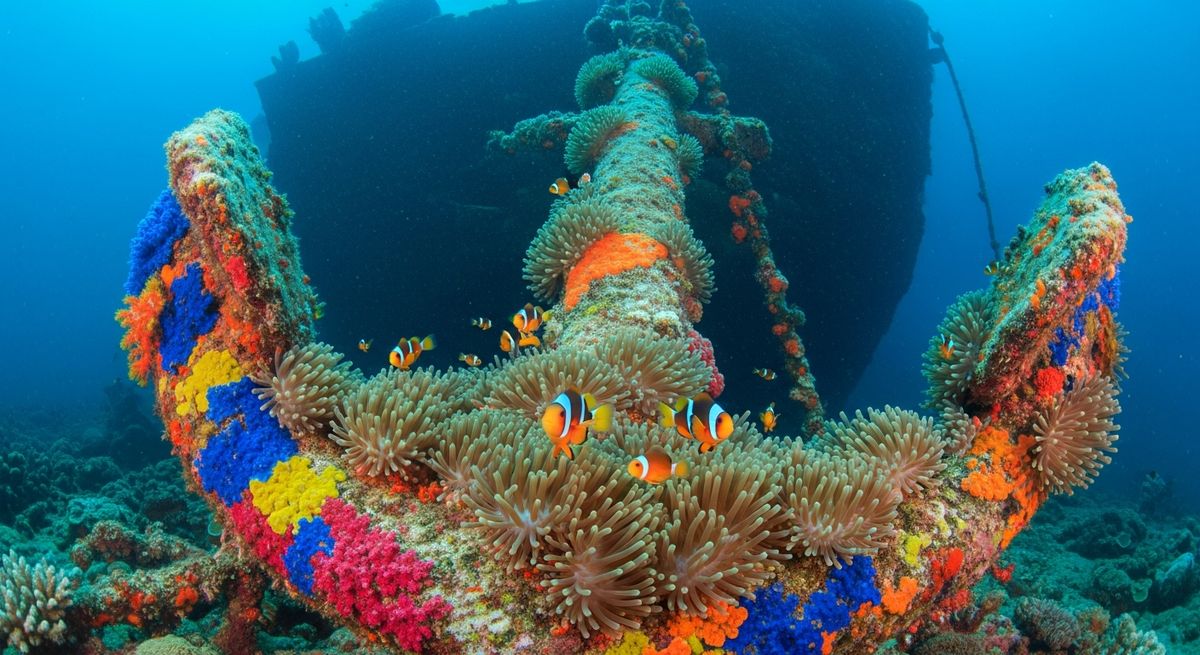
The Aristos isn't one for a quick splash. She’s a deep dive, down at 56 metres, and absolutely worth the effort for those with the training. What we love about her is the sheer scale – 136 metres long, broken but still impressively intact in parts. Dropping onto her deck in the often-murky Cornish water, you get a real sense of her sudden end back in 1967. We always approach the bridge section first; it's heavily collapsed but still identifiable, often draped in fishing nets, home to some seriously big conger eels. Further aft, you’ll find the engine room, penetration here is for the highly experienced and requires meticulous planning. The holds are generally open, offering good swim-throughs where you might spot some hefty pollack darting between the frames. Our favourite detail is the stern, often standing a little prouder, where the propeller shaft is a great spot to look for squat lobsters and the occasional anglerfish tucked into a crevice. Visibility varies wildly here. We’ve had days where you can see a good 10-15 metres, and others where it's a true torch dive. It’s always dark, even on a sunny day. This is a cold water, technical dive, best suited for advanced trimix divers comfortable with long decompression. For those who can get there, it’s a proper piece of history on the seabed, now fully reclaimed by the ocean.
Typical ARISTOS Dive Profile
Illustrative profile based on site depth and type. Actual dive profiles vary - always follow your dive computer and training.
Safety Notes
Maximum depth 56m exceeds recreational limits (40m). Technical diving certification and equipment required.
Wreck site - avoid penetration without wreck diving certification. Watch for sharp metal and entanglement hazards.
Always perform a 3-minute safety stop at 5m before surfacing.
ARISTOS Wreck History
Year Sunk
1967
Vessel Type
cargo ship
Cause
collision
Tonnage
5,160 GRT
The Aristos was a Greek steamship built in 1939 by William Hamilton & Co. in Port Glasgow, Scotland. For nearly three decades, this resilient vessel served as a cargo carrier, transporting goods across European waters. By 1967, she was owned by the Argo (Hellas) Shipping Company and continued her workhorse duties in the post-war shipping boom.
On August 28, 1967, the Aristos was navigating the busy English Channel, en route from Piraeus, Greece, to Antwerp, Belgium, with a heavy cargo of ore. In the dense shipping lanes, tragedy struck when she collided with the German motor vessel Dortmund. The damage from the impact was catastrophic, and the Aristos quickly began to take on water and sink. While 22 of her crew were rescued from the cold channel waters, one life was tragically lost in the incident.
Today, the Aristos lies at a depth of 56 meters, approximately 25 miles off Start Point. This is a challenging technical dive, reserved for experienced trimix divers due to the depth and the potentially strong currents of the English Channel. The wreck is reported to be largely intact and sitting upright on the seabed, offering a formidable and atmospheric sight for those qualified to make the descent into the deep, dark water.
Nearest Dive Centres to ARISTOS
Dive shops near ARISTOS
View all dive centres in Cornwall & DevonReviews for ARISTOS
Conditions
Ocean conditions, forecast and tides for ARISTOS
ARISTOS Ocean Conditions
Monthly averages for ARISTOS, sourced from Open-Meteo marine data - nearest station: Open-Meteo marine grid (50.44, -2.73) (3km away)
October Averages
Sea Temperature
17°C
62°F · Range: 15.1–17.5°C
Air Temperature
13°C
56°F
Wind Speed
8.14 m/s
15.8 knots
Atmospheric Pressure
1011 hPa
Based on 4 years of monitoring data · Data sources: Open-Meteo marine data
Plan & book
Ways to dive Cornwall & Devon, from day trips to liveaboards.
Day trips & courses
via GetYourGuideGuided dives, courses and snorkel trips with instant booking.
Find dive trips in Cornwall & DevonPlaces to stay
via Booking.comHotels and dive resorts near Cornwall & Devon.
Search stays in Cornwall & DevonDive insurance
Most travel insurance excludes or limits scuba. Check what you need before you go.
Dive insurance explainedPartner links: we may earn a commission if you book, at no extra cost to you. How we make money
Where to Stay near ARISTOS
Prices from Booking.com. We may earn a commission at no extra cost to you.